Hotel Royal Continental
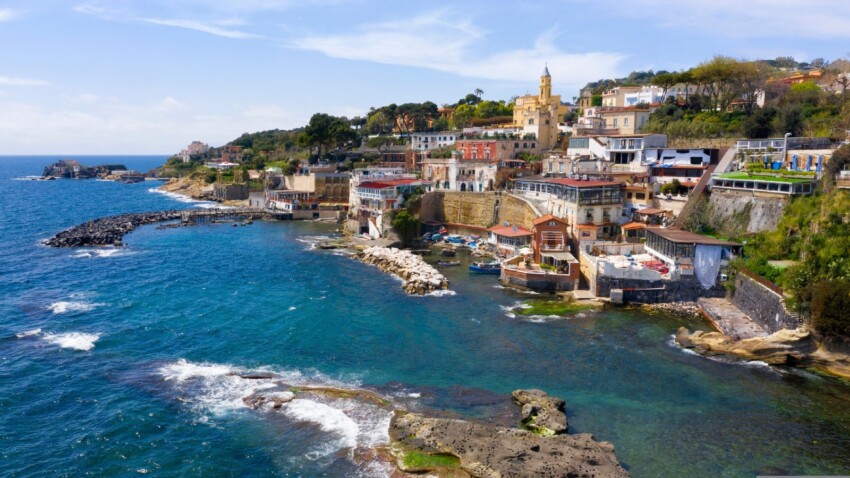
Campania is the Italian region with the highest concentration of UNESCO-recognised heritage sites: five locations within a radius of less than two hundred kilometres.
Naples’ historic centre, the largest in Europe, with its Greek street layout still perfectly legible after 2,700 years. The Vesuvian Cities of Pompeii and Herculaneum, buried by the eruption of 79 AD and revealed by archaeology in their complete everyday detail. The Royal Palace of Caserta with its park and Carolingian aqueduct, the world’s largest royal palace by volume. The Amalfi Coast, 55 kilometres of limestone cliffs, colourful villages and lemon groves descending to the sea. The Cilento National Park, with the Greek temples of Paestum, the philosophical colony of Velia and the Certosa di Padula. No other Italian region manages to concentrate such variety—active volcanoes, legendary islands, archaeological sites, Mediterranean coastlines among the most beautiful—within such a compact and interconnected space.
Planning an itinerary through Campania requires strategy, though: distances may look short on the map, but traffic, seasonal ferries, buses and the sheer mass of tourists in July and August can complicate timings.
In 7 days you can cover the unmissable stops: Naples, the Vesuvian sites, Capri and the Coast. With 10 days you can add Ischia, Paestum and Cilento, and the journey becomes complete.
The best time to visit Campania is April–June or September–October: pleasant temperatures, the sea already warm by late spring and still warm in September, museums and sites open with extended hours, and tourist numbers far lower than in July and August. In July and August, Capri, Positano and Amalfi are at bursting point with crowds; booking months in advance is essential. In spring and autumn, a few weeks’ notice will do.
For getting around, the best approach is a mix of transport: the Circumvesuviana train from Naples to Herculaneum, Pompeii and Sorrento; Travelmar ferries (seasonal, April–October) for the Amalfi Coast and the islands; SITA buses along the SS163 for the coastal villages.
A car is useful only for the Royal Palace of Caserta and Cilento; on the Coast and in Naples it’s more of a headache than a solution. Book entrance tickets to Pompeii, Herculaneum, the Royal Palace of Caserta and Capri’s Blue Grotto well in advance: during high season, queues without pre-booked tickets can stretch for hours.
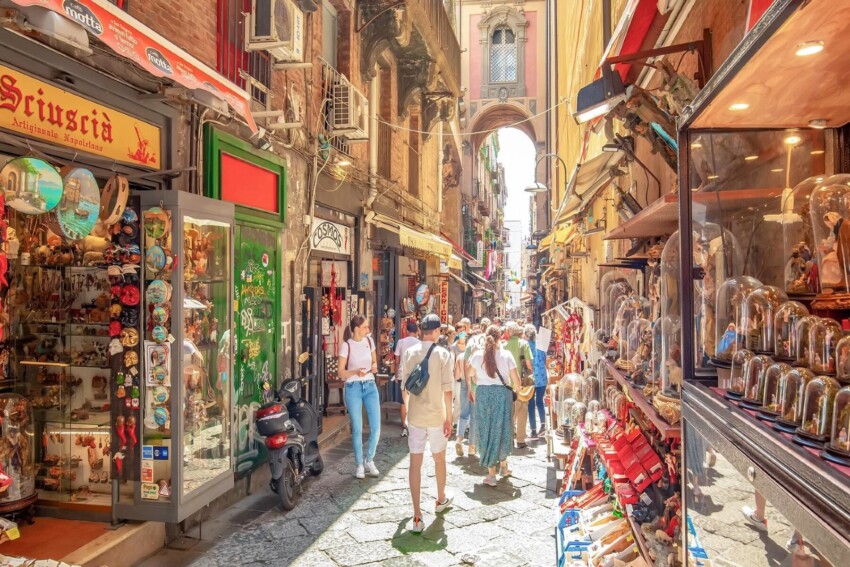
Dedicate your first day entirely to Naples. Start in the heart of the UNESCO historic centre: Spaccanapoli, Via San Biagio dei Librai and Via Benedetto Croce, which follows precisely the layout of the lower decumanus of the ancient Greek colony of Neapolis, founded in 470 BC.
The three-axis Greek urban plan (decumani) remains perfectly legible today – an urban continuity spanning 2,500 years with no parallel in Western Europe. Along Spaccanapoli you’ll find some of the city’s unmissable highlights: the Cappella Sansevero with Giuseppe Sanmartino’s Veiled Christ (1753), its drapery carved from marble so delicate it appears to be wet fabric – one of the most astonishing technical masterpieces of world sculpture – and the Church of the Gesù Nuovo, with its distinctive rusticated piperno façade.
Continue towards the Naples Cathedral to visit the Chapel of the Treasure of San Gennaro, a masterpiece of Neapolitan Baroque art, and the crypt containing the remains of the city’s patron saint. Spend the afternoon in the Spanish Quarter, where Neapolitan popular life still thrives among street food vendors, votive shrines and laundry-laden balconies. This is also where you’ll find the famous Maradona mural.
In the evening, enjoy pizza at one of the historic centre’s classic establishments.
Devote your second day to the National Archaeological Museum of Naples, or MANN, which houses the world’s largest collection of Greco-Roman art, featuring finds from Pompeii and Herculaneum, the Farnese Collection (including the famous Farnese Bull and Farnese Hercules), and the Secret Cabinet with erotic works from antiquity. Allow at least three hours – it’s impossible to see everything quickly, and there’s no point trying.
If you’d rather skip the MANN, you could spend the morning exploring Underground Naples or the Monastery of Santa Chiara instead.
In the afternoon, head down to the seafront along Via Caracciolo and walk to Castel dell’Ovo, the medieval castle built on the islet of Megaride – according to medieval legend, Virgil hid a magical egg here upon which the city’s fate depended. Continue to Piazza del Plebiscito, one of Italy’s largest and most impressive squares, dominated by the Basilica of San Francesco di Paola and the Royal Palace.
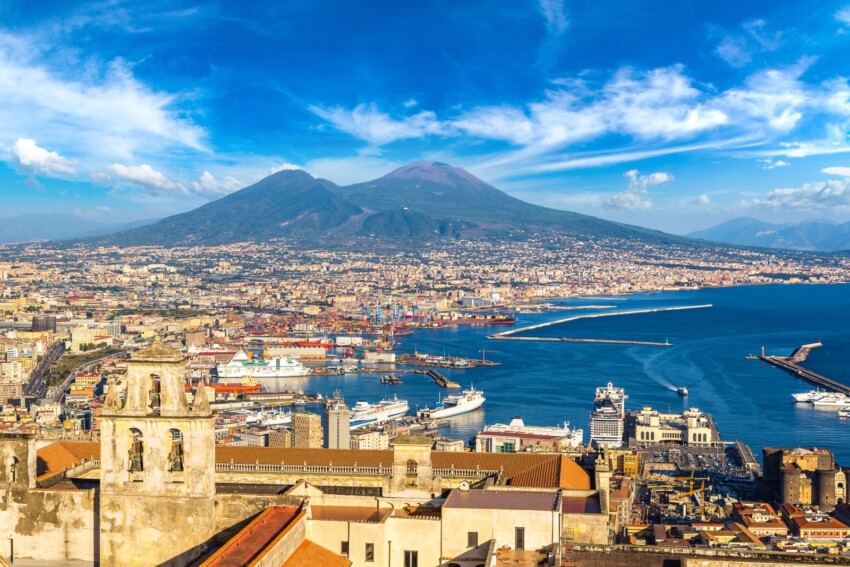
Before dinner, climb to Piazzale San Martino at the Vomero for sunset views across the entire bay, the Vesuvius and the islands – probably Naples’ most famous vista, and rightly so. An excellent alternative is taking a sunset boat tour of the Gulf of Naples.
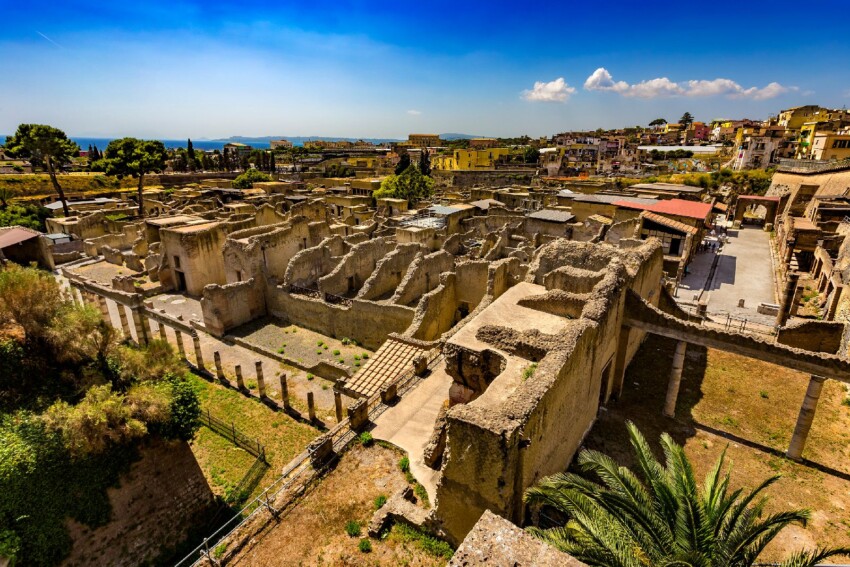
Your third day is devoted to Italy’s most dramatic history. Take the Circumvesuviana train from Naples’ Porta Nolana Station to the Herculaneum Excavations stop (18 minutes, around €2) and visit the Herculaneum Excavations before Pompeii – many experts consider it the superior choice.
Herculaneum was buried not under ash but beneath 25 metres of pyroclastic mud that solidified rapidly, preserving organic materials that Pompeii lacks: wooden furniture, food, textiles, carbonised papyri. The aristocratic homes with intact mosaics and polychrome decoration, shops with painted signs, thermopolia with tableware still in place, the unexcavated buried theatre – Herculaneum offers a window into 1st-century Roman daily life with an almost unbelievable completeness. Allow at least 2–3 hours.
In the afternoon, ascend Mount Vesuvius: shuttle buses depart from Herculaneum’s coach station to the car park at elevation (1,000 metres), from where a 20-minute path leads to the crater rim at 1,281 metres. The aerial view of the Gulf of Naples, the islands, the Sorrentine Peninsula and the coastline is unforgettable. The official park guide notes that the volcano has been dormant since its last eruption in 1944, ending a series that began in 79 AD, though it remains classified as active and is monitored 24/7 by the Vesuvius Observatory. The crater path is open March through November (check conditions at the time of your visit). Return to Naples by shuttle plus Circumvesuviana.
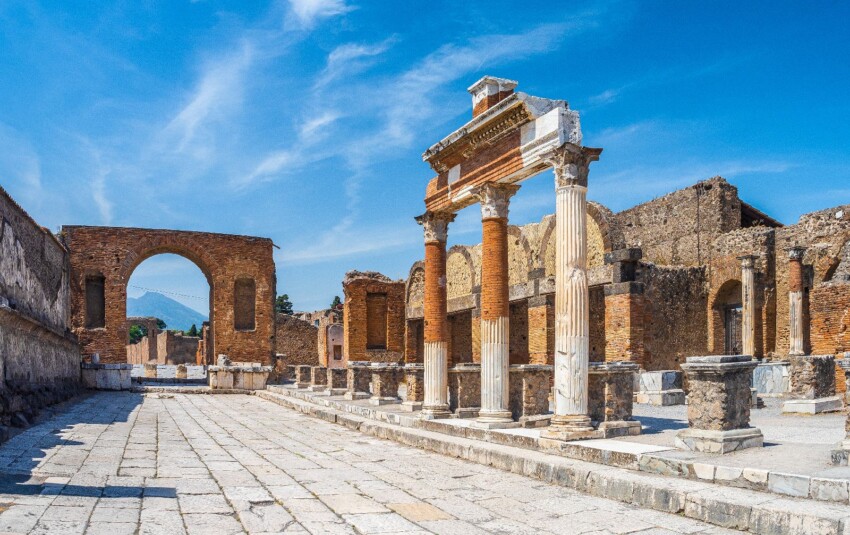
Dedicate your fourth day to Pompeii, Italy’s most visited archaeological site and among the world’s most important: 66 hectares of a 1st-century Roman city preserved beneath the ash and pumice of the 79 AD eruption, frozen in the moment of catastrophe.
Book your ticket online in advance – the on-site ticket office can have queues of hours – and arrive at opening time (9:00 AM).
Essential highlights include: the Forum with temples of Jupiter and Apollo, the House of the Vettii with its erotic and decorative frescoes among the best preserved on the site, the Stabian Baths (Pompeii’s oldest, from the 4th century BC), the Villa of the Mysteries with its fresco cycle depicting Dionysian initiation rites – one of the largest and best-preserved painted cycles from the ancient world – and the plaster casts of victims, made by pouring cement into the cavities left by bodies in the ash layer: one of the most visually intense and disturbing experiences in world archaeology.
Plan for a full day – Pompeii cannot be rushed without missing the details that make it unique.
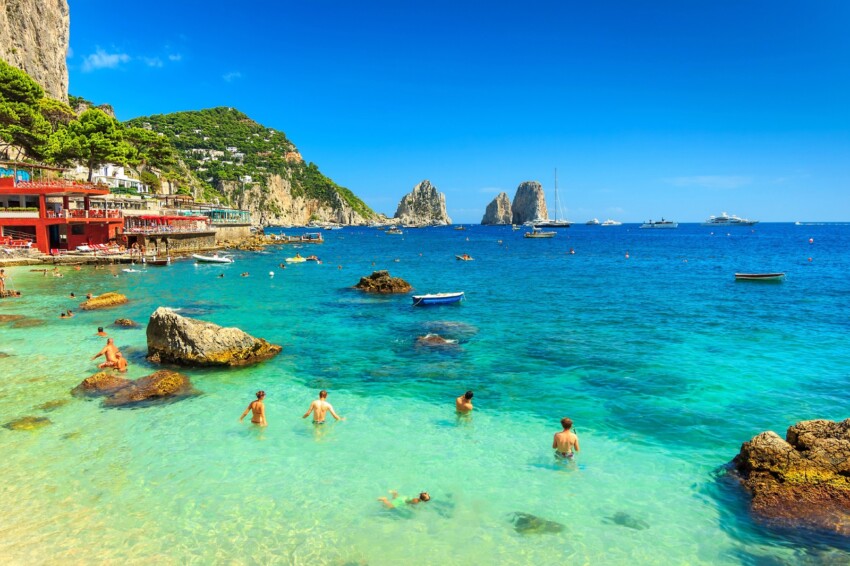
Dedicate your fifth day to Capri. Set out early by hydrofoil from Naples (Molo Beverello, 50 minutes) or from Sorrento (25 minutes) – if you’ve already relocated to Sorrento the evening before, this is the more convenient option.
Arrive at Marina Grande and take the funicular up to Capri town centre: the Piazzetta (officially Piazza Umberto I) is the island’s social hub, famous for its cafés with prices five times the Italian average and for the people-watching. It’s worth spending an hour here to understand why Capri has captivated generations of artists, writers and billionaires – the quality of light, the compactness of the setting, the sensation of floating between sky and sea is real.
From there, walk to the Faraglioni, three limestone crags rising from the water at the island’s eastern edge, reaching up to 109 metres – the endemic habitat of the Capri blue lizard, found in nature nowhere else – and to the Gardens of Augustus with sea views and Via Krupp, the zigzag staircase carved into the rock commissioned by German industrialist Friedrich Alfred Krupp in 1902.
In the afternoon, take a bus up to Anacapri (15 minutes, frequent service) and a chairlift to Monte Solaro (589 metres, 12 minutes up) for the island’s most expansive views: from the Gulf of Naples to the Gulf of Salerno, with the Apennines visible on clear days.
Visit Villa San Michele, home of Swedish writer and physician Axel Munthe, built in the 1890s atop Anacapri’s peak over the remains of a Roman imperial villa. Its open loggia overlooks the gulf and houses a collection of Roman artefacts; Munthe’s memoir The Story of San Michele (1929) made it famous worldwide.
Visit the Blue Grotto early in the morning, ideally before reaching Capri town: the small-boat transfer from outside and navigation through the low entrance require patience, and the light is better in the early hours. The blue effect, created by an underwater opening that filters sunlight, was “rediscovered” on 17 August 1826 by German painter August Kopisch and his friend Ernst Fries, guided by fisherman Angelo Ferraro known as “il Riccio” – locals already knew of the grotto but believed it was haunted by spirits.
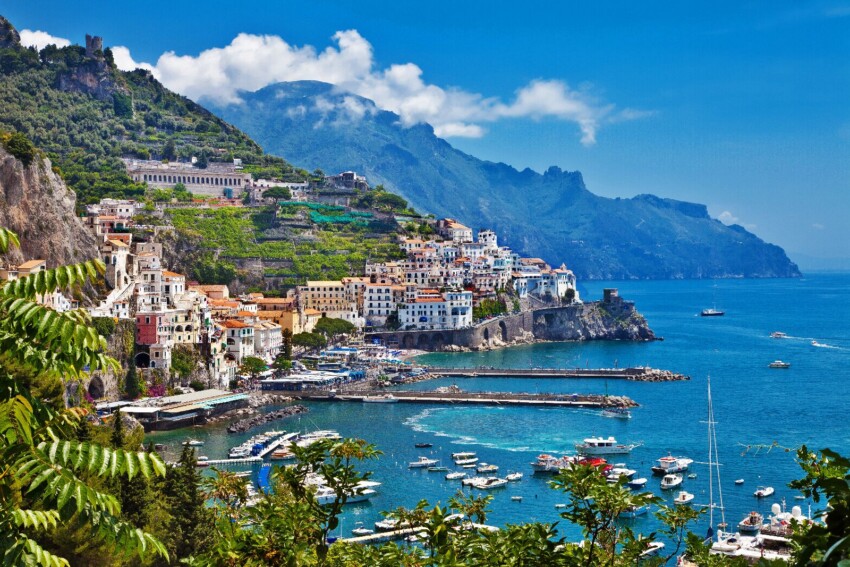
Spend your sixth day exploring the Amalfi Coast. If you’re still in Naples, travel in the morning by ferry from Molo Beverello to Positano (seasonal, approximately 90 minutes) or take the Circumvesuviana to Sorrento and then a ferry or SITA bus heading east.
The ideal route to explore the coast from west to east using public transport is: Positano in the morning (the Church of Santa Maria Assunta with its majolica dome, Via dei Mulini with artisan sandals, Spiaggia Grande beach), ferry to Amalfi in early afternoon (the Cathedral of Sant’Andrea with the Cloister of Paradise from 1266, the crypt housing the relics of St Andrew the Apostle brought from the East in 1206, the Museum of Paper in a 13th-century mill), a walk to Atrani (Italy’s smallest village, where M.C. Escher stayed between 1929 and 1934 and whose alleys inspired his “Metamorphosis” series), then a bus to Ravello in the late afternoon (Villa Rufolo with its terrace that inspired Wagner’s Parsifal in 1880, Villa Cimbrone with the Terrace of Infinity built by Lord Grimthorpe in 1904). Dine in Ravello or return to Amalfi.
Your final day combines two very different experiences. Spend the morning in Sorrento: the historic centre with its wood inlay boutiques (tarsia), an artisan tradition documented from the 16th century onwards, the Cathedral of Saints Philip and James, and a stroll along the tuff cliff edge with views of Vesuvius.
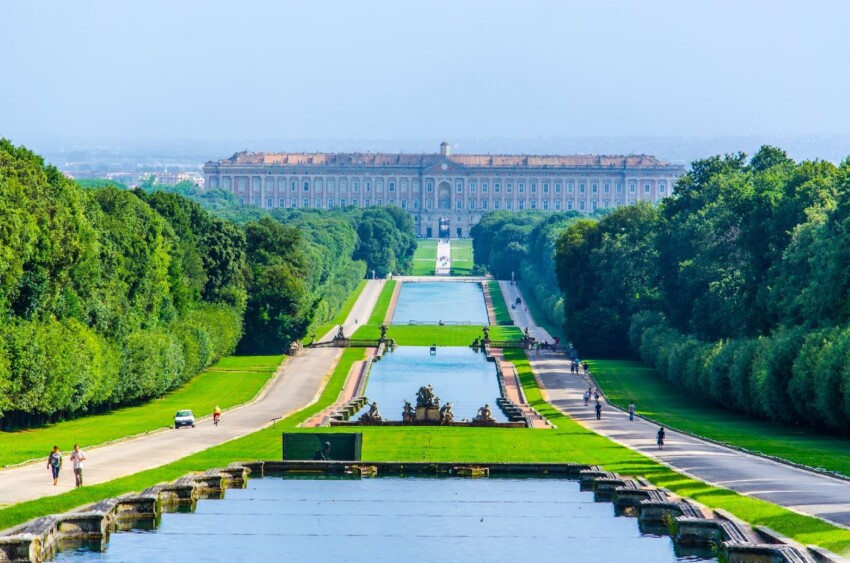
In the afternoon, if you have an evening flight from Naples, this is the perfect opportunity to visit the Royal Palace of Caserta: reachable from central Naples by regional train in 40 minutes. Otherwise, consider staying overnight in Caserta.
The Palace was designed by architect Luigi Vanvitelli on commission from Charles III of Bourbon in 1752 – the king wanted a residence to rival Versailles and Spain’s Royal Palace of Aranjuez in magnificence. The result surpassed both in size: 1,200 rooms across four floors, a 3-kilometre park with cascades, fountains and water features fed by the Carolino Aqueduct, also Vanvitelli’s work – a 38-kilometre aqueduct bringing water from Mount Taburno – and an overall volume making it the world’s largest royal palace.
An extra three days allow you to venture beyond the classic circuit and add the depth that transforms a tour into a true journey. The best options depend on your preferences: coast and countryside towards Cilento, islands and thermal springs towards Ischia, or historical heritage towards Paestum and Benevento.
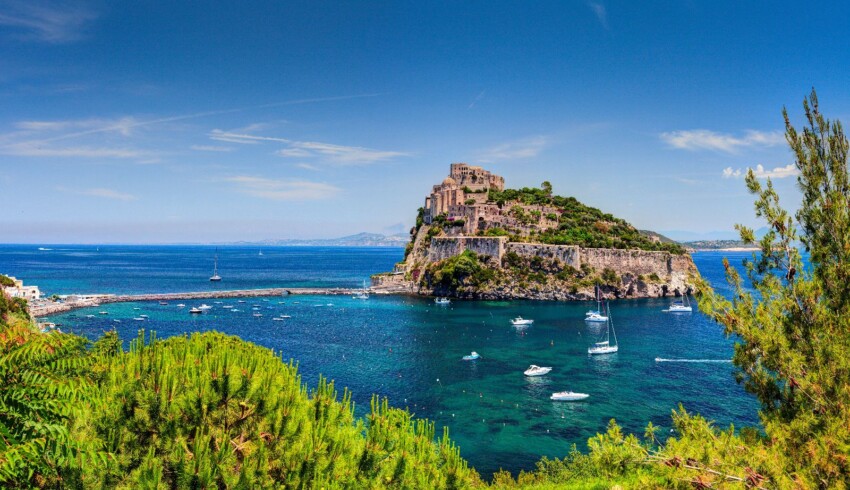
Ischia, the largest island in the Gulf of Naples with over 46,000 inhabitants, thrives on a flourishing tourism economy built around natural thermal springs fed by the island’s submarine volcanic activity. It really deserves at least two days to explore properly.
In a single day, the essential stops are: the Aragonese Castle (built in 474 BC by Euboean colonists, rebuilt and expanded by the Aragonese in 1441, home to the poet Vittoria Colonna from 1501 to 1536), the natural hot springs of Sorgeto Bay, geothermal waters reaching 70°C at source, accessed at night via a stone staircase lit by torches, and the village of Sant’Angelo, reachable only on foot, with its lagoon and waterfront restaurants.
Alternatively, Procida, the gulf’s smallest and least touristy island, named Italy’s Capital of Culture 2022, offers in a single day the colourful houses of Marina Corricella, the coves of Chiaiolella and the climb up to Terra Murata with its cathedral and the abandoned prison overlooking the gulf. Procida is reached from Naples by hydrofoil in 40 minutes.
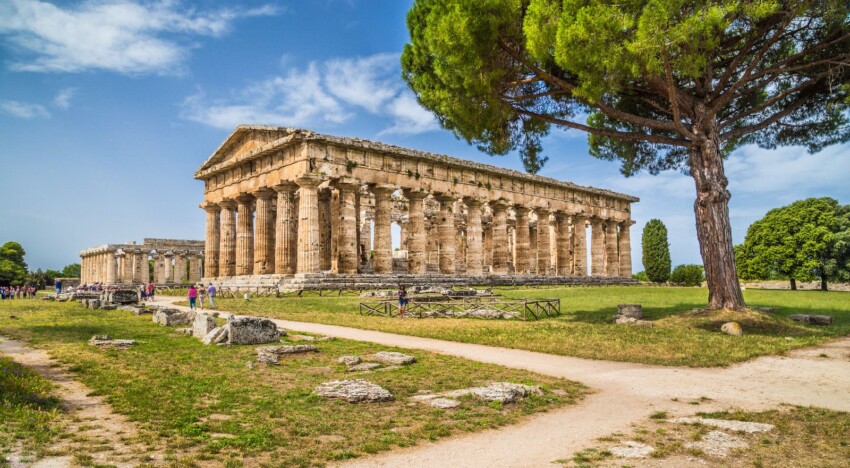
Paestum is probably the visit that most surprises travellers—Italian and foreign alike—encountering it for the first time: three Doric temples from the 6th and 5th centuries BC in a state of preservation that rivals those of the Athenian Acropolis.
The Temple of Hera I (known as the Basilica, 550 BC), the Temple of Hera II (known as the Temple of Neptune, 460 BC, the most imposing and best preserved) and the Temple of Ceres (Athena, 510 BC) stand in a flat plain with the sea as backdrop: the perspective is radically different from the Acropolis perched on a promontory, and the initial panorama ranks amongst the most powerful sights in Mediterranean archaeology.
The Museum of Paestum, just steps from the temples, houses the Tomb of the Diver (480 BC), the only example of Greek funeral painting found in southern Italy, featuring the famous youth diving over water that has inspired philosophical, symbolic and artistic interpretations for generations.
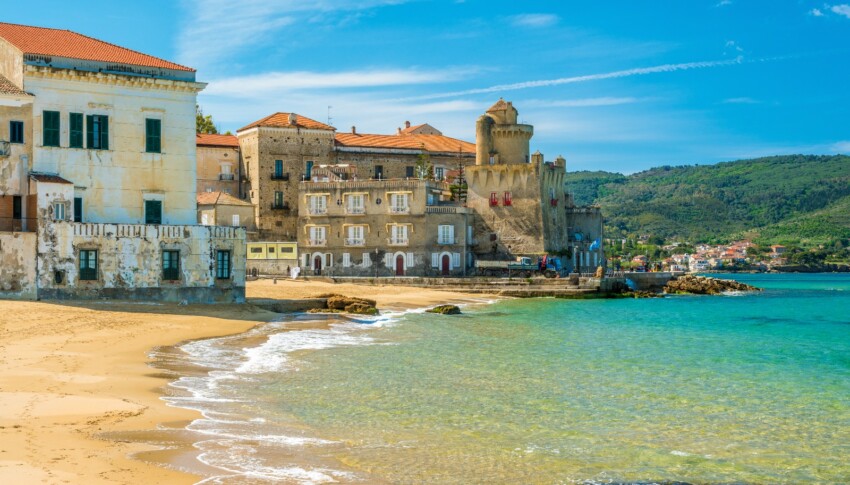
The tenth day takes you into Cilento, Campania’s most authentic and least touristy region: home to southern Italy’s largest national park, where rocky coastlines, medieval villages clinging to hillsides and Greek archaeological sites blend into a landscape that has remained largely untouched. Your choice depends on how much driving you’re willing to do—Cilento is vast and distances are considerable, requiring a car.
Castellabate (UNESCO heritage site) sits about 90 km from Paestum and offers northern Cilento’s most beautiful medieval village, along with the beaches of Pozzillo and Punta Licosa. Palinuro, 150 km from Paestum, is Cilento’s most scenic seaside destination, featuring thirty sea caves, the Natural Arch and the Bay of Buon Dormire accessible only by boat.
For a tenth travel day, the most practical choice is Castellabate, an hour from Paestum, on the coast, with everything you need for a leisurely and rewarding journey’s end.
Those preferring to conclude their trip on a cultural note can dedicate day ten to Benevento, just 50 km from Caserta, home to the Arch of Trajan (114 AD, the most complete and best-preserved honorary Roman arch in the world), the Roman Theatre from the imperial period (2nd century AD, originally seating 10,000), the Santa Sofia complex (760 AD, UNESCO) and an evocative collection of Egyptian obelisks scattered throughout the historic centre, remnants of the Egyptomania surrounding the cult of Isis, which had one of the largest temples in the Roman world here at Benevento. Benevento rarely features in standard itineraries and remains one of Campania’s most authentic and least touristy cities.
For base camps, the most efficient model is to spend the first days in Naples, then relocate to Sorrento or the Coast for the second part.
Sorrento is the most logistically convenient base for Capri, the Sorrentine Peninsula and the Coast’s villages: everything is connected by ferry, it’s less expensive than Positano and Amalfi, and retains a more authentic feel.
Those preferring to stay on the Coast can choose Amalfi, hub for ferries and SITA buses, or Positano for its position and charm.
Advance booking is essential for Pompeii, Herculaneum, the Royal Palace of Caserta, the Sansevero Chapel and the Capodimonte Museum in Naples. The Blue Grotto in Capri cannot be booked online: you reach it by boat from Marina Grande port and wait your turn; in July and August waiting times can exceed two hours.
Vesuvian sites open at 9:00 and close an hour and a half before sunset: in winter and spring closing times can be surprisingly early. For all Campania’s state museums (Pompeii, Herculaneum, MANN, Royal Palace of Caserta, Paestum), the first Sunday of the month is free, but queues on these days are proportionally enormous.
City Card allow you to save on public transport and / or on the entrances to the main tourist attractions.
 Hotel
Hotel  Budget accommodations
  Apartments
  Family Hotel
  Luxury Hotel
  Resorts