Pompeii: Entry Ticket with Audio Guide
13.560 reviews
Buy now
From 34,50€ per person
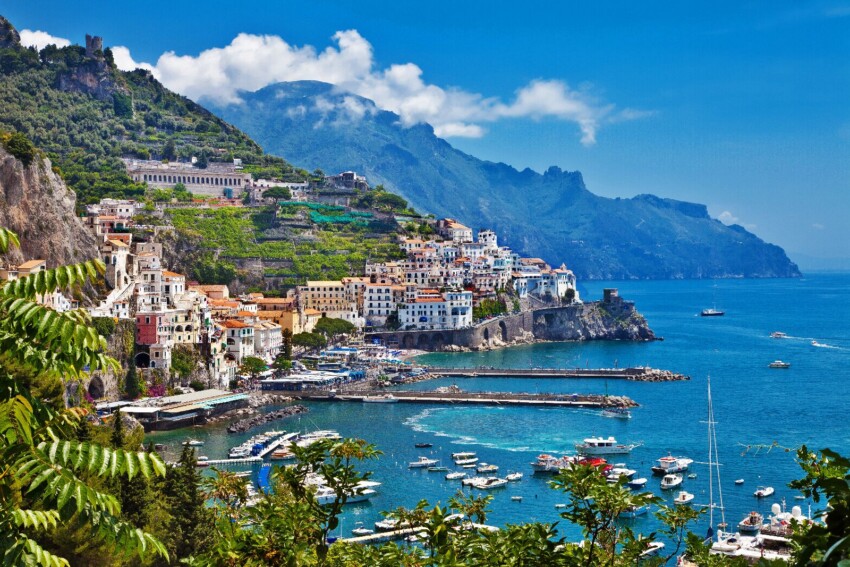
Planning an itinerary along the Amalfi Coast requires a logistical note: the SS163 state road, the only route connecting Positano to Vietri sul Mare, is narrow, winding and gridlocked during peak season.
A car, therefore, is often more of a hindrance than a help. The best way to get around is a combination of seasonal ferries (Travelmar, operating April to October between Salerno, Amalfi, Positano and the villages in between) and SITA buses (year-round, frequent and affordable).
A hired scooter or moped is the most flexible alternative for those comfortable driving on narrow roads.
However you travel, there’s just one golden rule: don’t try to see everything in a rush. The beauty of the Amalfi Coast is best savoured by lingering, not racing through.
Your choice of village will determine the pace of your entire itinerary. Positano is the most glamorous base, with the best sea connections to Capri and Sorrento, and the priciest. Amalfi is the most logistically convenient: a hub for ferries and buses to the entire coast, well-serviced, with generally lower prices.
Praiano, halfway between Positano and Amalfi, is the ideal choice if you want a balance of location, authenticity and value. Ravello, perched on the hillside, is the most exclusive and romantic but far from beaches. Maiori and Minori are the most affordable and best suited to families. Whichever base you choose, book well in advance: in July and August everything sells out weeks ahead.
The best time to visit is May–June or September–October: excellent weather, the sea already warm or still warm, lower prices, villages enjoyable without the stifling crowds of July and August. In spring, vegetation is at its most glorious, the lemon groves are in blossom and perfume the entire coast, and the walking trails are pleasant with ideal temperatures. In autumn, the afternoon light transforms the villages into living paintings. Winter is the season of authentic experience: many establishments close, but the villages regain their identity as small maritime communities far removed from tourism.
Two days is the minimum to get a true sense of the Amalfi Coast. The ideal itinerary covers the three most important villages (Amalfi, Ravello and Positano) with a stop at a smaller village or two. The most economical base for this short format is Amalfi, from which you can reach Ravello on foot (not recommended, the uphill walk is demanding) or by bus in 20–25 minutes, and Positano by ferry in approximately 40 minutes.
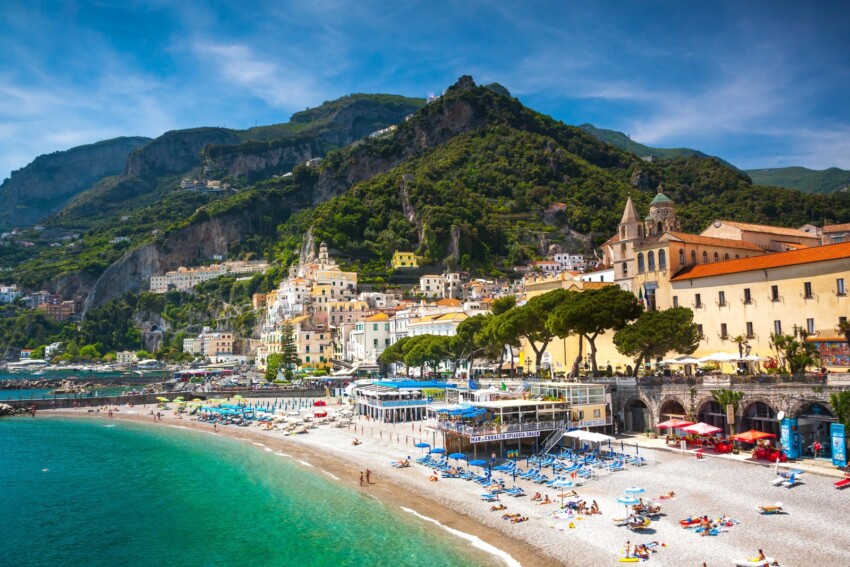
Spend the morning in Amalfi. Begin at the Cathedral of Sant’Andrea, whose Arab-Norman facade dominates the main piazza: built in the 11th century and reworked in Baroque style in the 17th, it houses in the Cloister of Paradise (1226) one of southern Italy’s medieval architectural masterpieces, a garden of interlaced columns with views of the bell tower and gilded mosaics of the facade.
In the crypt beneath the high altar rest the remains of Saint Andrew the Apostle, the city’s patron saint, whose arrival in Amalfi from the East in 1206 marked the rise of the Maritime Republic. The cathedral’s treasury and crypt are accessed with a separate ticket from the church.
From the Cathedral descend towards the harbour and walk for ten minutes along the waterfront to the gallery leading to Atrani: with fewer than 900 inhabitants, it offers a splendid little square and the Church of San Salvatore de Birecto opening directly onto the beach. Atrani is authentic and uncommercialised in a way Amalfi no longer is: its narrow alleys and irregular staircases inspired Dutch graphic artist M.C. Escher, who stayed there several times between 1929 and 1934 and transposed the country’s geometric patterns into his celebrated “Metamorphosis” series and “Stairs”. Maiolicaware along the beach’s edge pays homage today to this connection. The climb on foot to Atrani and then to Ravello (approximately 45 minutes of uphill walking from the beach) is the loveliest way to arrive, but not in summer at midday.
Ravello deserves at least two to three hours. The two villas that made its fame worldwide are Villa Rufolo, built by the wealthy merchant family Rufolo in the 13th century, whose terraced gardens inspired Richard Wagner in 1880 to write in his diary “I have found Klingsor’s garden!” referring to the magical park in Parsifal, and whose terrace hosts the stage for the Ravello Festival each summer, with the gulf as backdrop, founded in 1953, and Villa Cimbrone, which overlooks the sea with the famous Terrace of Infinity, a belvedere bordered by classical busts from which you can see the entire coast from Capo Sottile to the Faraglioni rocks of Capri.
The terrace was named thus in the early 20th century by the eccentric proprietor Ernest William Beckett, Lord Grimthorpe, who had it built in 1904 for his private residence. Dine in Ravello; the restaurants on the terraces at sunset are unforgettable, or return to Amalfi.
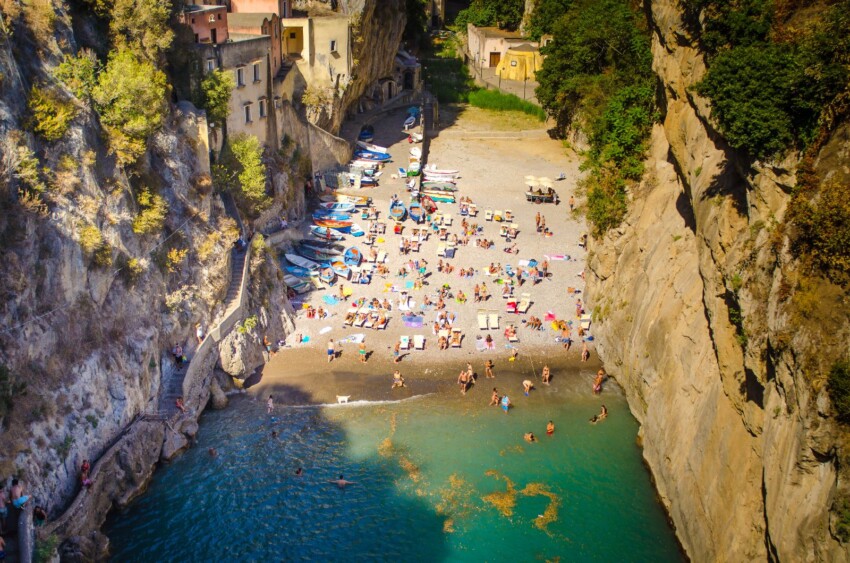
The second day is devoted to the western part of the coast. Leave Amalfi by ferry (seasonal) or bus towards Praiano and the Furore Fjord. The fjord is a deep fissure in the limestone rock where a small fishing village clings to the water’s edge: the inlet is so narrow and steep it’s called Europe’s smallest fjord, and the village of colourful houses at the foot of the stairs is only accessible on foot. From the road bridge spanning the fjord, where diving competitions are held every summer, the view out to sea is among the most striking on the entire Amalfi Coast. Furore is considered one of Italy’s most beautiful villages and a UNESCO World Heritage site.
Positano is the quintessential image of the Amalfi Coast: pastel-coloured houses stacked in tiers, the majolica bell tower of the Church of Santa Maria Assunta, the Grande Beach with colourful boats. Morning is the best time to explore on foot before day-trippers swarm the alleys. Walk down Via dei Mulini past artisan sandal boutiques (the Capri-Positano style with leather sole and interwoven straps, born here in the 1960s, is still handmade in the village shops) to the Grande Beach.
For those wanting to escape the crowds, Fornillo Beach, reachable in ten minutes on foot from the Grande by following the path on the headland, is quieter and more intimate. An aperitivo at sunset on a rooftop bar along Via dei Mulini with Capri’s Faraglioni rocks on the horizon rounds off the day perfectly.
With three days you have time to visit the Emerald Grotto, swim in one of the coves accessible only by sea, sit down to lunch in a beachfront restaurant or walk a stretch of trail through the Mediterranean scrubland.
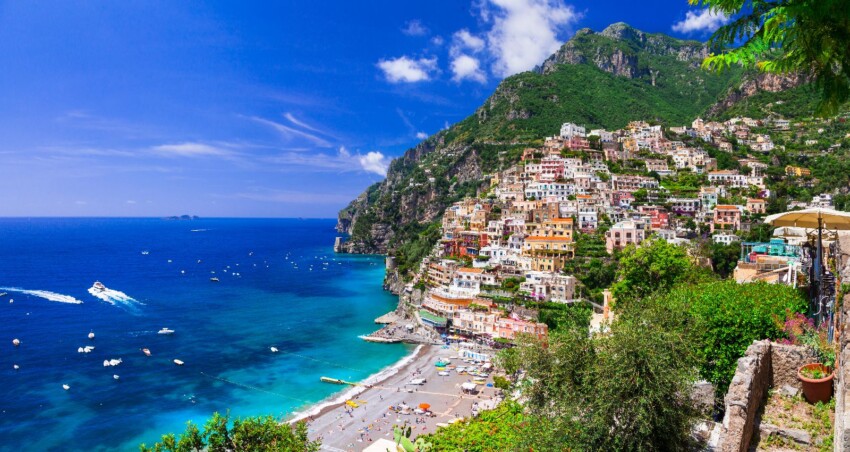
A whole day in Positano seems almost excessive until you experience it. Start from the top of the village, at the bus stop on the SS163, and walk down to the sea: the route winds through the village’s most picturesque alleys, past bougainvillea-laden terraces, ceramic and sandal shops, balconies with lemon pots.
Visit the Church of Santa Maria Assunta, which houses a Black Madonna with Child from the 13th century, one of the most venerated icons on the Amalfi Coast, probably of Byzantine origin. Legend has it that a Saracen, having stolen the painting, was struck by the child’s voice ordering the work be returned to the coast of Positano.
Morning is also the right time to explore the Roman Archaeological Museum, which has unearthed the remains of a 1st-century AD Roman villa right beneath the village, the so-called “little Pompeii of the Amalfi Coast”.
In the afternoon dedicate time to the beach and a boat excursion to nearby coves: Arienzo Beach (reachable only by sea), the bay of Laurito where the restaurant Da Adolfo (accessible only by your own boat or the restaurant’s shuttle) has served the freshest fish barefoot on the shore since 1949.
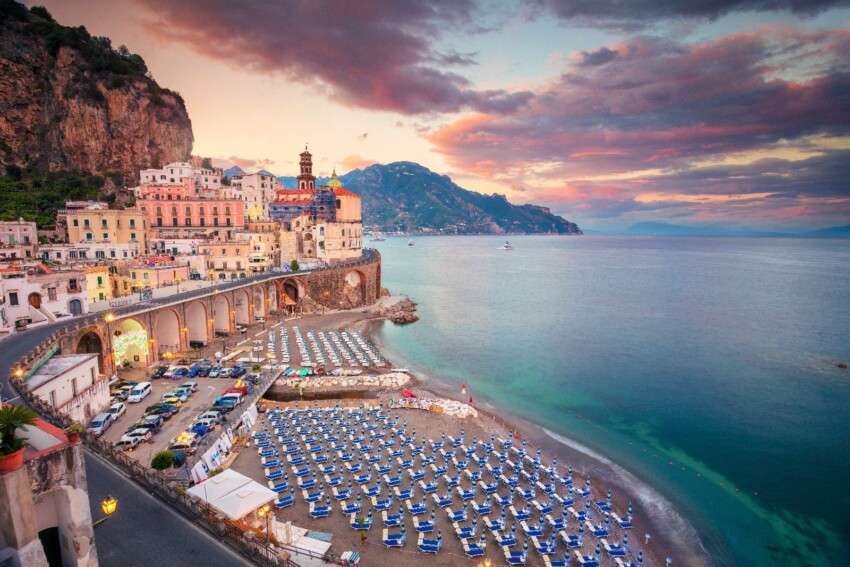
Spend the morning in Amalfi and Atrani as described in the two-day itinerary, adding a visit to the Museum of Paper: housed in one of the 13th-century mills along the Valle dei Mulini stream (where Amalfi bamboo paper was produced as early as the 11th century, making Amalfi one of Europe’s first papermaking centres) the museum preserves the ancient water-powered machinery, still functional, and documents the history of a production that supplied the chancelleries, universities and monasteries of all Europe for several centuries.
In the afternoon, take the bus or ferry to Conca dei Marini to visit the Emerald Grotto: a sea cave discovered in 1932 in which light enters through an underwater opening, colouring the waters an intense emerald, similar to the blue of Capri’s Azure Grotto. Stalactites hang from the ceiling and some stalagmites have formed on the cave floor; ceramic nativity figures rest on the seabed, placed there after the war. Access is by boat or lift carved into the rock from the SS163.
The evening offers the chance to stay in Conca dei Marini, one of the least visited villages on the Amalfi Coast, or return to Amalfi for dinner.
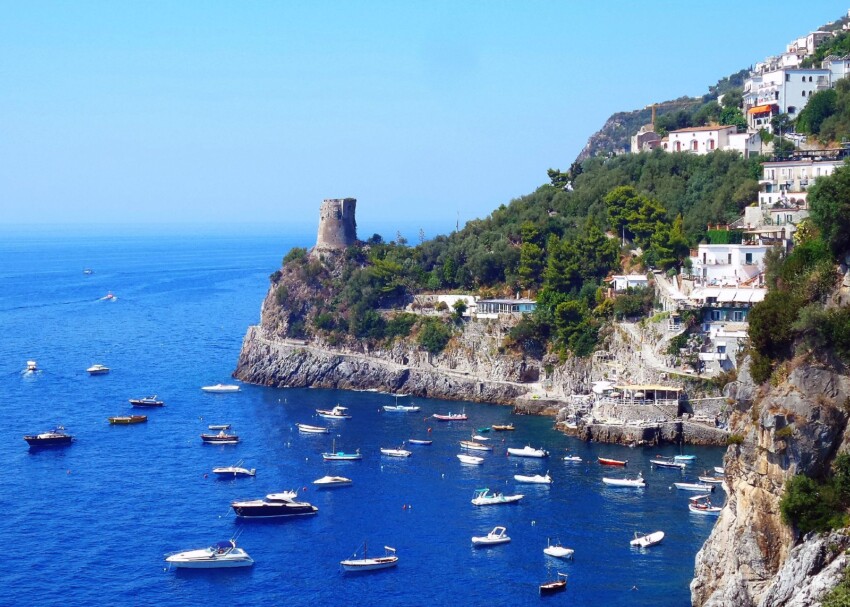
The third day takes you higher. Spend the morning in Ravello as described in the two-day itinerary, adding the Cathedral which houses a 1272 pulpit signed by Nicola di Bartolomeo da Foggia, and the Oscar Niemeyer Auditorium, the curved structure by the great Brazilian architect that hosts concerts and exhibitions with a glass wall opening onto the gulf.
In the afternoon walk down to Minori via the Lemon Path: a roughly 5-kilometre route through terraced lemon groves connecting Ravello to the waterfront, with Mediterranean scrubland scents and the sound of the Valle del Dragone stream accompanying your descent.
Minori is renowned for its pastry-making and for the Roman Seaside Villa from the 1st century AD, with mosaics and a walk-through cistern in the village centre. Finish the day with the ferry back along the coast at sunset.
Seven days give you the chance to explore the Amalfi Coast thoroughly. Build on the three-day itinerary by adding experiences that require more time or careful planning.
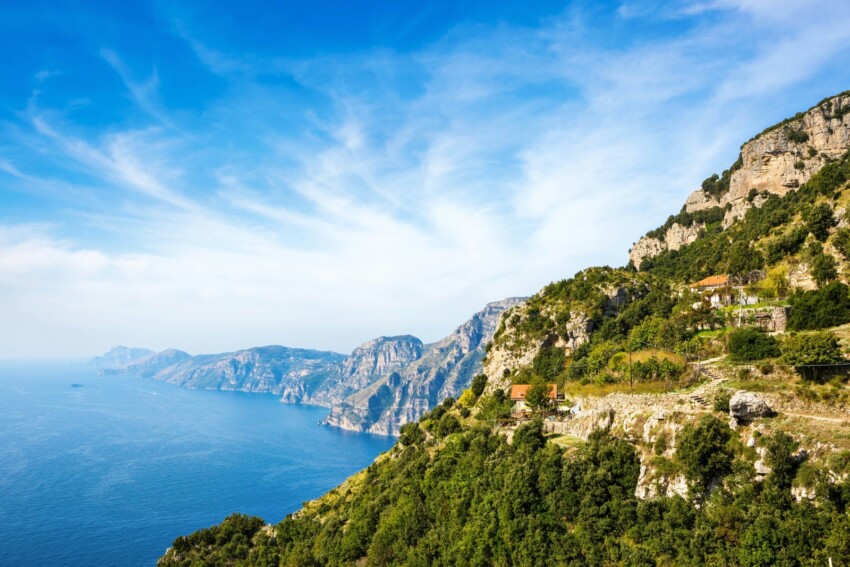
The Path of the Gods is Campania’s most famous trek and one of Italy’s finest: a 7.8-kilometre route connecting Bomerano (a hamlet of Agerola, at 650 metres elevation) to Nocelle (a hamlet of Positano, at 450 metres) along the ridge of the Lattari Mountains, with uninterrupted views across the gulf, Capri’s Faraglioni, the Li Galli islands and the Sorrentine Peninsula.
The classic route, chosen by the vast majority of visitors, is almost entirely downhill and takes 3-4 hours at a moderate pace. The starting point is Piazza Paolo Capasso in Bomerano, reached by SITA bus from Amalfi (roughly 40 minutes). The path winds through terraces of grapevines, goat pastures, stretches of bare rock and chestnut forests, always with the sea below and Positano gradually coming into view.
Upon arrival at Nocelle, you can walk down to Positano on foot via a staircase of approximately 1,500 steps, or catch the internal shuttle bus.
The trail isn’t suitable for children under eight due to exposed sections. The best time to visit is April to June and September to October: in summer, the sun and heat make the walk tiring and visibility becomes hazy.
Spending a full day on a boat along the Amalfi Coast brings everything together: the sea perspective lets you understand the geology and shape of the coastline at a glance, see the villages as fishermen see them at dawn, and enter coves accessible only from the water. Organised tours (traditional wooden boats with a skipper, or larger vessels for groups) depart from Amalfi or Positano, covering the entire coast or individual sections.
A classic itinerary from Amalfi includes a stop at Santa Croce Beach (accessible only by sea, with the Santa Teresa restaurant perched directly on the cliff), passing the Fjord of Furore, a visit to the Emerald Grotto, passing by Positano’s houses and a stop at the Li Galli islands (the small archipelago of three islets opposite Positano), historically identified with the Sirens’ Islands from Homer’s Odyssey. If you depart from Positano, you can extend the tour to Capri during the season.
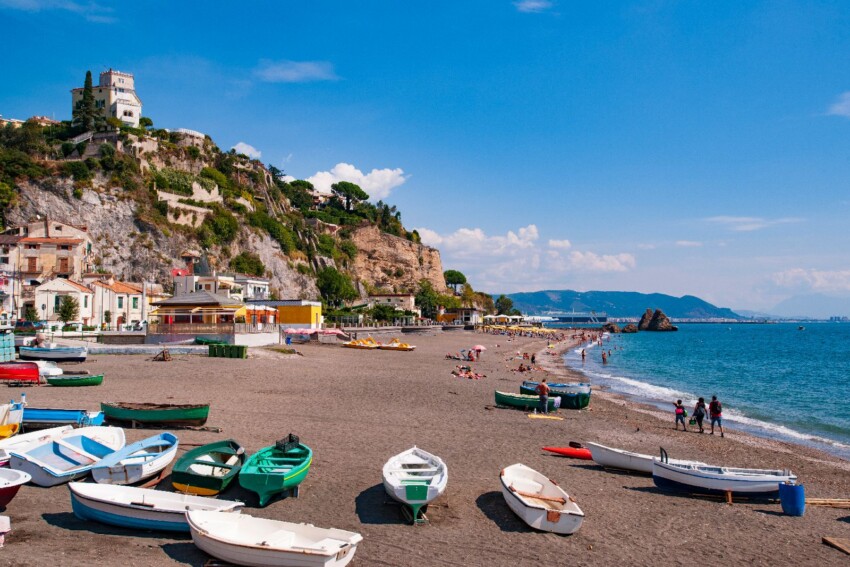
The sixth day is devoted to the most authentic and least photographed part of the coast.
Cetara is a small fishing village famous throughout Italy for colatura di alici, a sauce of fermented anchovies made by hand that is the direct heir to Roman garum, and for the quality of locally caught tuna: the restaurants by the harbour serve the freshest fish in a 1950s seaside village atmosphere.
A short distance to the east, Vietri sul Mare is the heart of Campanian artistic ceramics: its colourful maiolica decorates the domes of dozens of churches all along the coast, and the artisan workshops in the old town let you watch potters at work and take home unique pieces.
Salerno, reachable by ferry from Amalfi in 70 minutes, deserves a visit for the Cathedral of Matthew (1076-1085) with its crypt housing the relic of St Matthew the Apostle, its medieval old town and the waterfront where the gulf is reflected.
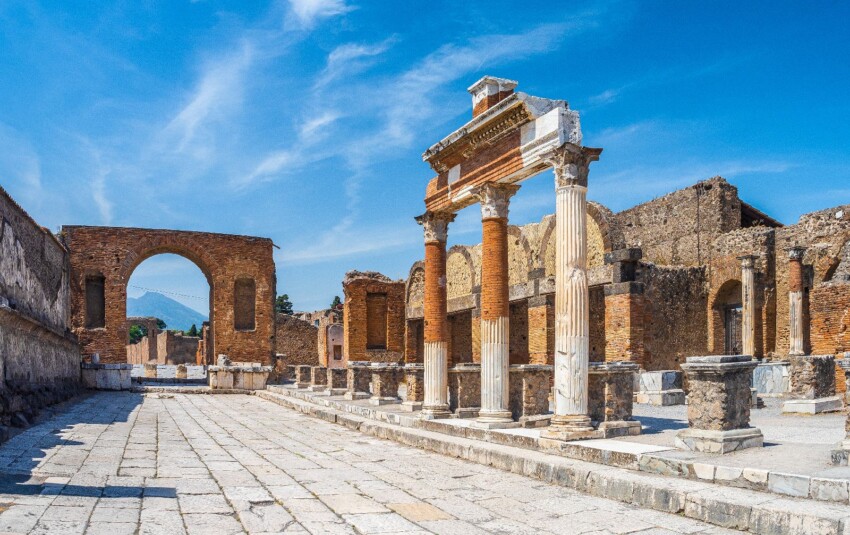
Your final day offers a choice between two remarkable excursions.
Pompeii is reachable from any point on the Amalfi Coast in roughly an hour by bus or ferry to Naples plus the Circumvesuviana train: the world’s most famous archaeological site, with its 66 hectares of first-century Roman city preserved by the eruption of Vesuvius in 79 AD, requires a minimum of half a day’s visit.
Capri is reached by ferry from Positano (seasonal, about 40 minutes) or from Amalfi: combining the Amalfi Coast and Capri in the same week is one of the most classic and effective itineraries in the Gulf of Naples.
Alternatively, if you haven’t yet taken to the water, you might dedicate day seven to a leisurely pace: choose a village you haven’t yet visited, such as Scala or Tramonti, and experience it without rushing.
Travelmar ferries are the most comfortable and scenic way to travel between Salerno, Cetara, Maiori, Minori, Amalfi, Conca dei Marini, Positano, Capri and Sorrento from April to October. Frequency increases in summer; tickets can be purchased at the quays or online.
SITA buses run along the SS163 year-round with fairly regular frequency, every 30-60 minutes depending on the time of day, and also serve inland hamlets such as Agerola (Bomerano, the starting point of the Path of the Gods) and Ravello. Tickets are bought at tobacconists, not on the bus.
A car is not recommended in July and August: parking is expensive and fills up quickly; the SS163 can become gridlocked for hours. If you’re driving during the rest of the season, park in Amalfi (Luna Rossa car park, the main one, offering overnight parking) and use buses and ferries to get around.
A scooter or hired motorbike (available in Amalfi, Positano and Sorrento) offers the most freedom: it solves the parking problem and lets you stop anywhere along the SS163’s scenic viewpoints. Drive carefully on blind curves.
For restaurants in the main villages, particularly Positano, Ravello and Amalfi, booking a few days in advance is essential in peak season, especially for tables with a sea view.
For all beaches and swimming spots on the coast, consult our guide to Amalfi Coast beaches.
 Hotel
Hotel  Budget accommodations
  Apartments
  Family Hotel
  Luxury Hotel
  Resorts