Palazzo Ferraioli
Atrani - Via Campo 16
The Ferraioli is a charming building from the early 20th century in Atrani, a pretty fisherman's village just outside Amalfi.
Book now
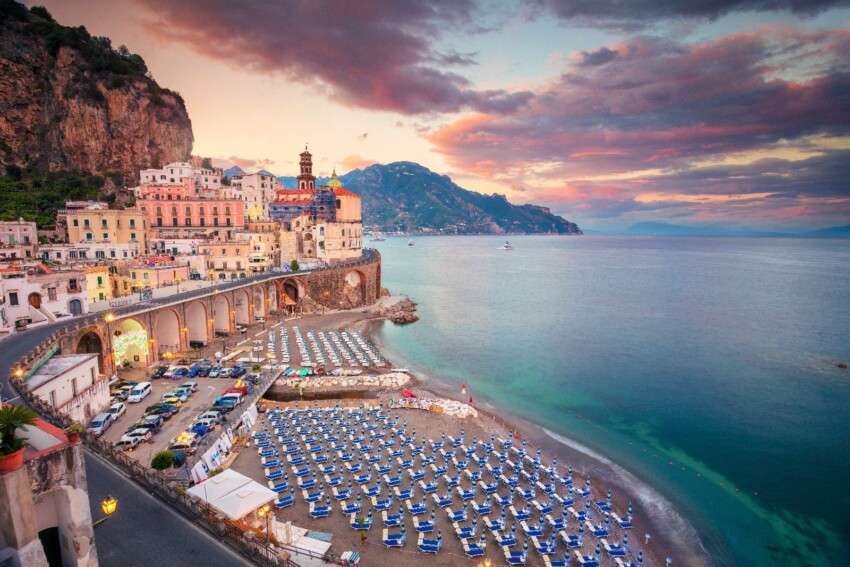
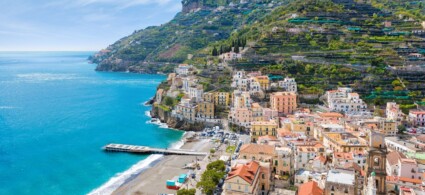
A picturesque fishing village along the Amalfi Coast, Atrani is not only one of Italy’s smallest towns but also a place that has managed to preserve its original urban layout unchanged over time. Atrani is characterised by little staircases known locally as “scalinatelle”, a maze of narrow alleyways and colourful buildings huddled together, often housing flowering gardens or small vegetable patches.
In this tiny town, the beauty lies in getting lost. Following a set itinerary to discover Atrani is genuinely difficult: the charm of this location resides precisely in the labyrinth of narrow streets that wind from the main square up to the upper reaches of the town, where you can admire a stunning panorama across the entire Gulf—particularly stunning at sunset.
Described as one of Italy’s most beautiful villages, Atrani has been chosen numerous times as the filming location for films and advertisements. Positioned along the Dragone river valley between the renowned towns of Amalfi, Ravello and Scala, Atrani is a small medieval town that represents the ideal destination for those seeking a stay devoted to tranquillity and relaxation. Over the years, the charm of this town has captivated intellectuals and artists, including German philosopher Walter Benjamin and artist Maurits Cornelis Escher, who created many of his works inspired by Atrani.
Located between Monte Civita and Monte Aureo, Atrani is a town best explored on foot. The village has maintained both its original layout and the charm of a small fishing community, whose life revolves around the famous “Piazzetta” of Atrani.
Though not particularly large, scattered throughout Atrani’s narrow streets are numerous churches and small chapels, including the Franciscan monastery of San Rosalia, the church of Santa Maria Immacolata, the Chapel of San Gertrude and the Church of the Carmine, which hosts a beautiful 17th-century nativity scene during the Christmas period.
The Piazzetta, also known as Piazza Umberto I, is the heart of Atrani and a meeting place for both locals and tourists who like to stop for a coffee or drink. Characterised by a relaxed, family-friendly atmosphere, Piazza Umberto I hosts numerous cafés and restaurants and features a fountain dating from 1927 at its centre. The square is directly connected to the sea through an ancient passageway originally created to protect fishermen’s boats during stormy weather.
Piazza Umberto I also welcomes one of the most famous churches not just in the town but along the entire Amalfi Coast: the Church of San Salvatore de Birecto, where the investiture of the Doges took place. From Piazza Umberto I, narrow alleyways and staircases wind throughout the entire town, leading up to the upper reaches of Atrani.
Dating from the 10th century and undergoing various restoration works, the Church of San Salvatore de Birecto currently features a square floor plan divided into three naves with barrel vaults.
The church played a significant historical role as it was a Palatine Chapel where the Doges of the Amalfi Republic were crowned and where their ashes were kept following their death. During the grand investiture ceremony for a new Doge, a special headdress called a “bireto” was presented, from which the church’s name is derived.
In 1274, on the ruins of an ancient medieval fortress, the inhabitants of Atrani decided to build a church dedicated to Santa Maria Maddalena to thank her for liberating the town from Saracen occupation. The Collegiate Church sits atop a hill that dominates the entire village, and from the square in front of the church you can enjoy a beautiful view over the Gulf of Salerno.
Externally, the building’s baroque façade is impressive, whilst from a distance the dome covered in majolica tiles and the exceptionally tall bell tower of brown tufa stone are striking features. Santa Maria Maddalena is considered the patron saint of the town, and every year on 22 July the people of Atrani organise a grand festival in her honour.
Built in the 10th century, the Church of Santa Maria del Bando is set into the rock of Monte Aureo. The church has a single nave with a small sacristy and features beautiful majolica flooring with geometric patterns. According to an ancient tradition, the church’s name derives from the fact that from its terrace, thanks to its special acoustics, proclamations, laws and sentences were announced.
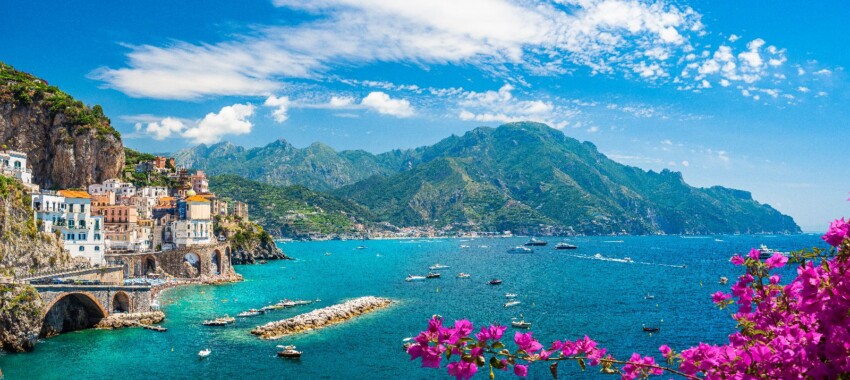
Atrani also has a small beach approximately 130 metres long, which is popular with families with children thanks to its sandy seabed and shallow waters.
The Spiaggia di Atrani5 is easily accessible from Amalfi, being only about 800 metres away, and is considered one of the most beautiful beaches on the Amalfi Coast. The beach is well equipped with a facility that hires out umbrellas and sunbeds, and there is also a free beach area available.
In the following map you can see the location of the main places of interest mentioned in this article.
The small village of Atrani offers a wide range of accommodation, from luxury hotels to family villas, from sea-view hotels to holiday homes nestled in nature. Scattered throughout Atrani’s alleyways you will also find numerous bed and breakfasts and simple yet welcoming guesthouses.
We offer a selection of hotels at Atrani to suit all categories of travellers. The most booked by tourists are the sea-facing hotels, often right on the beach. If you want to play it safe, choose one of the following: they are among the most booked hotels in Atrani, sorted by number of reviews.
If you prefer space, privacy and the ability to prepare your own meals to a hotel holiday, book a holiday home at Atrani. We recommend a few below, but in this case we advise you to book early because houses and apartments for rent at Atrani are in high demand.
Many choose to reach Amalfi first and then make their way to Atrani on foot, as the two towns are less than 1 km apart.
The cities of Salerno and Sorrento are well connected to Amalfi via SITA buses and therefore represent two excellent starting points for visiting Atrani. From Naples, those choosing to visit Atrani by car can take the A3 Naples-Salerno motorway and exit at Angri. Once you exit, you will need to take the SP2b followed by the SS163 towards Amalfi and Atrani.
Those opting to reach Atrani by train should use Salerno railway station, which is also served by Frecciarossa high-speed trains. Once you arrive in Salerno, you will need a car journey of approximately sixty minutes to reach Atrani, or you can take a SITA bus.
During summer, departing from both Salerno and Naples, there are convenient sea connections to Amalfi that allow you to reach the coast whilst avoiding the road traffic that often builds up along the SS163.
Atrani is a tiny village on the Amalfi Coast situated just under 1 km from Amalfi, 61 km from Naples and 25 km from Salerno.
 Hotel
Hotel  Budget accommodations
  Apartments
  Family Hotel
  Luxury Hotel
  Resorts