Hotel Voce del Mare
Vietri sul Mare - Via Costiera Amalfitana 21
Book now
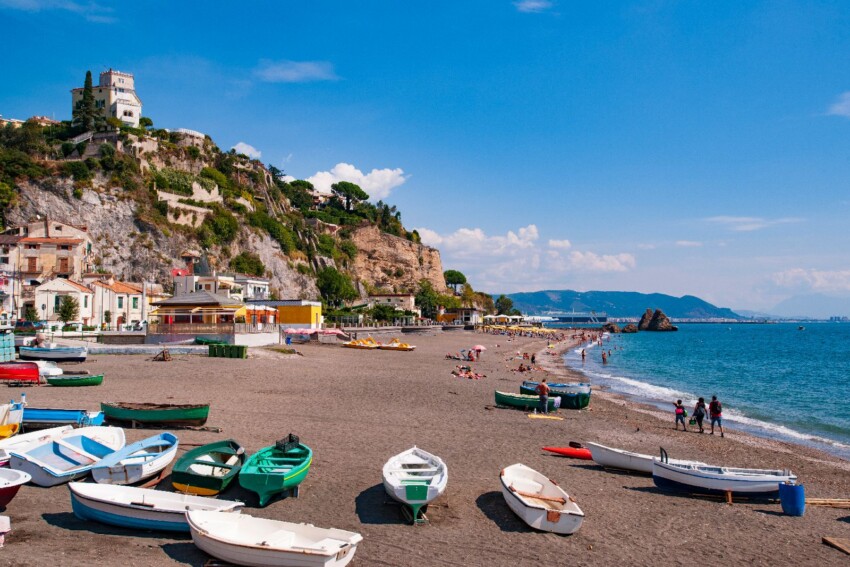
Renowned as the undisputed capital of artistic and traditional ceramics, the town of Vietri sul Mare is the southernmost settlement along the magnificent Amalfi Coast. This charming coastal village has been home to the production of artistic ceramics since the 17th century, some of which can be admired at the famous Vietri Ceramics Museum.
Formerly known as Marcina, the town has Etruscan origins but was also dominated by the Samnites, Lucanians and finally the Romans, who established here a collection and shipping point for agricultural and wine products from the Nocera-Sarno region.
Like the other cities on the Amalfi coast, Vietri sul Mare is characterised by a historic centre developed in a hillside area and a seafront area with several beaches. The city is certainly renowned for its crystal-clear sea and sandy beaches, but also for its historic centre, which features beautifully decorated buildings and boutiques selling genuine masterpieces in ceramics and local craftwork.
The foundation of the city’s historical and cultural identity, Vietri ceramics are just one of the fundamental reasons to visit this locality, which is defined as the ″First Pearl of the Amalfi Coast″. Nestled on a hillside embraced by the Tyrrhenian Sea, Vietri is a town characterised by colourful houses, alleyways decorated with vibrant majolica and ancient artisan workshops.
The best way to discover this place is to stroll through the colourful streets of the historic centre and visit the ceramic workshops where meticulous artisans create wonderful creations every day. Vietri is also famous for its culinary tradition, which includes among its most famous dishes anchovies, Gragnano paccheri pasta, seafood scialatielli and excellent pizza made in a wood-fired oven.
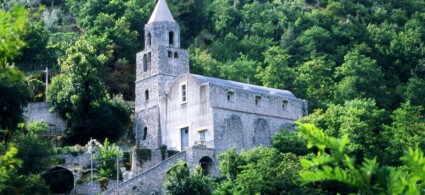
The Cathedral of Vietri sul Mare, dedicated to San Giovanni Battista, dates back to the 10th century, although the building has undergone various restoration works that have altered its original appearance, presenting it now as a mix of Romanesque, Renaissance and Baroque styles.
The cathedral is located in the centre of the ancient village and is famous for its magnificent dome dating from the 18th century, which stands 36 metres high and is made of coloured majolica in shades of green, yellow and blue. Beside the church stands the bell tower, consisting of six orders and topped with a small dome also made of majolica.
The church features a 16th-century façade characterised by two superimposed orders and topped by a pediment made of black tuff stone. The religious building has a Latin cross plan with a single nave and houses numerous works of great prestige inside, such as paintings by Solimena and Flammingo. The ceiling is coffered in gold and the high altar is decorated with marbles, while the side altars are all adorned with majolica and ceramics.
Right next to Vietri’s Cathedral is the Archconfraternity of the Most Holy Annunciation and Most Holy Rosary. This splendid 17th-century building features a façade with three large ceramic panels dating from 1931 depicting the Annunciation, San Michele and San Raffaele. Inside, there are pictorial works dating from the 18th century, created by the painter Master Filippo Pennini of Benevento.
The Ceramics Museum houses prized ceramic works created by craftsmen and artists and is currently located inside Villa Guariglia, an elegant and sumptuous residence in the Raito locality. The Villa, which takes its name from its former owner, nobleman Raffaele Guariglia, hosted King Vittorio Emanuele III of Savoy in 1943 and in 1970 passed to the property of the Provincial Administration of Salerno.
The Museum, established in this villa in 1992, preserves everyday utensils, religious and devotional objects from the 17th century and artefacts from the “German period”. The “German period” dates back to the 1920s when artists from all over the world, but especially from Germany, revolutionised the local repertoire by providing new contributions to ceramic production. The villa’s Library houses over four thousand volumes on historical and economic themes and precious editions of Latin and Greek classics dating from the 16th century.
The Parco Croce is a green oasis located at the foot of Monte Falerio, which was donated in March 2000 by the family of Benedetto Croce to the WWF. In one part of this beautiful park there is a woodland with Mediterranean vegetation, while in the other there are terraces typical of the Amalfi coast cultivated with fruit trees and vines. The flora that can be admired here is also very varied, with specimens of reptiles, amphibians and mammals.
Just off the coast of Vietri, two large rock formations rise from the sea in the middle of the water, which are considered the symbol of the city and are known as the Due Fratelli (Two Brothers). These two practically identical rocks emerge from the water side by side and regarding their origin, various legends are told.
The most famous of these legends tells of two shepherds who had ventured to Vietri’s beach with their flock and there, in the middle of the sea, they saw a mysterious maiden. Suddenly, a fierce storm broke out and the two boys threw themselves into the water in an attempt to save the young woman. Unfortunately, the two shepherds perished in the rough sea, while the girl, who was actually the nymph Roda, daughter of Poseidon, god of the sea, managed to save herself. Poseidon, amazed by the courageous gesture of the two young men, decided to transform their bodies into two rocks so they could watch over the sea forever and their sheep were turned into the small rocks that still surround them.
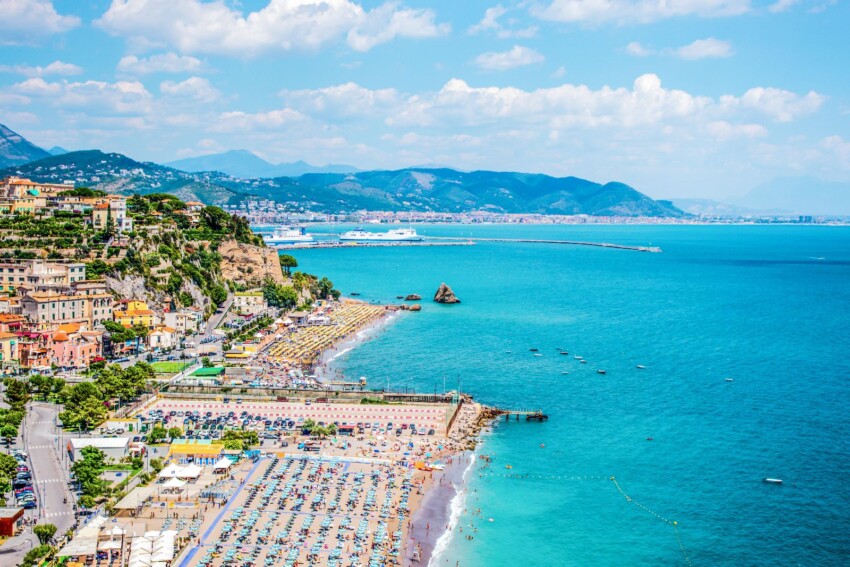
Vietri sul Mare is also famous for its beautiful beaches, some of which can only be reached by sea. The most famous and most popular of all the beaches is Marina Di Vietri4, which is frequented in summer by both tourists and locals. This beach, divided into two by the Bonea river, has equipped beach establishments on one side while on the other there is free beach.
Among the other beaches we recommend Spiaggia La Baia5, one of the few beaches with a sandy seabed, although its proximity to Salerno’s port means the sea water is not particularly clear, and Marina di Albori6, famous instead for its clear and crystalline sea. Finally, Spiaggia della Crestarella7, where you’ll find an ancient 16th-century watchtower and from where you can see the two rocks called the “Due Fratelli” emerge from the sea, reminiscent of Capri’s faraglioni.
In the following map you can see the location of the main places of interest mentioned in this article.
Vietri sul Mare is the ideal location to stay on the Amalfi Coast, given its proximity to both Salerno and Amalfi. Here you can find accommodation at more affordable prices compared to other coastal locations, such as Positano and Amalfi, especially if you book your stay in advance.
The city nevertheless offers a good choice of accommodation and lodging options: from small B&Bs to large luxury hotels with private beach access, from holiday homes to apartments.
The city of Naples is about 52 km from Vietri sul Mare, which is easily reached by car along the A3 motorway towards Salerno and taking the Vietri sul Mare exit. Once here, simply continue along the SS 163 road and follow the signs for Vietri.
Salerno, on the other hand, is just 5 km away and between the two cities there are both railway connections and bus services run by SITA. The train takes less than ten minutes, while the bus takes about fifteen minutes to connect Salerno to Vietri.
If you’re already in one of the other Amalfi Coast towns, such as Amalfi, Atrani or Cetara, you can take a SITA bus heading towards Salerno and get off at the Vietri stop. From Amalfi the bus takes about an hour to reach Vietri along the scenic SS 163 road. For those coming from southern Italy, simply take the Salerno-Reggio Calabria motorway towards Salerno, exit at Salerno centre and follow the signs for Vietri sul Mare.
The nearest airport to Vietri sul Mare is Naples Capodichino, about 55 km away, but it is not directly connected to Vietri. In fact, if you want to use public transport from the airport to reach Vietri, you will need to reach Naples Piazza Garibaldi Station where you can catch a train to Vietri sul Mare, which is the only city on the Amalfi Coast with a railway station. The train journey from Naples Piazza Garibaldi to Vietri sul Mare – Amalfi station is approximately one hour and fifteen minutes.
What's the weather at Vietri sul Mare? Below are the temperatures and the weather forecast at Vietri sul Mare for the next few days.
Vietri sul Mare is a small village on the Amalfi Coast, located 52 km from Naples, 5.6 km from Salerno and 21.4 km from Amalfi.
 Hotel
Hotel  Budget accommodations
  Apartments
  Family Hotel
 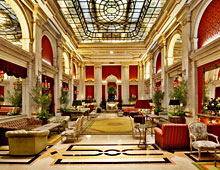 Luxury Hotel
 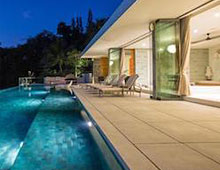 Resorts