Albergo Della Corte
Benevento - Vico Papa Vittorio III 7
Book now
Benevento is a city nestled in the Campanian hinterland that boasts a historical, artistic and archaeological heritage which is a symbol of the various civilisations that have dominated the city throughout its history. Originally, the city was known as Maleventum because of the defeat the ancient Romans suffered here during the Second Samnite War in the famous Battle of the Caudine Forks; it was only around 275 BC, when the Romans defeated Pyrrhus, that the city took the name Beneventum, to commemorate this fortunate event.
The city is a true open-air museum: it hosts not only the remains from the Samnite and Roman periods, but also evidence from the Lombard era. The city will also captivate you with its numerous stories and ancient legends that describe it as the ”city of witches”. These witches were women who, during the medieval period, gathered around a walnut tree along the banks of the River Sabato, where they practised dances and other ritual ceremonies.
During the Inquisition years, the city became the site of a true ”witch hunt” where they were persecuted, captured and killed. Legend also tells of a special Strega liqueur that has been produced here in Benevento for many years following a secret recipe that includes over 70 herbs.
The city of Benevento presents itself as the ideal destination for a weekend discovering a beautiful Italian city rich in history. Alternatively, if you find yourself in a nearby location, you can visit Benevento on a day trip.
Few realise that the historical, architectural and gastronomic heritage of this city is truly unique. Benevento is famous above all for its stunning Theatre of Roman origins and the Church of Santa Sofia, a religious building of Lombard origins that has been declared a UNESCO World Heritage Site.
The Roman Theatre of Benevento was commissioned by Hadrian in the early 2nd century and later enlarged by Caracalla. Originally it consisted of three storeys of twenty-five arches; today only the first storey and part of the second have survived. Unfortunately, until the late 19th century the theatre was covered by houses and other buildings that had been constructed over it, and only after its discovery in the early 20th century did work begin to bring this masterpiece back to light.
The theatre is truly a majestic work that could accommodate up to 10,000 people and was famous for its extraordinary acoustic system comprising two tunnels positioned beneath the cavea which functioned as a resonance chamber. Even today, thanks to its excellent acoustics, musical and theatrical events are regularly held here, particularly during the summer months.
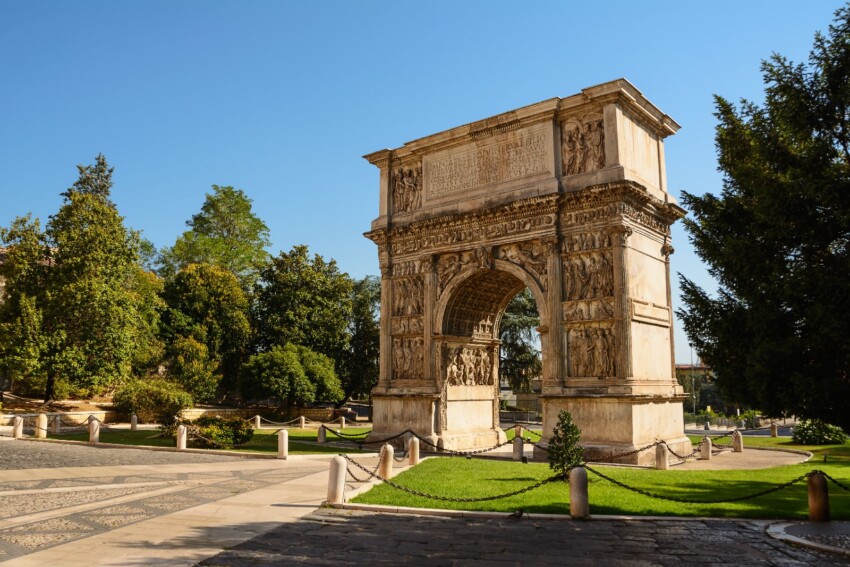
The Arch of Trajan is a truly majestic work built around 114 AD to celebrate the opening of the Via Traiana, the road that connected Benevento to Brindisi. The sculptural decorations are in excellent condition so much so that this Roman arch is one of the best preserved in Italy.
The arch features scenes of peace on the facade facing the city, whilst the outer facade depicts military scenes. Inside the single archway are depictions that narrate the life and deeds of the Emperor Trajan.
One of the most important testimonies to the Lombard period is represented by the Church of Santa Sofia, which appears to date back to around 760. The religious building follows the canons of early medieval Lombard architecture, although unfortunately it has undergone various restructurings and alterations over the centuries.
The church’s plan with a central hexagon makes it a truly original architectural work for the period in which it was built, so much so that since 2011 the church has been inscribed on the UNESCO World Heritage list. Not to be missed is a visit to the former monastery adjacent to the church, which today houses a section of the Museo del Sannio. Here you can find not only a beautiful cloister dating back to the Roman era, but also a collection of paintings from the 16th and 17th centuries.
The Cathedral of Benevento, consecrated around 780, is dedicated to Santa Maria de Episcopio and is one of the earliest religious buildings constructed in Benevento. Unfortunately the Cathedral suffered considerable damage during the bombing raids of the Second World War, but the bell tower and facade, dating back to the late 13th century, have been almost completely restored.
The facade has been rebuilt in white marble and features two storeys each with six arches, whilst the bell tower with a square base was constructed with white stone blocks. The Cathedral has a Latin cross plan with three naves; inside, a visit to the crypt is not to be missed, which, not having been hit by bombing, still preserves original painted cycles from the 9th century.
The Hortus Conclusus is located in one of the gardens of the Convent of San Domenico and is a true open-air museum which, since 1992, has housed works of a particularly symbolic, religious and mythological significance. These special sculptures, created by artist Domenico Paladino together with a team of architects and designers, allude to historical, religious and mythological facts and lend themselves to various interpretations. Among many others, you can admire the work depicting a horse with a mask on its face which seems to reference the famous Trojan Horse.
The Castle of Benevento, also known as the Rocca dei Rettori, is a building that was constructed for defensive purposes but over time became first a monastery and then the seat of the Papal Rectors (and this is where its second name comes from). Positioned on a hilltop overlooking the city, the complex is of Lombard origin but its current structure is the result of numerous restructuring works.
The Castle currently consists of a tall keep and the Palace of the Papal Governors, a rectangular building with three storeys and an internal courtyard. Today it houses the seat of the Province of Benevento and one of the headquarters of the Museo del Sannio which preserves historical artefacts that tell the story of the city.
The Museo del Sannio Beneventano is a museum divided into 4 departments where works and archaeological remains are displayed ranging from prehistory to the modern age. Three sections are located in the cloister of the Church of Santa Sofia, whilst the fourth is at the Rocca dei Rettori. The Museum preserves not only considerable testimony to Samnite history, but also an important collection of Egyptian artefacts which is second in Italy only to that held in Turin’s Egyptian Museum.
In the following map you can see the location of the main places of interest mentioned in this article.
Benevento is a city rich in art and history that offers a wide choice of accommodation across various price ranges, from small bed and breakfasts to large hotels. The city proves to be an ideal destination for a weekend of history, relaxation and excellent food, so if you choose to visit it during low season you will find excellent accommodation at very reasonable prices.
The best area to stay remains the historic centre which allows you not only to reach the main attractions on foot but also to find excellent restaurants where you can try local cuisine. The city welcomes many tourists, especially in summer when interesting cultural summer events are organised, such as Benevento Città Spettacolo.
Benevento is easily accessible from the major Italian cities both by car and by train. By car, if you are coming from cities like Bari, Salerno or Naples you can take the A16 motorway Naples – Bari and take the Benevento east exit, first following the signs for Caserta and then those for Benevento. If you are coming from Rome you can take the A1, exit at Caianello and then continue along the SS372 Telesina towards Benevento, until the Benevento west exit.
As for the train, Benevento is well connected, even with high-speed trains, to other cities such as Avellino, Campobasso, Foggia, Bari, Caserta, Naples and Rome.
The nearest airport is Naples Capodichino which is approximately 80 km from Benevento and has direct flights from major Italian and European cities. Once you arrive in Naples you can reach your destination by coach, by train in approximately two hours, or by car.
What's the weather at Benevento? Below are the temperatures and the weather forecast at Benevento for the next few days.
Benevento is situated inland in Campania, nestled among the Apennine hills. The city lies approximately 80 km from Naples, the regional capital, 60 km from Caserta and roughly 227 km from Rome.
 Hotel
Hotel  Budget accommodations
  Apartments
  Family Hotel
  Luxury Hotel
  Resorts