From Baia: Submerged Park of Baia Glass-Bottom Boat Iris
366 reviews
Buy now
From 19,20€ per person
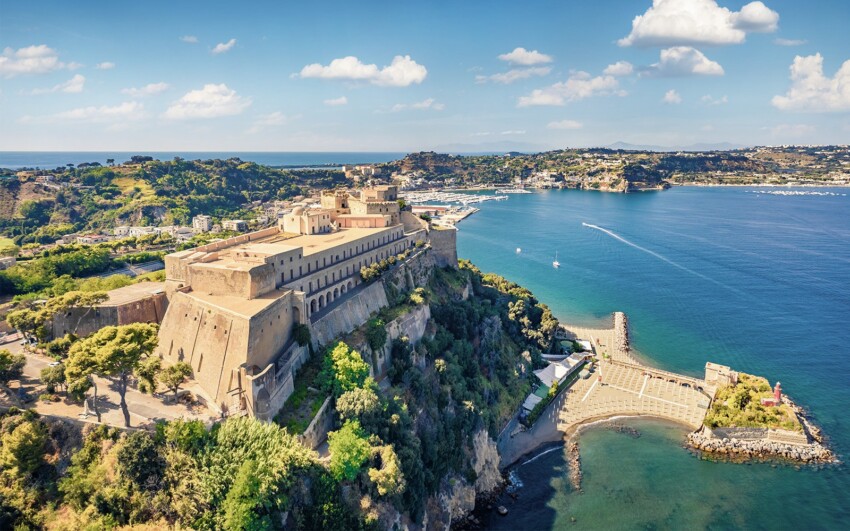
Just a few kilometres from Naples, in a landscape where the earth steams, crater lakes mirror skies heavy with history and Roman ruins emerge from the sea, stretches the Phlegraean Fields: one of the most extraordinary volcanic areas on the planet and, at the same time, one of the Mediterranean’s richest territories for historical and archaeological heritage. The name derives from the ancient Greek φλέγω, “I burn, I blaze”, and tells the story of this place far better than any guidebook could.
The Phlegraean territory encompasses the municipalities of Pozzuoli, Bacoli, Monte di Procida and Quarto, overlooking a gulf of extraordinary beauty to the north-west of Naples. Here, beneath the Earth’s crust, beats a supervolcano with a caldera that remains active: one of only a few examples worldwide of volcanism so close to a densely populated area. The phenomenon of bradyseism, the slow and continuous vertical movement of the ground, which can rise or fall by several centimetres a year, has shaped the history and geomorphology of the zone for millennia, and continues to modify the coastal landscape today.
Despite this geological dynamism, the Phlegraean Fields have been traversed by Greeks, Romans, Normans and Spanish, who left behind amphitheatres, thermal baths, necropolises, patrician villas and ports. Today the Phlegraean Fields Archaeological Park, established by the Ministry of Culture, manages four main visitable sites, with dozens of additional places of interest accessible to the general public. In this guide you’ll find everything you need to know to plan your visit: from unmissable locations to opening hours, from tickets to transport, as well as answers to the most frequently asked questions from travellers.
The range of experiences the Phlegraean Fields have to offer is nearly impossible to fit into a single day. There’s classical archaeology, natural hot springs, diving into a Roman city buried by the sea, and walks through the sulphurous vapours of an still-active crater. Below are the sites and attractions you shouldn’t miss during your visit.
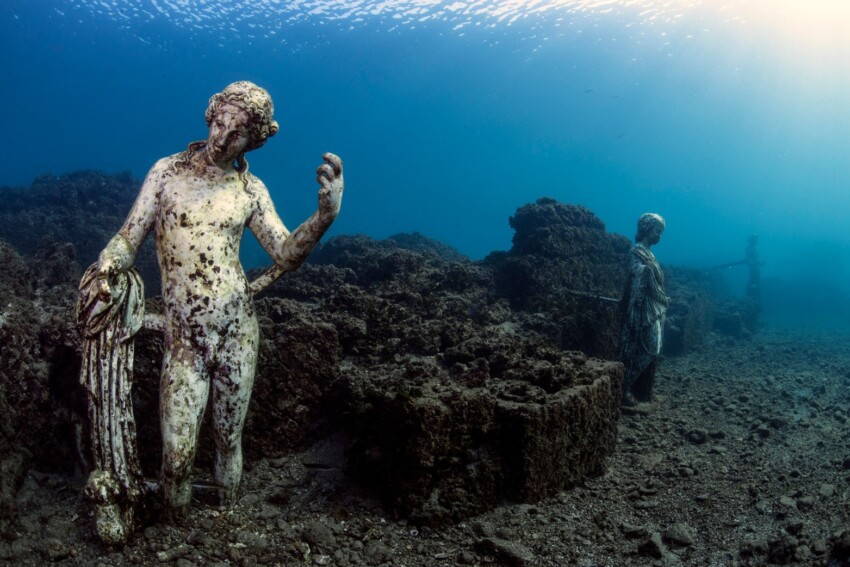
One of the most spectacular experiences in the Phlegraean Fields is found not on dry land, but beneath the sea: the ancient city of Baia, progressively swallowed by bradyseism in the centuries following the fall of the Roman Empire, now lies at a depth of between 1 and 7 metres in the waters of the Baia Underwater Park Marine Reserve. Paved streets, mosaics, sculptures, amphorae and wall structures remain intact on the seabed, protected by the water that submerged them.
Visitors can explore the Underwater Park in two ways: by glass-bottomed boat, perfect for families and those who don’t want to get wet, or by guided scuba diving with authorised operators, for those with certification. In either case, the clarity of the gulf’s waters makes the experience truly memorable. The area is protected by a marine reserve established in 2002, which prohibits fishing and any removal from the seabed.
If you only have time for one “out of the ordinary” experience during your visit to the Phlegraean Fields, choose the Underwater Park: nothing comparable exists in Europe. Glass-bottomed boat tours depart from Baia harbour; advance booking is recommended during summer months.
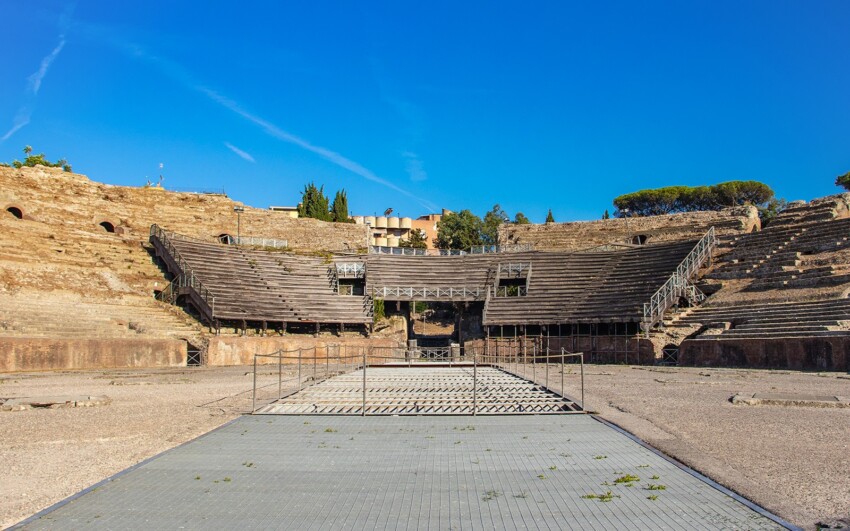
The Flavian Amphitheatre of Pozzuoli is the third-largest Roman amphitheatre by size, after Rome’s Colosseum and the amphitheatre of Capua, with an original seating capacity estimated at around 40,000 spectators. Built between the 1st and 2nd centuries AD, probably under the Flavians, it represents one of the best-preserved Roman monuments in all of Campania and certainly the most important in the Phlegraean Fields. The elliptical structure measures 147 metres along its major axis and 116 metres along its minor axis—dimensions that immediately convey the scale of the empire that built it.
What truly sets the Flavian Amphitheatre apart from the Colosseum is the preservation of its underground chambers: the subterranean tunnels designed to house wild beasts and stage machinery are still entirely accessible and offer a rare glimpse into the logistics of gladiatorial games. Walking through the underground corridors, imagining the roar of crowds above you and the confined smell of wild animals, is an experience no museum can provide. Also worth seeing are the remains of the seating tiers and arena, from which you can fully appreciate the building’s scale.
A historical note few know: according to Christian tradition, Pozzuoli’s amphitheatre is where in 305 AD San Gennaro, patron saint of Naples, was condemned to be torn apart by wild beasts. Miraculously, the animals prostrated themselves before him without attacking. The saint was later martyred at the Solfatara.
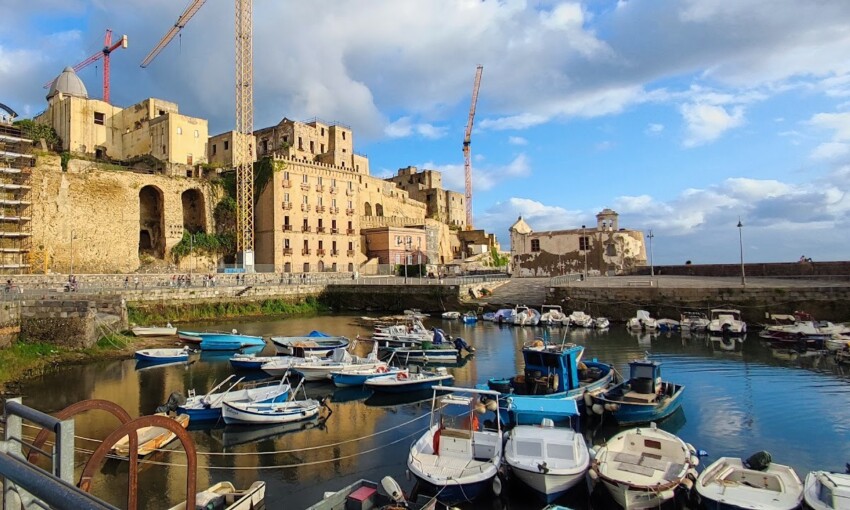
Rione Terra is the original nucleus of Pozzuoli, a tufa promontory extending into the gulf that shows traces of continuous settlement from its Greek founding as Dicaearchia (6th century BC) through to the 20th century. The city was evacuated between 1970 and 1984 due to increasing bradyseism, and restoration work begun in the late 1990s revealed, beneath the foundations of medieval and baroque buildings, an almost entirely intact Roman city.
The Rione Terra Underground Archaeological Route allows you to walk through paved streets, shops, horrea (warehouses), private baths and insulae (residential blocks) of ancient Puteoli, the Roman city that served as the main hub for trade with the East before Ostia took over. Walking physically beneath today’s alleyways and seeing the Roman urban level is a disorienting experience you won’t soon forget. The route also lets you admire the Cathedral of San Procolo, a baroque cathedral built on top of an ancient temple of Augustus, several of whose columns are still integrated into the church structure.
At the top of Rione Terra, a walk through the restored alleyways offers magnificent views over Pozzuoli’s harbour, the gulf, and on clear days, the islands of Ischia and Procida. It’s worth climbing at sunset, when the low light accentuates the yellow tufa stone and the reflection on the water becomes almost surreal. The site is managed by Pozzuoli Municipality; it’s advisable to check opening hours and guided tour availability on the municipal website before visiting.
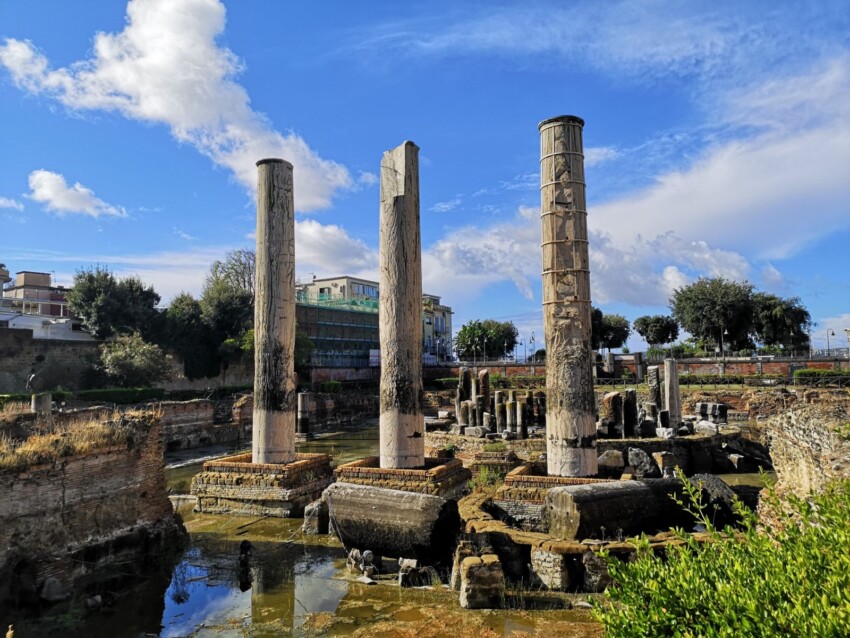
In the heart of Pozzuoli’s harbour stands one of the most photographed monuments of the Phlegraean Fields, erroneously renamed in the 18th century the Temple of Serapis after the discovery of a statue of the Egyptian god during early excavations. It is actually the Macellum of Puteoli, the great food market of the Roman city, built in the 1st century AD and enlarged in the 2nd. The square-plan structure with a central porticoed courtyard could accommodate dozens of shops and market stalls.
The Macellum is one of the most eloquent documents of the bradyseism phenomenon: the three Corinthian columns still standing show, between 3.5 and 3.7 metres up their height, the characteristic holes bored by Lithodomus lithophagus, marine molluscs that perforate rock to embed themselves. This means that over the centuries the columns were submerged by the sea to at least 3.5 metres, and subsequently the ground rose again, bringing them back to light. The Macellum is thus a gigantic measuring instrument of bradyseism, studied by geologists worldwide since the 18th century.
Admission to the Macellum is free and it’s located just a few steps from the harbour, in a particularly convenient location for those arriving by metro. Despite its scientific and historical importance, the monument is often overlooked by hurried visitors: dedicate at least half an hour to it.
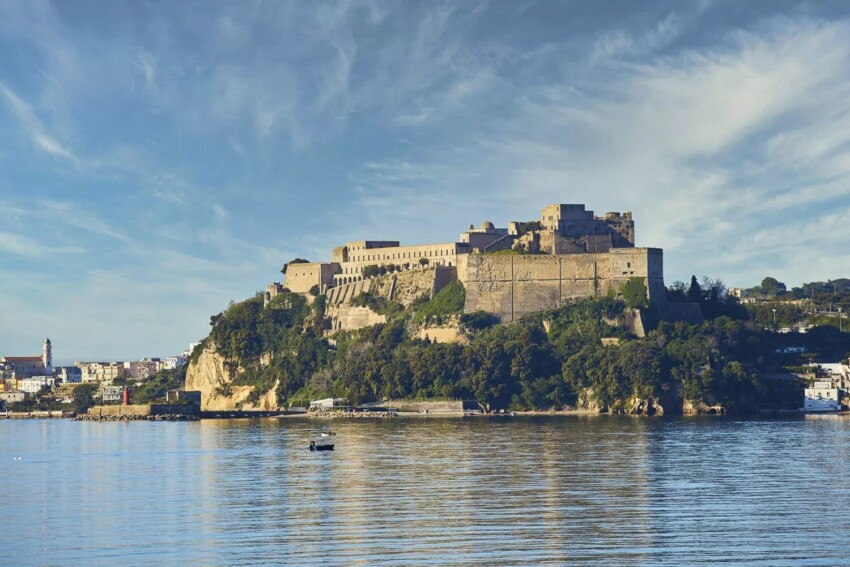
Perched on a promontory with 360-degree views over the Gulf of Pozzuoli, the Aragonese Castle of Baia is one of the most spectacular settings in the entire area. The structure was built by the Aragonese in the 15th century and radically restructured by Spanish Viceroy Pedro Álvarez de Toledo following the 1538 eruption that created Monte Nuovo. The star-shaped design is typical of Renaissance military fortresses built to withstand artillery.
Inside the castle is housed the Archaeological Museum of the Phlegraean Fields, one of the most important in Campania, which holds an exceptional collection of artefacts from Pozzuoli, Baia, Cumae and Miseno. The most famous piece is undoubtedly the Nymphaeum of Punta Epitaffio, a faithful reconstruction of an underwater triclinium attributed to Emperor Claudius, featuring statues of Ulysses and his companion Baius, from whom Baia supposedly takes its name. From 31 May 2025, it’s also possible to visit the Castle dungeons, open to the public for the first time as part of a heritage valorisation project.
The castle’s panoramic terrace, known as the Piazza d’Armi, is one of the finest observation points in the Phlegraean Fields. From there you can take in the coast from Miseno to Bacoli, the silhouettes of Procida and Ischia, and on clear days, Capri as well. Climb up in the late afternoon to enjoy the fading light over the gulf.
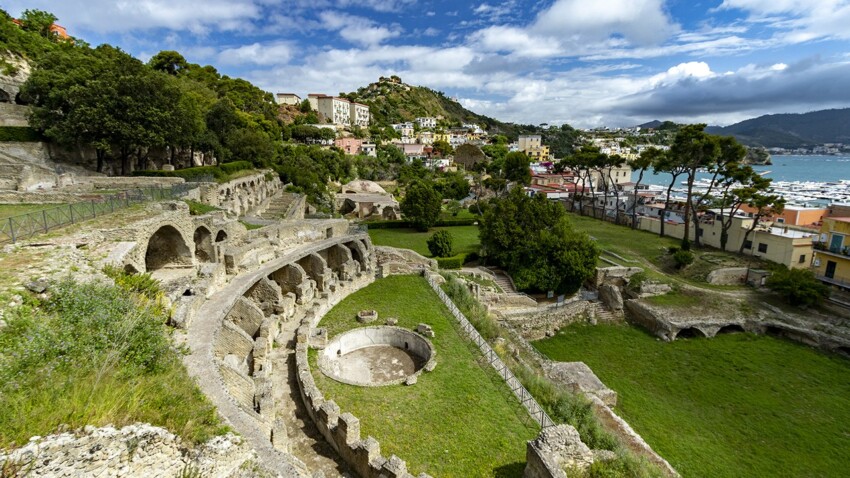
The Archaeological Park of the Baia Baths occupies a hillside that opens towards the sea in a succession of monumental terraces: baths, small temples, nymphaea and colonnades that once formed one of the most luxurious bath complexes of the Roman world. Baia was the Monte Carlo of antiquity: Julius Caesar, Pompey, Nero, Hadrian and dozens of other powerful figures had villas here. Cicero called it the “home of vice”, testament to how renowned it was for luxury and pleasure.
The park extends over an area of about 30 hectares and includes three main complexes, conventionally called the Baths of Venus, Baths of Sosandra and Baths of Mercury, 19th-century names that don’t correspond to the buildings’ actual use. The large dome attributed to the Temple of Mercury, about 26 metres in diameter, is one of the oldest hemispherical vaults in the history of Roman architecture, predating Rome’s Pantheon by at least a century.
The site also displays copies of statues found during excavation campaigns and later transferred to the castle museum: wandering among casts of the original marble sculptures, surrounded by Mediterranean scrub and with the scent of the sea rising from the coast, is an experience that combines cultural heritage rigour with the beauty of a historic garden. The visit requires comfortable shoes: the elevation change is significant.
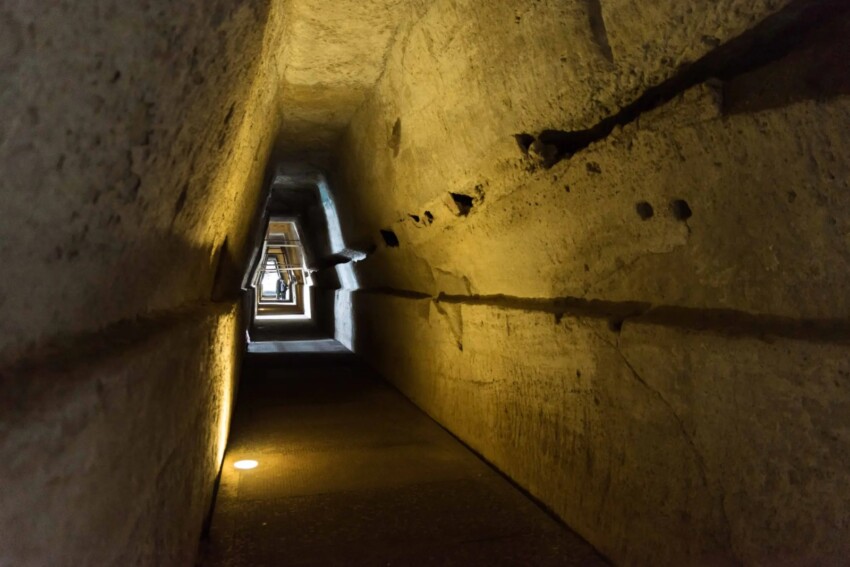
Cumae is the oldest Greek colony in the Western world, founded in the second half of the 8th century BC by Euboean colonists from Chalcis. From its harbour the Greek alphabet radiated throughout central and southern Italy: without Cumae, there would be no Latin alphabet, and therefore not even the one you’re reading now. This alone should justify a visit.
The Archaeological Park of Cumae sprawls across a hill overlooking the coast from an extraordinary vantage point. The park entrance immediately introduces the most evocative feature: the Cave of the Sibyl of Cumae, a trapezoidal corridor 131 metres long carved into tufa rock, lit by lateral triangular-section tunnels that filter light dramatically. According to Virgil (Aeneid, Book VI), it was here that Aeneas consulted the prophetess Sibyl before descending into the Underworld through Lake Avernus. The corridor, damp and cool even in summer, with its passage towards the light at the far end, still conveys a sense of threshold between the world of the living and that of the dead.
From the gallery you climb towards the acropolis, where the ruins of the Temple of Apollo, transformed into a paleo-Christian basilica in the 5th century, and the Temple of Jupiter on the upper terrace stand out. The panorama from the acropolis opens out to Ischia, Procida and Cape Miseno: looking down you see Lake Fusaro and the coastal plain that formed the northern border of Magna Graecia. The park visit takes about 2 hours; paths are dirt tracks, suitable for trekking shoes.
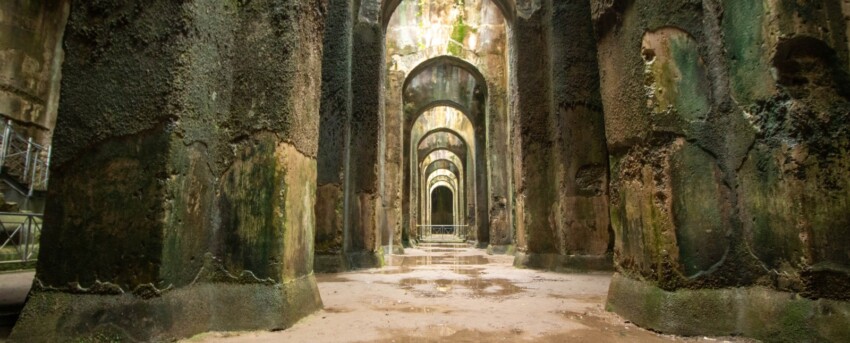
In Bacoli, at the end of a narrow alley in the old town hidden among buildings, opens one of Italy’s least-known and most astonishing Roman monuments: the Piscina Mirabilis, the largest fresh-water cistern of the entire Roman era. Built in the 1st century AD to supply fresh water to the imperial fleet stationed in the nearby port of Miseno, the cistern measures 70 metres in length, 25 metres in width and approximately 15 metres in height, with a capacity of over 12,000 cubic metres.
The interior is divided by five rows of cross-shaped pillars, 48 in total, supporting a barrel vault still perfectly intact after two thousand years. Light filters from above through circular openings in the ceiling (oculi), creating reflections on the stagnant water still present on the floor and a chiaroscuro effect that has inspired photographers and filmmakers from around the world. The acoustics are extraordinary: even the slightest sound multiplies in the space. It’s not hard to see why the Romans called it the “cistern of wonders”.
The site is managed by Bacoli Municipality and provides a guide to accompany you down: management can change seasonally, so it’s wise to verify current information before visiting. Admission is generally free or with a symbolic contribution, but visits may be suspended in cases of heavy rain.
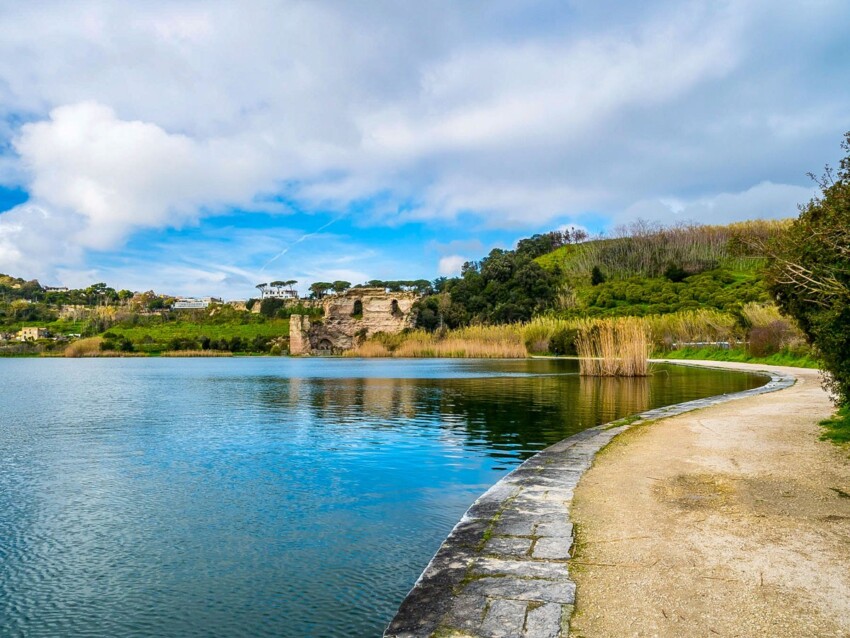
Few places in Europe have accumulated as much mythological symbolism as Lake Avernus. Situated in the crater of an extinct volcano, this nearly circular body of water, 2 kilometres in diameter and with a maximum depth of 60 metres, was identified by the ancients as the gateway to the Underworld. Virgil chose it as the starting point for Aeneas’s descent into the Underworld; before him, Homer had probably described similar places in the Odyssey. The name itself derives from the Greek aornos (“without birds”): according to the Romans, the vapours rising from the lake were so toxic they would strike down any bird that flew near.
Today the lake is reclaimed, vegetation on its shores is lush and in summer its waters are home to the occasional fisherman. But the loop walk around the crater’s perimeter, about 4 kilometres on unpaved track, retains an atmosphere of temporal suspension hard to find elsewhere. Along the route you encounter the remains of the so-called Temple of Apollo on the lake, the Grotto of Cocceius (a military tunnel nearly a kilometre long carved by order of Agrippa) and the ancient Avernus port, the Roman military port artificially excavated by Marcus Vipsanius Agrippa in 37 BC.
Sunset at Lake Avernus, with the waters turning leaden and tree silhouettes standing out against the sky, is a spectacle worth the trip to the Phlegraean Fields alone. The lake is freely accessible and requires no admission ticket.
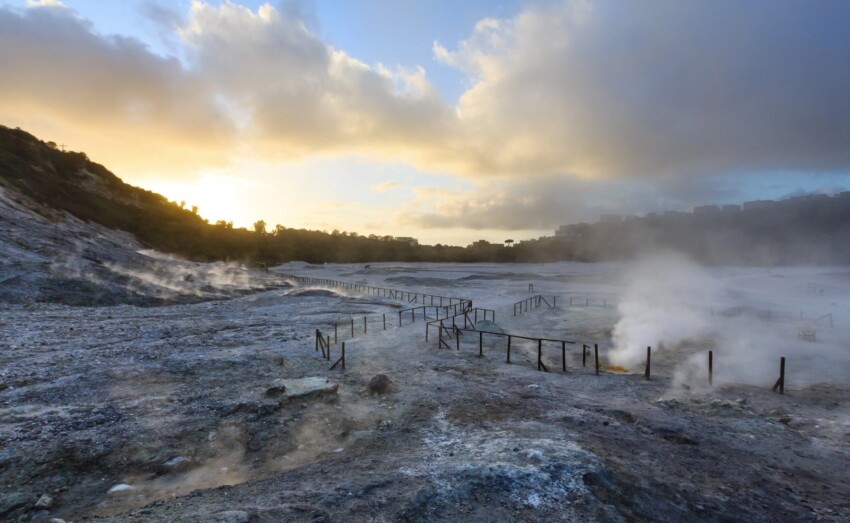
The Solfatara of Pozzuoli, a historic tourist destination in the Phlegraean Fields that has welcomed visitors since the days of the 18th-century Grand Tour—Goethe and Stendhal visited—is currently closed to the public and under judicial sequestration following a serious incident in September 2017, when a family fell into one of the crater’s areas. The external areas are nonetheless visible from the road that runs around the perimeter. It is strongly advised against approaching the ground in unmonitored zones given the geological characteristics of the area.
Those wishing to observe active volcanism in the Phlegraean Fields can turn their attention to the Solfatara Zone in its broader sense; fumaroles and gas emissions are visible also from some panoramic roads in the neighbourhood, or visit the Montenuovo Nature Reserve in Lucrino, a natural park situated in the crater of Europe’s youngest volcano, formed by the 1538 eruption.
In the following map you can see the location of the main places of interest mentioned in this article.
The four principal sites of the Phlegrean Fields Archaeological Park—the Archaeological Museum in Baia Castle, the Baia Thermal Baths, the Cumae Park and the Flavian Amphitheatre in Pozzuoli—are managed by the Ministry of Culture and accessible with various ticket types. The “Phlegrean Circuit” combined ticket, valid for three consecutive days, grants entry to all four sites at a cost of €10 full price and €5 concession for EU citizens aged 18–25. Admission is free for under-18s and for all visitors on the first Sunday of each month. There is also an annual myfleg card for €20, which offers unlimited access to all four sites for one year.
Online booking is highly recommended for all visitors and is mandatory for groups of more than 10 people and school parties. Tickets can be purchased on the official website. Access to Baia Castle is limited to a maximum of 50 people every 30 minutes, with a maximum stay of 120 minutes. Please note that if sites close due to bradyseism, a ticket refund mechanism applies. For the Rione Terra and the Piscina Mirabilis, managed by the municipalities of Pozzuoli and Bacoli respectively, up-to-date information on costs and availability can be found on the respective council websites.
For guided tours of the submerged area of Baia by glass-bottomed boat or scuba diving, prices and booking procedures vary depending on the authorised operators: it is advisable to check directly with the companies based in Baia harbour, remembering that advance booking is necessary during the summer months.
The opening hours of the Phlegrean Fields Archaeological Park sites vary seasonally and may change in the event of special events or adverse weather; it is always recommended to check the official website before your visit. As a rough guide, the four main sites are open daily except Tuesdays, from 9:00 to 19:00 during the summer months with last admission at 18:00 (reduced hours during winter). The official website publishes updates in the event of temporary closures due to bradyseism.
When planning your visit properly, bear in mind that the Phlegrean Fields are not a single site but a vast area: visiting everything in one day is practically impossible. A reasonable distribution requires at least two or three days. The first day could be devoted to Pozzuoli (Flavian Amphitheatre, Macellum, Rione Terra); the second to Baia and Bacoli (Castle-Museum, Thermal Baths, submerged city, Piscina Mirabilis); the third to Cumae and Lake Avernus.
The best time to visit is spring (April–May) and early autumn (September–October): temperatures are pleasant, the light is ideal for photography and the summer crowds are considerably reduced.
On weekday mornings you will avoid queues at ticket offices and enjoy the sites in greater peace and quiet. The Flavian Amphitheatre and the Baia Thermal Baths are particularly busy during spring weekends: it’s best to arrive at opening time. For Lake Avernus, which is freely accessible, the best moment is at sunset.
The history of the Phlegrean Fields is inseparable from the geology that created them. The entire area is a caldera, a depression formed by the collapse of a supervolcano after a massive eruption, originating approximately 40,000 years ago with the Campanian Ignimbrite eruption, one of the most powerful volcanic events of the last 200,000 years in Europe, which deposited ash as far as Russia and Central Europe. A second catastrophic eruption, approximately 15,000 years ago, generated the Neapolitan Yellow Tuffs, the rock that still today constitutes the structure of Pozzuoli, Naples and much of their historic buildings.
Greek colonists from Chalcis and Eretria were the first to settle permanently in the area, founding Pithecusa (on the island of Ischia, around 750 BCE) and then Cumae on the Phlegrean coast around 730 BCE. Cumae rapidly became the metropolis of Campanian Magna Graecia, and from its script the alphabet spread throughout the Italian peninsula. The people of Cumae transmitted the script to the Etruscans, who passed it on to the Latins: the history of Western culture has one of its deepest roots here.
After the Samnite Wars, the territory was absorbed by Roman power. The Romans immediately grasped the potential of the area: hot thermal springs, abundant natural steam and the fertility of volcanic soil transformed the Phlegrean coast into the Riviera of Roman aristocracy. Baia became the favourite seaside resort of the Republican and Imperial elite: Julius Caesar, Cicero, Augustus, Caligula (who had a bridge of boats 5 km long built from Baia to Misenum to challenge an oracle’s prophecy), Nero and Hadrian all stayed there. The poet Horace called it “sinus… pulcherrimus”, the most beautiful gulf in the world.
At Misenum, Agrippa had the military port built, which became the base of the Classis Misenensis, the main warship fleet of the Roman Empire in the western Mediterranean. It was from Misenum that Pliny the Elder, the fleet commander, set out on 24 August 79 AD to help survivors of the Vesuvius eruption: he died at Stabiae, a victim of volcanic gases. His nephew Pliny the Younger, who remained at Misenum, left us the most detailed written account of these events that has survived from antiquity.
With the fall of the Western Roman Empire, progressive bradyseism gradually submerged Baia and much of the Phlegrean coast. In 1538, the most recent documented historical eruption of the Phlegrean Fields generated Mount Nuovo in just two days, a volcanic cone 133 metres high that rose from the plain between Pozzuoli and Lucrino. The eruption buried the village of Tripergole and terrorised the population, but remained confined to a limited area. Since then, volcanic activity has manifested primarily through bradyseism and hydrothermal emissions: between 1982 and 1984, a period of significant ground uplift of up to 1.80 metres in two years, caused the evacuation of thousands of Pozzuoli residents and the permanent abandonment of the Rione Terra.
The Phlegrean Fields are located 15–20 km from Naples city centre and are connected to the capital by several transport systems. The main reference point for those arriving from outside is Naples Capodichino International Airport, approximately 25–30 km from Pozzuoli. For directions on public transport in Naples and connections between the airport and the rest of the city, you can consult our dedicated guide.
The most convenient way to reach Pozzuoli from Naples is the Metro Line 2: from Naples Central Station (Piazza Garibaldi) you reach the Pozzuoli Solfatara stop in approximately 25–30 minutes. From there, Pozzuoli town centre, the Macellum and the Flavian Amphitheatre are reachable on foot or by a short bus ride. For details on the underground network, consult our guide to Naples metro.
The Cumana Railway, run by EAV, connects Naples (Montesanto station) to Torregaveta passing through Pozzuoli, Lucrino, Baia and Fusaro. It is the most useful system for visiting the Baia and Bacoli sites: the Baia stop is just a few minutes’ walk from the Thermal Baths Archaeological Park and the harbour from which submerged tours depart; the Fusaro stop is close to the Piscina Mirabilis. The service is frequent on weekdays, more limited at weekends.
Those arriving by car from Naples take the Naples Ring Road (Pozzuoli exit for the town centre and Amphitheatre; Agnano exit for the Solfatara) or the SS7 Quater. Car use is particularly useful for reaching Cumae and Lake Avernus, which are less served by public transport. Please note that traffic towards Pozzuoli can be heavy at weekends and that parking in the historic centre is limited. Car hire in Naples is a convenient solution for those who wish to explore the Phlegrean area freely without depending on public transport schedules, especially for reaching Cumae, Mount Nuovo and the less central sites.
During the summer months, there are sea connections between the harbour of Naples (Mergellina) and the harbour of Pozzuoli: a scenic and pleasant alternative, particularly recommended for the return journey at sunset. Pozzuoli harbour is also the departure point for ferries and hydrofoils to Ischia and Procida, making it possible to combine a visit to the Phlegrean Fields with a day trip to the island in a single journey.
There’s no one-size-fits-all answer—it depends on how many sites you want to see. To get an overview of the main attractions (Flavian Amphitheatre, Macellum, Baia Castle, Baia Thermal Baths, Lake Avernus), you’ll need at least two full days. If you also want to include Cumae, the underground Rione Terra, Piscina Mirabilis and Baia’s Submerged Park, plan for three days or more. Many visitors choose to stay in Naples and dedicate one or two days to the Phlegraean Fields as a day trip.
The Phlegraean area is monitored 24/7 by the Vesuvian Observatory of the INGV (National Institute of Geophysics and Volcanology). The alert system uses four risk levels (green, yellow, orange, red); in recent years the level has remained at yellow (caution), indicating ongoing volcanic activity but no immediate risk to the population. Archaeological sites are monitored and access is permitted under standard safety conditions. Any temporary closures due to bradyseism are communicated by the Archaeological Park and are accompanied by ticket refunds. We recommend checking the latest official updates before your visit, especially during periods of heightened seismic activity.
Absolutely. Many sites—the Flavian Amphitheatre, Lake Avernus, Cumae Park—are accessible and engaging for young visitors too. The Submerged Park at Baia reached by boat with a transparent floor is an experience that thrills children of all ages. Piscina Mirabilis, with its cave-like atmosphere, captivates young people. We recommend wearing closed, comfortable shoes at all sites, bringing plenty of water and sun protection during warm seasons. Children under 18 enter free to all four sites within the Archaeological Park.
Visits to Baia’s Submerged Park are organised by authorised operators departing from Baia harbour, reachable via the Cumana Railway (Baia station). There are two types of experience: the transparent-bottomed boat, accessible to everyone without any technical preparation, and scuba diving, for which a certification is required. We recommend booking online in advance, especially during summer. Prices vary depending on the operator and tour type you choose.
The “Phlegraean Circuit” combined ticket includes four sites within the Phlegraean Fields Archaeological Park: the Museum at Baia Castle, Baia Thermal Baths, Cumae Park and the Flavian Amphitheatre. It does not include municipally managed sites such as the underground Rione Terra (Municipality of Pozzuoli) and Piscina Mirabilis (Municipality of Bacoli), nor private experiences like Baia’s Submerged Park. On the first Sunday of each month, entry to the four state-run sites is free for everyone.
The Phlegraean Fields are a perfect base for exploring some of Campania’s most iconic destinations. Naples is 20-30 minutes by train: our guide to what to see in Naples will help you plan your day in the city. In the opposite direction, Vesuvius and the excavations of Pompeii and Herculaneum are reachable in about an hour. From Pozzuoli harbour, frequent ferries depart for Ischia and Procida.
Some beaches in the Phlegraean area are suitable for swimming. Lucrino Beach, Baia Beach and Torregaveta Beach at Monte di Procida are among the most popular. The waters of the Baia Marine Reserve are subject to restrictions to protect the submerged heritage. In some parts of the gulf, water temperature can be unusually warm due to underwater geothermal activity: it’s not dangerous, but it’s worth being aware of the phenomenon. For those seeking crystal-clear waters away from the metropolitan area, the islands of Ischia and Procida are easily reached from Pozzuoli harbour.
If you want to stay in the Phlegraean area, you can choose from accommodation options in Pozzuoli, Bacoli and Monte di Procida, with prices generally lower than Naples. Alternatively, Naples offers a much wider choice of hotels, B&Bs and flats, with excellent connections to the Phlegraean Fields via the metro and Cumana Railway. Staying in Pozzuoli has the advantage of being right in the heart of the Phlegraean area, allowing you to enjoy the scenic seafront in the early morning or evening.
Temporary closures of Archaeological Park sites due to bradyseism or seismic activity are promptly communicated on the official website pafleg.cultura.gov.it and the Park’s social media channels. In case of closure, the Park has a ticket refund mechanism: instructions are available in the dedicated section of the website. We therefore recommend purchasing tickets with reasonable advance notice, always checking the latest news before your visit, especially during periods of intense seismic activity.

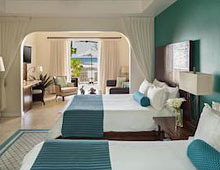 Hotel
Hotel 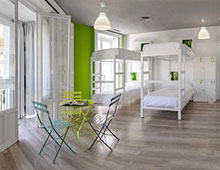 Budget accommodations
  Apartments
  Family Hotel
 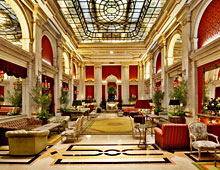 Luxury Hotel
 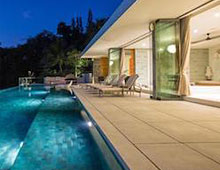 Resorts