Bestseller
Royal Palace of Caserta with English Gardens & Smart Guide
From 25,00 €
Buy the ticket
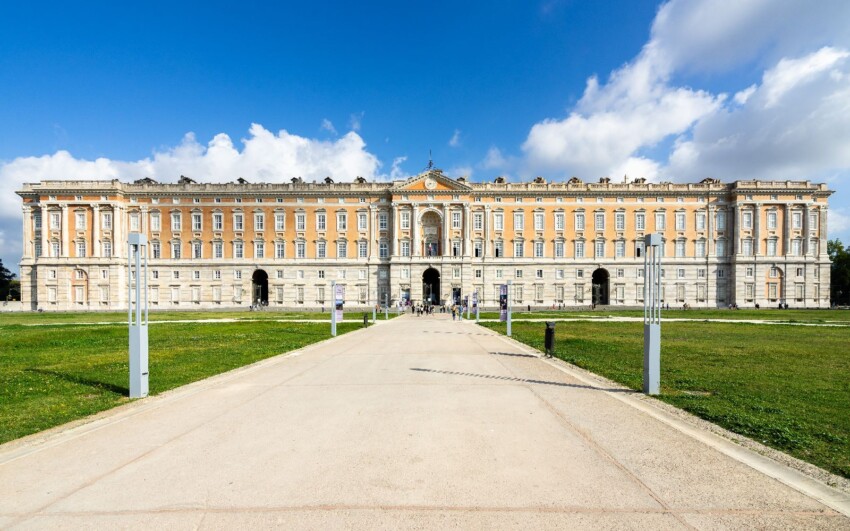
Commissioned by Charles of Bourbon, King of Naples, in the second half of the 18th century, the Royal Palace of Caserta was built in a strategically important location, set inland away from the sea yet not far from the city of Naples.
The King wanted a palace that could rival the grand complexes built in other European capitals and, in particular, match the beauty and majesty of the Palace of Versailles.
Thanks to the genius and creativity of architects Luigi and Carlo Vanvitelli, the Royal Palace is regarded not only as one of Italy’s main attractions, but also as one of the most sumptuous buildings in the world, drawing almost a million visitors annually. Beyond the palace itself, the site comprises an enormous park spanning around 120 hectares, characterised by grand avenues, fountains with water displays and stunning gardens. For these reasons, we recommend setting aside at least a full day to explore this magnificent complex.
Elegant, regal and truly majestic, the Royal Palace of Caserta with its beautiful gardens is a magnificent complex representing one of the finest masterpieces of 18th-century Italian architecture. The site was not only the court palace of the Bourbon family but also a museum where you can admire frescoes created by important artists of the period and book collections dating back to the 1800s.
A visit to the Royal Palace is certainly a must-see during a trip to Campania, as the complex was designated a UNESCO World Heritage Site in 1997.
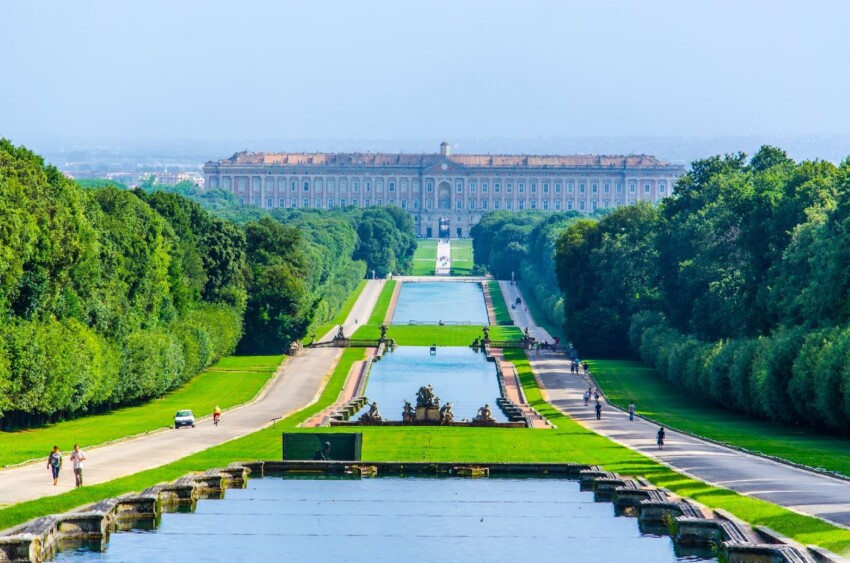
The Royal Palace of Caserta has a rectangular floor plan and covers an area of approximately 47,000 square metres across five storeys. The palace complex offers visitors both internal rooms and outdoor spaces. Regarding the interior of the palace, you’ll immediately notice a grand staircase connecting the lower vestibule with the upper one, leading to the sumptuous Royal Apartments. On the outside, the palace park extends for 3 kilometres across approximately 120 hectares and features elegant boulevards adorned with statues of ancient deities, fountains and water features.
A grand double-flight staircase leads to the ‘Noble Floor’ where the Royal Apartments are located. Upon climbing the stairs, you’ll find the Palatine Chapel, built drawing inspiration from the Chapel of the Palace of Versailles and inaugurated by Ferdinand IV on Christmas Day 1784.
The Royal Apartments of the House of Bourbon were created between the 18th and 19th centuries with Reception Rooms finely decorated in neoclassical style. Among the most significant spaces are the Hall of the Halberdiers with frescoes by Domenico Mondo and precious stuccowork, the Throne Room extending a full 40 metres, the Hall of the Bodyguards and the Hall of Alexander, known as the ‘Hall of Marbles’, which separates the New Apartment wing from the Old Apartment wing.
The Old Apartment, located to the left of the Hall of Alexander, comprises the spaces used by Ferdinand IV of Bourbon and his wife Maria Carolina. This area is characterised by white and gold furniture and decoration, with walls lined with silk from the San Leucio factory. The New Apartment, built between 1806 and 1845, features the Hall of Mars in neoclassical style, the Hall of Astraea and the Throne Room, which was the most important space in the royal apartments where the king received official visits and held court balls.
During the 19th century, Joachim Murat, along with his wife Caroline Bonaparte, also stayed at the Royal Palace, creating apartments in imperial style with furnishings from the Royal Palace of Portici.
On the western side of the palace stands the Court Theatre, commissioned by Charles III of Bourbon and designed after the model of the San Carlo Theatre in Naples. Featuring a horseshoe-shaped floor plan, the Court Theatre was built as a venue for festivities and performances and had a capacity of around 450 seats.
The Theatre was not part of Luigi Vanvitelli’s original design but he later devoted considerable effort to its construction, creating what was to be a true architectural jewel. Featuring five tiers of elegantly decorated boxes with allegorical and celebratory elements, the Theatre was inaugurated in 1769 in the presence of Ferdinand I of the Two Sicilies and all Neapolitan nobility.
Commissioned by Queen Maria Carolina of Habsburg-Lorraine, wife of Ferdinand IV of Bourbon, the Palatine Library dates to the late 18th century and comprises five finely decorated rooms. The Library’s halls house volumes dating back to the 1800s and contain frescoes by Heinrich Friederich Füger and paintings by Luca Giordano.
Among the most precious works in the Library is undoubtedly the collection of architectural drawings by Luigi Vanvitelli, through which the building plan for the Royal Palace of Caserta was presented to King Charles.
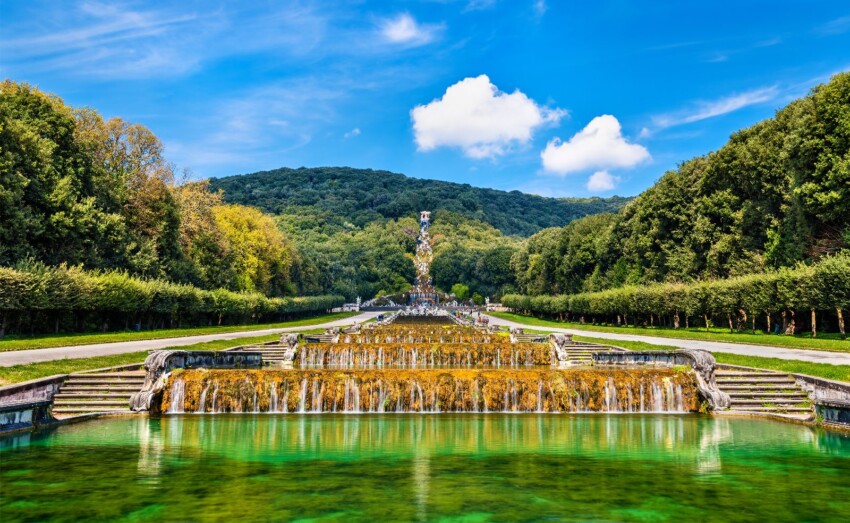
The Royal Park of the Palace of Caserta draws inspiration from the gardens of other European palaces, uniquely blending the Italian Renaissance garden tradition with the characteristics of the gardens at Versailles. According to Luigi Vanvitelli’s original design, water from the slopes of Monte Taburno would have fed the park’s fountains through the Carolino Aqueduct. In reality, Luigi died before completing this project and the external works were finished by his son Carlo, who respected his father’s design and created a landscape alternating between fountains, water basins, meadows and cascades.
Upon leaving the royal palace, two tree-lined avenues emerge, surrounded by various fountains such as the Fountain of the Three Dolphins, the Fountain of Aeolus, the Fountain of Ceres and the Margherita Fountain, which closes off the Italian garden and opens onto the English Garden. Within the Italian Garden area you’ll also find the Fish Pond, a place where royalty could indulge in mock naval battles, and the Castelluccia, a building constructed for the military training of royalty and battle simulations.
The English Garden, commissioned by Queen Maria Carolina of Habsburg-Lorraine, wife of Ferdinand IV, was created in 1875 by English botanist John Andrew Graefer. The garden spans approximately 24 hectares and is home to woodlands, fountains, small lakes and plants from not only many cities in Campania but also from various countries around the world, including cedars from Lebanon, flowers from Japan, holm oaks, plane trees and camellias of different origins.
The English Garden’s fountains are also fed by the Carolino Aqueduct. When John Andrew Graefer left Caserta, his three sons took care of the garden and prevented it from falling into disrepair.
Once known as the Royal Estate of San Silvestro, this green space was part of, along with San Leucio, the Royal Park of the Palace of Caserta. In the early 19th century, a broad road was built from the palace’s Belvedere to the Woods, and other roads within this area were made passable for carriages.
The complex, stretching across two hills over an area of approximately 76 hectares, is currently a WWF Nature Reserve that manages visits and organises various initiatives. Part of the woodland is used for cultivation of the “San Silvestro Vineyard”, a typical local grape variety that produces white and red Pallagrello wine.
The Royal Palace of Caserta is open every day except Tuesday, 25 December and 1 January.
The Royal Apartments are open from 9:30 to 19:30 (ticket office closes: 18:45).
The Royal Park and English Garden open at 8:30 with closing times varying by month: January closes at 16:00, February 16:30, March 17:00, April to September 19:00, October 17:30, November and December 15:30.
Online ticket purchase is mandatory. There are several ticket types:
Given the high number of visitors to the Royal Palace of Caserta, consider purchasing a priority ticket that includes an audio guide and, if you wish, the option for train transfer from Caserta.
The Royal Palace of Caserta is one of the attractions included in the Campania Artecard, the tourist pass for the Campania region that also includes entry to must-see attractions such as the Archaeological Park of Pompeii, those of Herculaneum and Paestum, and Naples attractions such as the Royal Palace or the Museum and Royal Wood of Capodimonte.
The Royal Palace of Caserta is part of Italy’s fabulous historical and architectural heritage and it may well be worth discovering it through a visit with expert and qualified guides who will tell you all the details of this magnificent complex.
The Royal Palace of Caserta is easily accessible by car, train and bus. From Naples, the regional train takes approximately 45 minutes to reach Caserta, whilst from Benevento it takes an hour and fifteen minutes. The complex is located close to the historic centre of the city and is reachable on foot in about 5 minutes from Caserta railway station.
Those arriving by car can park in Piazza Carlo di Borbone, near the station, where there is a municipal car park.
The nearest airport is Naples Capodichino, where you’ll find bus routes that allow you to reach Caserta in approximately 40 minutes.
Visiting the Royal Palace of Caserta and its beautiful park is a task that can require an entire day, so it may be useful to stay in Caserta near the site so you can reach it early in the morning.
For the construction of the new Royal Palace, King Charles of Bourbon turned to architect Luigi Vanvitelli, asking him to create a complex that would be a symbol of the Bourbon royal family and communicate the importance and prestige of the monarchy.
With work beginning in 1752, at the King’s request the complex was to be efficient and functional and was to include a sumptuous royal palace, served by the new Carolino Aqueduct, and a park with an Italian garden.
Unfortunately in 1759, Charles of Bourbon, following the death of the King of Spain, left Naples to travel to Madrid, which caused significant delays in the construction work.
King Ferdinand IV of Naples, following the eruption of Vesuvius in 1767, decided to abandon the Royal Palace of Portici and declared the Royal Palace of Caserta as his hunting residence. Thanks to the passion of his wife, Queen Maria Carolina, the palace was enriched with a valuable collection of porcelain and an important art gallery.
In 1773 Luigi Vanvitelli died and his son Carlo Vanvitelli, along with other architects who had trained under his father, completed the construction of the royal residence. In 1787 the writer Goethe, in Italy on his Grand Tour, also visited the Palace, remaining particularly amazed by its beautiful gardens.
In 1808 Joachim Murat was proclaimed King of Naples and immediately fell in love with the Royal Palace of Caserta, so much so that he had an entire apartment in imperial style built here. Unfortunately, after the Congress of Vienna in 1815, the palace was abandoned and served only as a hunting residence for the Bourbon family. With the birth of the Kingdom of Italy, the palace passed into the possession of the House of Savoy, which ceded it to the Italian state in the early 20th century.
The Royal Palace of Caserta stands approximately 400 metres from Caserta's city centre and is therefore easily accessible on foot from the heart of the town.
City Card allow you to save on public transport and / or on the entrances to the main tourist attractions.

 Hotel
Hotel  Budget accommodations
  Apartments
  Family Hotel
  Luxury Hotel
  Resorts