Bestseller
Paestum Archaeological Park Guided Tour
From 39,50 €
Buy the ticket
An archaeological site recognised in 1998 as a UNESCO World Heritage site, alongside the Cilento National Park, Paestum was already an important commercial centre of Magna Graecia in the 6th century BC, known as Poseidonia in honour of the god Poseidon. By the end of the 5th century, the city came under the rule of the Lucani and later the Romans, who gave it its present name.
With the fall of the Roman Empire, the city also lost its importance until the first half of the 18th century when Paestum became one of the destinations chosen by intellectuals and aristocrats from across Europe as a stop on the Grand Tour, a journey aimed at rediscovering the historical treasures of the Mediterranean. Official excavations of the archaeological site began in spring 1907 and brought to light countless artefacts that we can admire today alongside several temples, monuments, the forum and other important finds.
In 1952, the National Museum was opened, which tells the story of Paestum and its territory from prehistoric times onwards, preserving artefacts of inestimable value. A visit to Paestum proves to be a wonderful journey through time, discovering the ancient civilisations of the Mediterranean that left an important legacy here. All this has made Paestum a major tourist destination that attracts visitors not only from Italy but from around the world each year.
Located in the municipality of Capaccio, Paestum is an ancient city covering approximately 120 hectares and surrounded by defensive walls. The walls of Paestum are considered one of the best-preserved defensive systems dating back to Magna Graecia, whilst the temples of Paestum are among the best-preserved buildings from the classical period that we can still admire today. The part of the ancient city currently open to visitors contains temples and sacred monuments, the Roman forum, the basilica and the places where political assemblies took place, such as the Greek ekklesiasterion and the Roman comitium.
Mighty stone walls with a pentagonal perimeter, 7 metres high and 4.7 km long, protect the historic town of Paestum. Surrounded by a moat, along the walls there are 4 main gates, corresponding to the four cardinal points, 28 towers and 47 secondary entrances (posterns) that were used only in emergencies.
Unfortunately, the SS 18 road built in 1829, which cuts the archaeological site in two from north to south, destroyed the northern gate, (the Porta Aurea) where there was once a bridge that allowed passage across the moat and entry into the city.
The Temple of Athena appears to date from the late 6th century BC, although between the 7th and 8th centuries AD it was converted into a church and later fell into disrepair, being used as a stable. It was initially thought that the temple was dedicated to the goddess Ceres, but the discovery of numerous votive statuettes and the temple’s position, built on the highest part of the city, confirmed that this building was dedicated to the goddess Athena.
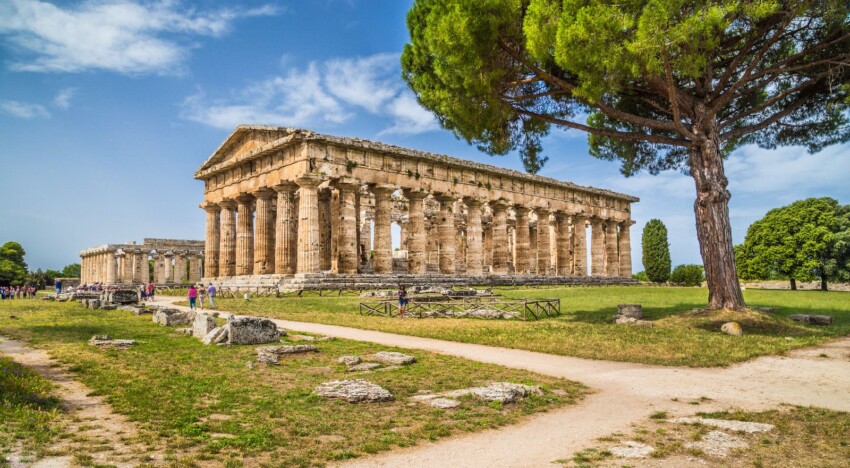
The temple presents itself as a blend of two different styles, archaic Doric and Ionic, and with a particularly tall pediment, a unique example in a Greek temple, and a Doric frieze composed of wide blocks of limestone. The internal plan is very simple and consists of an antechamber (the “pronaos”) decorated with eight columns with Ionic capitals and the cella (or naos) which is positioned on a raised level.
Dated to around the 5th century BC, the Temple of Neptune is one of the best-preserved temples from ancient Greece to survive to this day. The temple is attributed to Neptune, although according to some scholars it was actually dedicated to the god Apollo. After a base of three steps that includes a peristyle of Doric columns, we find the pronaos, or entrance, and then the cella which housed the cult statue.
Dating from 550 BC, the Temple of Hera is considered the oldest temple in Paestum, although some believe it was not a temple but a Roman basilica. Following the discovery of objects donated as votive offerings to Hera, wife of Zeus and goddess of fertility, it was decided to attribute the temple to the Greek goddess. From a stylistic point of view, the temple is a peripteros with nine columns on the front and eighteen on the sides, and has a cella divided into two aisles by a central row of columns.
The National Museum of Paestum was opened in 1952 with the aim of collecting and preserving archaeological artefacts from the Paestum excavations. A visit to the museum allows you to retrace the history of the city: from prehistoric times through the Greek period and then the Roman period.
The tour reconstructs how societies were organised in different eras, various aspects of religious, daily and political life, and finally presents objects of art and craftsmanship. A special section tells the story of the discovery of the archaeological site and the history of the excavations that have involved Paestum from the 20th century onwards.
One of the most valuable finds preserved in the museum are undoubtedly the slabs from the famous Tomb of the Diver, a rare example of painting dating from the era of Magna Graecia. The slabs that form part of a tomb feature various frescoes on the internal walls, whilst on the covering slab a man is depicted diving into water: a symbolic image representing the passage from life to death.
The Church of the Holy Annunciation is an Early Christian basilica dating from the 5th century AD that has undergone several restoration works over the years. After falling into disrepair, the church underwent major work in the 16th and 18th centuries when the high altar dedicated to the Annunciation, the chapel of Saint Michael the Archangel and the chapel of the Sorrowful Virgin were also created.
In the 20th century, work revealed the ancient columns, the original flooring, which is almost two metres lower, and in the central apse some fresco fragments dating from the 11th century.
The Roman amphitheatre at Paestum dates from 50 BC but is now only partially visible as part of it remains underground, having been covered by the construction of the SS 18 Tirrenia Inferiore state road, which runs through the entire Paestum archaeological park.
The amphitheatre is among the oldest examples of Roman theatres to survive to the present day and consists of a main structure made of limestone blocks and a secondary structure of bricks. All around is a gallery that was used to bring gladiators, animals or necessary equipment into the arena.
The focal point of civic life in ancient Roman times, the Forum of Paestum housed buildings important to the city’s political, social and religious life, such as the curia, the prison and the comitium. On one side of the square were shops whilst on the other were the macellum (market), the comitium where magistrates were elected, and the Temple of Peace.
The residential quarter of ancient Paestum contains several attached houses built closely together along the city’s streets. The more modest houses were made of mud, pebbles or wattle, whilst the more “luxurious” ones were made of fired bricks with tiled roofs.
Currently eight residential quarters of various sizes have been uncovered dating from both the Roman and Greek periods, where you can see small dwellings such as the “House with Marble Impluvium” and larger residences such as the “House with Swimming Pool”. Many of these dwellings are characterised by decorations, decorated floors and various ornate rooms.
If you plan to visit the Paestum and Velia Archaeological Park, purchase a skip-the-line ticket with priority entrance in advance: you’ll avoid queues at the ticket offices and guarantee your visit on your chosen date.
If you wish to learn more about Paestum’s history in depth, we recommend having an expert guide accompany you during your visit to the archaeological park. The guided tours we offer are in Italian and include priority entrance tickets.
Furthermore, Paestum is one of the attractions included in the Campania Artecard, the tourist pass dedicated to the region’s main monuments such as the Royal Palace of Caserta, the parks of Herculaneum and Pompeii, and attractions in the city of Naples such as the Royal Palace or the Capodimonte Museum and Royal Wood.
The town of Capaccio, of which Paestum is a district, offers a wide choice of accommodation to host all those who wish to visit the historical, artistic and cultural treasures in this area.
Those who wish to enjoy a holiday focused on sea and relaxation should choose to stay in a hotel or resort by the sea, whilst those who want accommodation close to the archaeological site can choose one of the facilities located right around the excavations, allowing you to reach the site on foot.
If, instead, you’re looking for more secluded and less touristy accommodation, you can choose a farm stay or B&B nestled among the hills surrounding the Paestum area.
Paestum is easily reached from Naples by both car and train. Those who decide to reach the town by car will need to take the A3 Salerno-Reggio Calabria motorway, until the Salerno Est/Tangenziale Salerno exit. Once you exit, you need to drive along the Salerno Ring Road for approximately 9 km and then take the Zona Industriale/Litoranea exit. Finally, you need to drive along the provincial road SP175 towards Paestum for approximately 30 km. Alternatively, you can take the A3 until the Battipaglia exit and then the SS 18 Tirrena State Road to Paestum.
From Naples, regional trains depart that allow you to reach Paestum station in approximately one hour and fifteen minutes. Alternatively, you can take a Frecciarossa train to Salerno and then take a regional train to Paestum from there. Paestum train station is located approximately 700 metres from the archaeological site.
Paestum is a district of the municipality of Capaccio in Salento, situated in the Sele Plain, north of the Cilento, Vallo di Diano and Alburni National Park. Paestum lies approximately 95 km from Naples, 40 km from Salerno and 22 km from Castellabate.

 Hotel
Hotel  Budget accommodations
  Apartments
  Family Hotel
  Luxury Hotel
 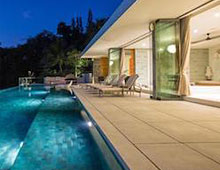 Resorts