Campania: Artecard 3-Day, 7-Day, or Gold/Lite 365 City Pass
804 reviews
Discover Campania and Naples with a pass to visit 40 cultural sites and use public transport (included only in the 3-day pass).
Buy now
From 27,00€ per person
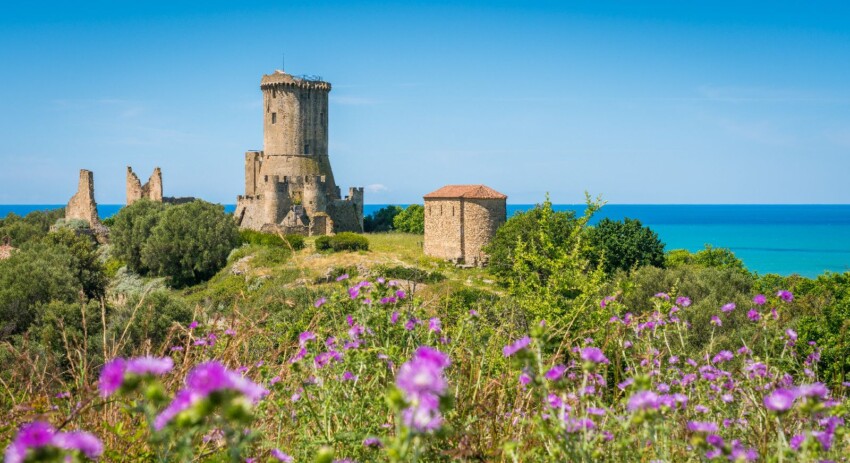
The Velia Archaeological Park, or Elea in its Greek name, is one of the most fascinating and least crowded archaeological sites in Southern Italy: a Magna Graecia city founded around 540 BC by Phocaean refugees, which would have remained historically obscure had it not given birth to two of the most influential philosophers of ancient Western thought, Parmenides and his pupil Zeno, founders of the Eleatic School, and had it not preserved within itself the Porta Rosa: Italy’s oldest rounded arch, a masterpiece of 4th-century BC construction engineering that still astounds anyone who stands before this structure, which has remained intact for over 2,300 years.
The park is part of the Archaeological Parks of Paestum and Velia system and a UNESCO World Heritage Site, a recognition awarded in 1998 to the entire Cilento National Park, Vallo di Diano and Alburni together with the sites of Paestum and the Certosa di Padula.
The visit route covers approximately 3 kilometres with an elevation gain of about 70 metres: you start from the lower city, where most of the buildings date from the Hellenistic and Roman periods, and climb towards the acropolis via the road leading to the Porta Rosa and the theatre, up to the Angevin Tower at the top.
Allow at least 1.5–2 hours for a self-guided visit; a guided tour takes around 2.5 hours. The route is of easy-to-moderate difficulty and winds through Mediterranean scrubland and olive groves, with views of the sea off Marina di Ascea.
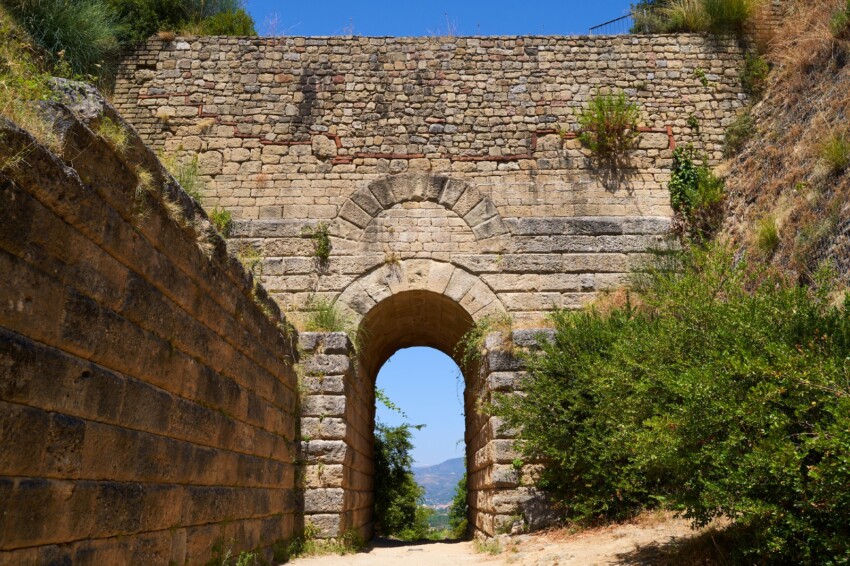
The Porta Rosa is Velia’s symbolic monument and the engineering masterpiece that makes this site unique in Mediterranean archaeology: it is Italy’s oldest known rounded arch, built in the second half of the 4th century BC, a time when stone arch technology was still in its infancy in the ancient world. It was discovered in the 1960s by archaeologist Mario Napoli, who named it Rosa in honour of his wife: an intimate detail that pleasantly contrasts with the grandeur of the structure.
Despite its name “gate”, the structure is not actually a gate in the traditional sense, as there is no trace of hinges or pivots, but rather a viaduct: a work of civil engineering that connected the two natural summits of the acropolis across a narrow vertical gorge in the limestone ridge, locally called vuccolo. The structure consists of two superimposed rounded arches, the upper one allowing the passage of the road and defensive walls, the lower one allowing water from the valley to flow through, built with eleven perfectly fitted blocks of sandstone. The measurements used are not those of Classical Greece but rather Oscan-Italic, in use throughout the Italian territory from Etruria to Lucania: valuable evidence of the level of integration achieved by the Phocaean colonists with local populations already in the 4th century BC.
Before the Porta Rosa, along the ancient paved road that visitors traverse today, you encounter the lesser-known Archaic Gate: an earlier structure with trapezoidal cross-section, which represented the original connection between the two quarters of the city before arch technology made the viaduct construction possible. The contrast between the two gates—the archaic with its slanted stones and the Rosa with the geometric perfection of its arch—is one of the most visually eloquent moments of the entire site.
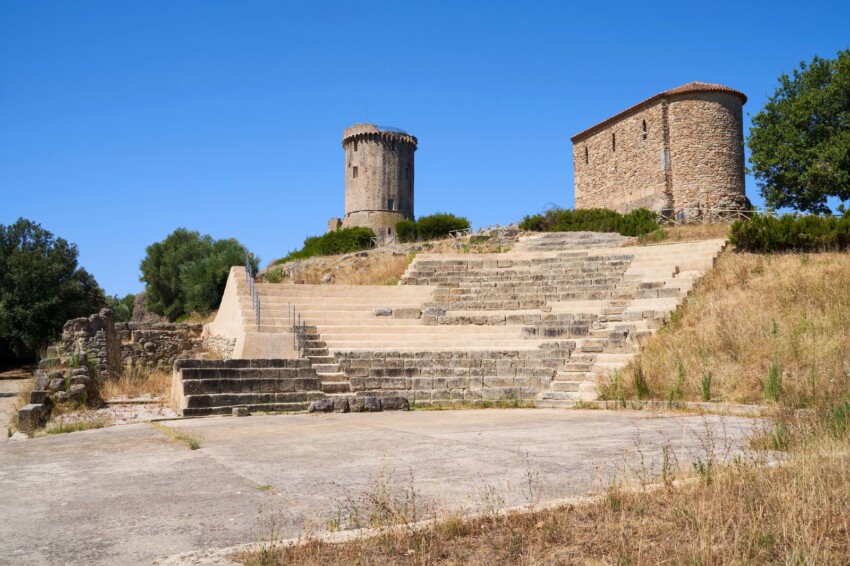
Along the path climbing towards the acropolis stands the Greek theatre of Elea, one of the park’s less well-known yet most evocative features. The original structure was built by Phocaean colonists exploiting a natural slope of the terrain: part of the cavea is carved directly into the rock, part built in earth.
In a later period, presumably during the medieval phase, the theatre’s stones were partially dismantled and reused for building the castle on the acropolis: a spoliation common in Mediterranean archaeological history, where ancient monuments became quarries for construction material.
The preserved semicircular structure is sufficient to understand the original building’s proportions and its function as a space for theatrical performances, public assemblies and civic ceremonies. The site’s acoustics and views of the surrounding landscape make it today a venue for summer cultural events organised by the Park.
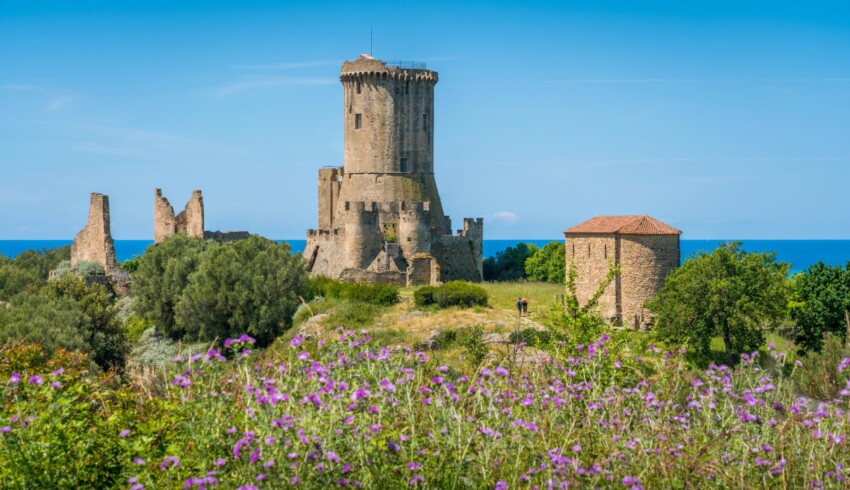
The summit of the route, the headland known in the medieval period as Castellammare della Bruca, corresponds to ancient Elea’s acropolis. Here lay the original settlement of Phocaean refugees before the city expanded onto the plain below, and here the most important temples were concentrated.
The acropolis is dominated by the Angevin Tower of the 11th–12th centuries: a medieval tower built over Greek ruins that stands out against the surrounding landscape and offers, for those able to access it when open, one of the most comprehensive panoramic views of the entire coastal Cilento. From the terrace beside the tower you can see the entire coast from Acciaroli to Palinuro, with the coastal plain where the lower city once stood and the Mediterranean scrubland covering the surrounding hills like a thick green blanket.
The presence of the medieval tower on the acropolis tells another story: when the lower city was progressively submerged by marshland and abandoned, the surviving population concentrated here above, building their medieval settlement on the remains of the Greek and Roman city. Castellammare della Bruca was the site’s last inhabited centre: its definitive depopulation, which occurred in the late medieval period, completed Elea-Velia’s transformation into a forgotten place, covered by vegetation and earth for over a millennium, until modern excavations.
On the acropolis summit, beneath the visible remains of the Angevin Tower and the subsequent medieval settlement, lie the ruins of the Temple of Athena: Elea’s principal place of worship, dedicated to the goddess protector of the Phocaeans. The structure of the oldest temple, an archaic sanctuary whose existence archaeologists had hypothesised since the 1920s, dates to 540–530 BC, the very years of the city’s foundation, and was partially restructured around 480–450 BC.
It was in this archaic sanctuary that in February 2022, during excavations directed by Francesco Scelza, two Corinthian-style helmets were brought to light, making headlines throughout the archaeological world. Director Osanna’s hypothesis is that these were reliquaries offered to Athena, votive objects deposited in the sanctuary as a gesture of gratitude to the goddess, and that their arrival at Elea was directly connected to the Battle of Alalia: the Phocaean warriors who survived the clash and founded this city brought with them the weapons of the fallen as testimony to their epic voyage.
The helmets, still under study, may contain inscriptions identifying their wearers. The discovery, Osanna commented, “clarifies many details of that story from more than 2,500 years ago”.
The lower city, the Southern Quarter, is the area where Hellenistic and Roman remains are concentrated: public and private buildings, shops, paved streets, cisterns for water collection. It is the site’s point of entry and the first section of the visit route, the one that allows you to understand the city’s general layout before climbing towards the Porta Rosa.
Among the most interesting structures are the remains of the Roman Baths, which document the continuation of urban life in the imperial age, and the Sanctuary of Asclepius, dedicated to the Greek god of medicine, which testifies to the city’s therapeutic vocation in antiquity. This is no coincidence: Elea-Velia was known in the Greco-Roman world as a health resort, so much so that Marcus Tullius Cicero stopped there on several occasions, appreciating its climate and sea air.
The sanctuary fits into this tradition: a place where the sick sought healing through ritual, incubation and medical practices connected to the cult of Asclepius.
The story of Elea begins with flight. Phocaea was a Greek polis on the coast of Asia Minor, present-day Turkey, which by the 6th century BC had become one of the most enterprising cities of the ancient Greek world: the Phocaeans built the fastest ships of the age, the pentèkontoroi, and had established colonies throughout the western Mediterranean, from Corsica to Spain. When Cyrus the Great’s Persians conquered Phocaea, the citizens chose en masse to abandon their homeland rather than live under foreign rule: an epic decision, recounted by Herodotus in his “Histories”, which first took them to Alalia in Corsica.
But Phocaean prosperity in Corsica generated commercial tensions with Etruscans and Carthaginians, who formed a coalition: the Naval Battle of Alalia (c. 540 BC) was, according to Herodotus, the first great naval battle in history. The Phocaeans resisted but at great cost: many damaged ships, many men lost. Forced to abandon Corsica, a group of refugees sailed south and reached the Cilento coast, purchasing land from the Oenotrians with the consent of neighbouring Poseidonia (Paestum).
The city was initially called Hyele, from the name of a freshwater spring that ran through it, then Elea in its Greek name, and finally Velia in the Roman age, as Strabo describes it in his “Geography”: “from which came the Pythagoreans Parmenides and Zeno”.
The city prospered rapidly: an active port centre on the southern Tyrrhenian Sea, it maintained its commercial traffic and developed intellectual life of exceptional quality. Parmenides (born c. 515 BC) founded the Eleatic School here, the most radical of the pre-Socratic philosophical schools, with his fundamental theory: Being is one, eternal, immobile and complete; non-Being cannot exist; movement and the plurality of things are illusions of the senses.
This position, expressed in the didactic poem “On Nature” (Perì Phýseos) in Homeric hexameters, influenced Plato, Aristotle and through them the entire Western philosophical tradition. His pupil Zeno of Elea (c. 490–430 BC) developed a series of logical paradoxes, the most famous being that of Achilles and the Tortoise, which demonstrates the logical impossibility of motion, so effective in argumentation that Aristotle called him the inventor of dialectic.
In 88 BC Elea was enrolled in the Romilia tribe and became a Roman municipium with the name Velia, obtaining from Rome two exceptional privileges: the right to maintain Greek as its official language and the right to mint its own coins. The city continued to prosper through the 1st century AD, with the construction of new public buildings and villas on the coast. Decline was slow and progressive: the silting up of ports, the advance of marshy terrain in the coastal plain, and finally the construction of the Via Popilia which cut it off from the main terrestrial trade routes.
The last inhabitants withdrew to the acropolis, where the medieval settlement of Castellammare della Bruca survived for a few more centuries before definitive depopulation. Elea-Velia disappeared under vegetation and marshland for over a thousand years, until the modern excavations of the 20th century restored its monuments.
Entry to Velia Archaeological Park alone costs €3.00 (concession €1.50). The combined ticket with the Paestum Museum and Archaeological Park costs €10.00 in the winter season (December–February) and €14.00 in the main season (March–November), and is valid for 3 days: a convenient solution that allows you to spread your visits to the two sites without rushing. The combined ticket includes one entry to the Velia area and one entry to the museum and Paestum area. On the first Sunday of the month entry is free for all state-run sites.
Tickets can be purchased directly at the park entrance ticket office or online via the Musei Italiani app. For guided tours, prices vary depending on the operator: a guide for groups of up to 30 people costs approximately €120.00 for around 2.5 hours of visiting.
The park is included in the Campania Artecard according to the specific conditions of the card you choose.
Velia Archaeological Park is open Wednesday to Monday, from 9:00 am until sunset. Tuesday is the day the park is closed.
The ticket office closes one hour before sunset. Exact opening hours vary seasonally to align with sunset times: in summer (July–August) the park stays open until around 8:00 pm, whilst in winter (December–January) it closes at 4:00–4:30 pm. Always check the updated opening hours on the official website parchipaestumvelia.cultura.gov.it before you visit, especially during seasonal transition periods.
For a self-guided visit, 1.5 to 2 hours at a moderate pace with photo stops is sufficient. Those wishing to examine every structure in detail or who move slowly may take up to 3 hours. The total route is approximately 3 km with 70 metres of elevation gain: the stretch from the ticket office to Porta Rosa is flat, whilst the climb to the acropolis requires some effort.
Comfortable walking shoes with a non-slip sole are essential; a hat and water are necessary in summer. The park is partially accessible for visitors with mobility difficulties in the lower areas, although the uphill stretches towards the acropolis are not wheelchair-accessible. The best time to visit is early morning or late afternoon: the midday summer heat is intense and the site is exposed to full sun. Spring (April–May) is the most pleasant season, with Mediterranean scrubland in bloom and ideal temperatures.
The site is located in the hamlet of Marina di Ascea, in the municipality of Ascea (SA), along the Cilento coast between Acciaroli and Palinuro. By train, the nearest stations are Pisciotta–Palinuro or Ascea on the Naples–Reggio Calabria line (Trenitalia): from both stations the park is accessible by bus or taxi.
By car, from the A3 Salerno–Reggio Calabria motorway, exit at Battipaglia or Eboli and follow the SS18 south along the coast, or exit at Buonabitacolo and head towards the sea through the Cilento interior. Parking near the park is available and free of charge. From Salerno, the drive takes approximately 1 hour and 15 minutes. From Paestum, Velia is roughly 40 kilometres away.
 Hotel
Hotel  Budget accommodations
  Apartments
  Family Hotel
  Luxury Hotel
  Resorts