Bestseller
Herculaneum: Skip-the-Line Guided Tour with Archaeologist
From 36,30 €
Buy the ticket
Struck by the earthquake of 62 AD and buried by the eruption of Mount Vesuvius in 79 AD, together with Pompeii and Stabiae, Herculaneum is a town in the province of Naples that is home to an archaeological park, declared a UNESCO World Heritage Site. The origin of the name Herculaneum traces back to an ancient legend that sees the city founded by Hercules in 1243 BC and, after being dominated by the Greeks, subsequently came under the control of the Samnites and then the Romans.
Under Roman rule, the city became a wealthy residential centre that took the name of Resina, a name it retained until 1969 when it was once again called Herculaneum. The excavations of Herculaneum are less well-known than those of Pompeii, but are equally a jewel within our historical and archaeological heritage.
In 79 AD, following the violent eruption of Mount Vesuvius, the areas surrounding the volcano were covered with mud, lava and pumice that destroyed much of the cities. It appears that many inhabitants managed to escape, however, according to recent studies the majority of those who could not escape were mainly the poor and enslaved people.
At the same time, the layer of lava that covered the city ensured that the remains of Herculaneum were preserved in perfect condition over the years, and even organic materials, such as wooden furniture, papyri and textiles, were discovered intact.
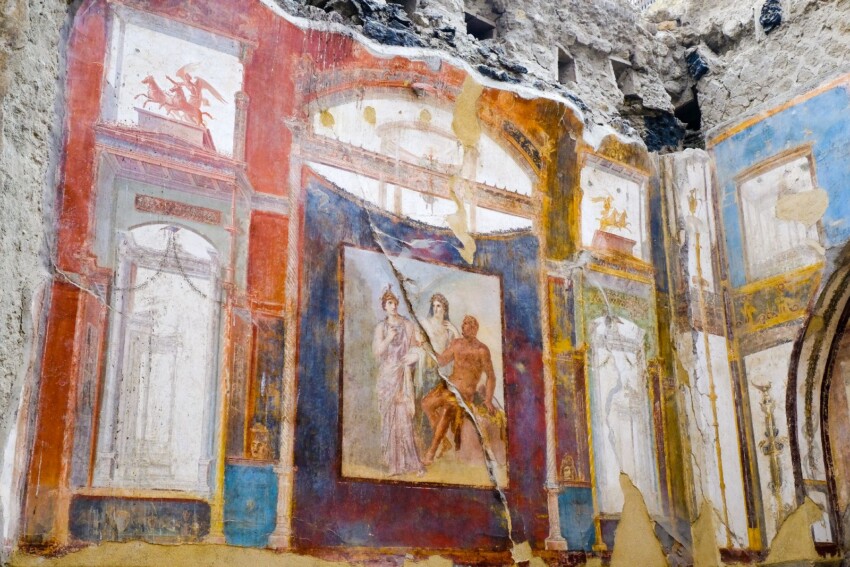
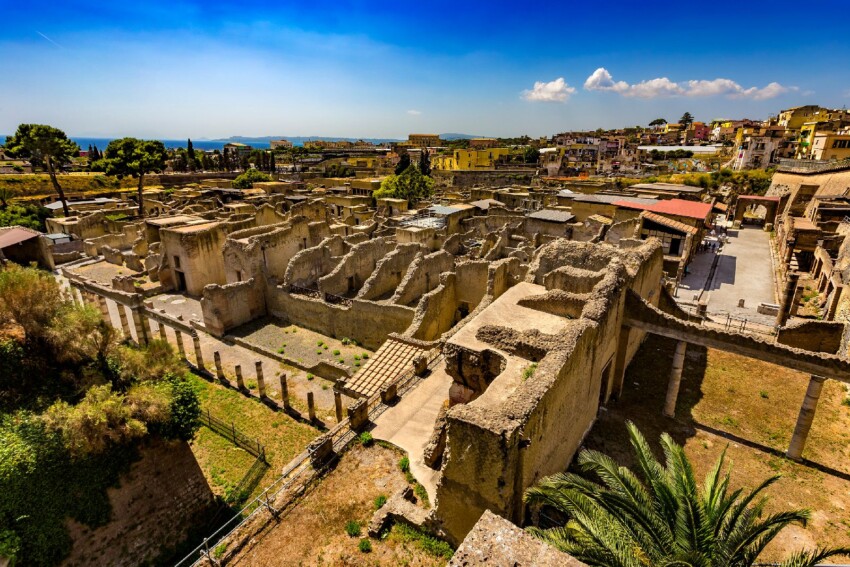
The archaeological site of Herculaneum is smaller than that of Pompeii but the archaeological remains here are in excellent condition. Much of the visitable archaeological area consists of private dwellings, public buildings, temples and sumptuous thermal baths.
Many of the artefacts recovered are housed in the National Archaeological Museum in Naples, while in 2008 the Virtual Archaeological Museum (MAV) was opened, which reconstructs Herculaneum before and during the eruption of Mount Vesuvius.
Villa of the Papyri belonged to the ancient Piso family and owes its name to approximately one thousand papyri found in the library. The villa was built in an exclusive position perched high above the sea, where it was possible to admire wonderful views of the Gulf of Naples.
Considered one of the grandest villas of antiquity, it has only been partially brought to light after extensive restoration work. This villa had finely frescoed rooms, mosaics that are unique in the world, and it was here that 58 bronze statues and 29 marble ones were discovered.
The Basilica Noniana appears to date to the Augustan period and remains almost completely buried. The structure has a rectangular floor plan with an apse at the far end, and inside it were found statues, columns and several frescoes in the fourth style, such as those depicting the labours of Hercules.
The Central Baths date from the second half of the 1st century BC and are divided into two sections: one for men and one for women. As was customary in the baths of the time, each section featured three thermal areas: the frigidarium (cold water), the caldarium (hot water) and the tepidarium, which contains a magnificent mosaic with black and white tesserae depicting a triton among dolphins. Several skeletons of people who died as a result of the volcanic eruption were found here, still wearing gold jewellery and accessories.
Among the various things to see at the Herculaneum excavations, the ancient Roman domus are worthy of mention, standing out as they are elegant buildings that have managed to retain part of their original appearance.
The House of the Stags, so named because of the presence of two statues of stags attacked by dogs, is the most elegant residence of ancient Herculaneum, with a terrace offering stunning sea views. The cryptoporticus in particular has a mosaic floor with black and white tesserae and had frescoes on the walls that are now preserved in the Archaeological Museum in Naples.
The House of Neptune and Amphitrite was owned by a wealthy merchant who had decorated it with glass paste mosaics, a truly expensive product for the time. The name of the domus comes from the mosaic that decorates the eastern wall of the house, depicting the sea god Neptune with his companion Amphitrite.
The fornici are port warehouses that were also used as shelters for boats found on the beach. Here in 1980, approximately 300 human skeletons were recovered from people who died whilst trying to leave the city following the eruption. Most of those who died in this place were inhabitants who wanted to escape by sea, taking with them precious goods, jewellery and valuables. In addition to the bodies, a Roman boat nine metres long was discovered, along with the skeletons of a rower and a soldier, with swords, chisels and various coins.
The cost of a full ticket is €13.00, whilst young citizens of the European community aged between 18 and 25 (not yet reached) can take advantage of a reduced ticket costing €2.00. Children and young people under 18 years of age enter free.
For an unforgettable visit, book online a guided tour with expert and qualified staff who will introduce you to everything about the history of the Herculaneum Excavations.
Additionally, Herculaneum is one of the attractions included in the Campania Artecard, the tourist pass dedicated to the region’s major monuments such as the Royal Palace of Caserta, the parks of Paestum and Pompeii, and attractions in the city of Naples such as the Royal Palace or the National Archaeological Museum.
The Herculaneum excavations are open at the following times:
The weekly closure day is Wednesday. The archaeological site is closed on 1 January and 25 December, whilst it remains open on 1 May and 8 December.
Herculaneum is a town well connected to other locations in Campania and can be reached in several ways. The city has two railway stations: Herculaneum-Excavations station, located 700 metres from the archaeological excavations, and Herculaneum-Golden Mile station, which allows you to visit the 18th-century villas on the slopes of Vesuvius. By train, therefore, departing from Naples Central station, you can take either the Circumvesuviana line Naples-Sorrento or the Naples-Poggiomarino line, as both lines stop first at Herculaneum Excavations and then at Herculaneum Golden Mile.
Herculaneum can also be reached via the Trenitalia railway line Naples-Salerno and getting off at Portici-Herculaneum FS station. The station is about 1.6 km from the excavations, so once there you will need to take one of the special buses that lead to the Archaeological Park. Herculaneum is also easily reached from Pompeii thanks to a train journey of about twenty minutes that runs from Pompeii Excavations station to Herculaneum Excavations station.
Alternatively, from Naples, EAV buses on the “Naples-Torre Annunziata-Sorrento” line depart, which with a journey of about twenty minutes will take you to the “Herculaneum Excavations” stop. Finally, those reaching the town by car will need to take the A3 motorway Naples-Salerno, exit at the Herculaneum toll booth and then follow the road signs for the archaeological excavations.
In the mid-18th century, with the arrival of the royal family in the Portici area, other members of the aristocracy decided to build sumptuous summer residences along the Royal Road of Calabria and in the surrounding countryside, between Villa de Bisogno in Resina and Palazzo Vallelonga in Torre del Greco. The quantity and quality of the buildings constructed in this area was truly of a high level, so much so that that stretch of road was named the Golden Mile.
Even today, this route is rich in wonderful 18th-century villas built in late Baroque or neoclassical style with parks, manicured gardens and sea views. Some of these are now hotel facilities, whilst others are still open to visitors, such as Villa Campolieto, designed by the architect Luigi Vanvitelli (the same person who designed the Royal Palace of Caserta) and Villa Ravone, also known as Villa Maturi, a building of immeasurable historical value where archaeologist Amedeo Maiuri also lived for many years.
The most famous palace of all, however, is the Royal Palace of Portici, a genuine royal palace that the Bourbons used as a summer residence. The complex, designed by Vanvitelli and Ferdinando Fuga, was equipped with a hunting reserve in the upper wood and an ornamental wood. Inside it is still possible to admire a Museum where artefacts from the excavations of Herculaneum are displayed, which the Bourbons had collected in their personal collection.
Herculaneum is a town that offers various accommodation options tailored to all budgets and suited to different needs. However, the town is just 11 km from Naples, so many travellers prefer to stay in the city of Naples, which has always offered a wide choice of accommodation at often very competitive prices.
The first remains of the town were discovered by chance by a peasant who, around 1709, had begun work in this area on the construction of a well. Emanuele Maurizio d’Elbeuf was building his palace near the Portici coast at that time and, upon hearing the news, decided to purchase the land and begin excavations that reached the ancient Theatre of Herculaneum. In this area, columns, statues and marble were found, which the Prince kept in his personal collection or sent as gifts to relatives, friends and other European royals.
In 1740, the success of these discoveries prompted King Charles III of Bourbon to build, within the boundaries of the Portici hamlet, a royal palace near the Resina excavations. This historic residence, built in an extensive park equipped with an English garden and an amphitheatre, was given the title of Royal Villa of Portici. During the construction of the Royal Palace of Portici, Spanish archaeologist Roque Joaquín de Alcubierre became aware of the discoveries made in this area and resumed excavating. The excavations brought to light statues, pieces of marble, fragments of inscriptions and cornices.
From the mid-18th century onwards, all artefacts discovered were transferred as a personal collection to the Royal Palace of Portici, where the king displayed these finds only to his illustrious guests. In 1760, the Villa of the Papyri was discovered by chance, which contained not only statues but also thousands of carbonised papyri, though still legible. However, with the discovery of Pompeii, which presented simpler excavation methods, interest in Herculaneum gradually declined, coming to a halt in 1780.
Unfortunately in the 19th century the excavations underwent several resumptions and interruptions until 1924, when archaeologist Amedeo Maiuri began a programme of land expropriation with the aim of protecting the ruins of Herculaneum from the intense building expansion of those years. Furthermore, in 1927, a new excavation campaign began, which ended in 1942, bringing to light approximately four hectares of the ancient city. In the 20th century, work proceeded with the securing and restoration of the recovered architectural heritage, and under the direction of Giuseppe Maggi, almost three hundred human skeletons were discovered.
City Card allow you to save on public transport and / or on the entrances to the main tourist attractions.

 Hotel
Hotel  Budget accommodations
  Apartments
  Family Hotel
  Luxury Hotel
  Resorts