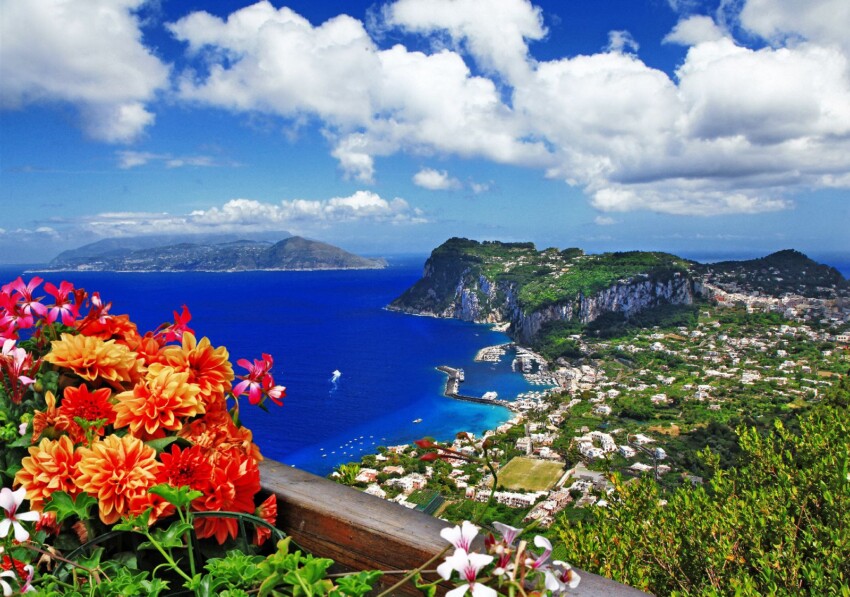
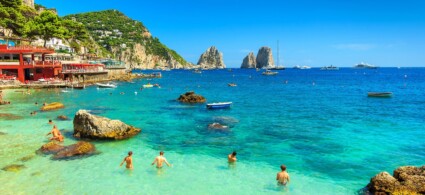
Capri is an island in the Gulf of Naples that, thanks to its exclusive atmosphere, its breathtaking landscapes and its crystal-clear waters, is synonymous with refined and elite holidaymaking.
Refined, exclusive and synonymous with elite holidays, Capri is an island in the Gulf of Naples that enjoys international fame thanks to its exclusive atmosphere and breathtaking landscapes. Since ancient Roman times, the island has been regarded by emperors and nobles as a place of great allure, and over the years it has captivated many famous personalities and become the set for numerous cinematic masterpieces. The island is now synonymous with a holiday characterised by elegance, glamour, beautiful beaches and crystal-clear waters.
The island of Capri is a truly enchanting destination that has become world-famous for its splendour and comprises two municipalities: Capri and Anacapri. Capri is the most famous and most visited town on the island, where you’ll find the beaches, the renowned Piazzetta, luxury boutiques, the port and the main venues for nightlife. Anacapri, on the other hand, is a quieter town where an authentic atmosphere still prevails and life follows the unhurried rhythms of yesteryear, with fewer luxury boutiques and more traditional artisan shops.
The island of Capri, strategically positioned, is easily accessible from Naples, Sorrento and the Amalfi Coast, making it an ideal destination for a stay centred on history, nature and relaxation. Its location makes it perfect for either a day trip from nearby cities or as the sole focus of your holiday.
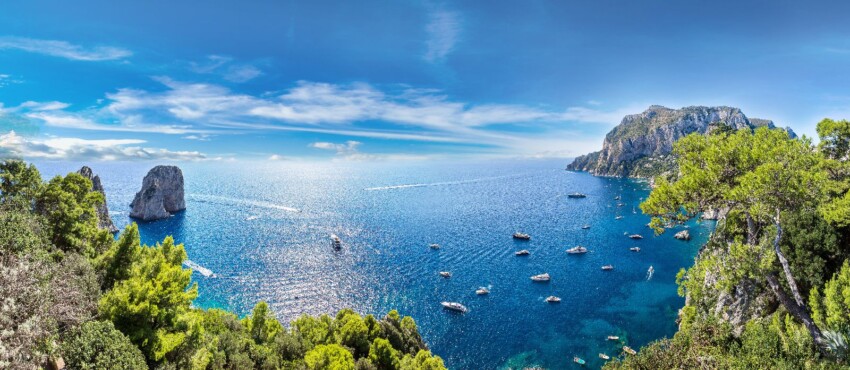
Traces of its ancient past and the civilisations that inhabited it remain evident, coexisting with a natural landscape that is unique in the world and crystalline, turquoise waters. These characteristics, combined with a truly exclusive setting, have made the island the ideal destination for an unforgettable holiday. From the Faraglioni to the celebrated Piazzetta, from Augustus’s Villa to Monte Solaro, every corner of Capri is magical and captivates all who visit.
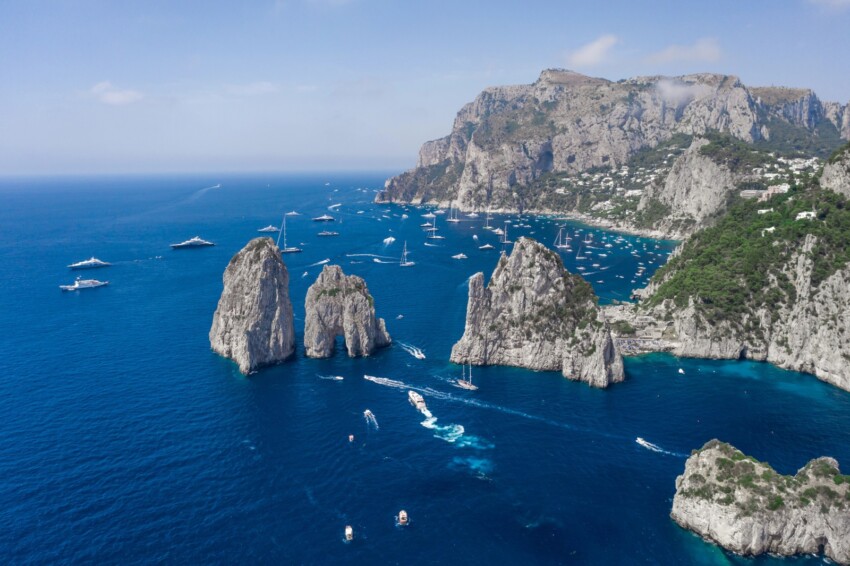
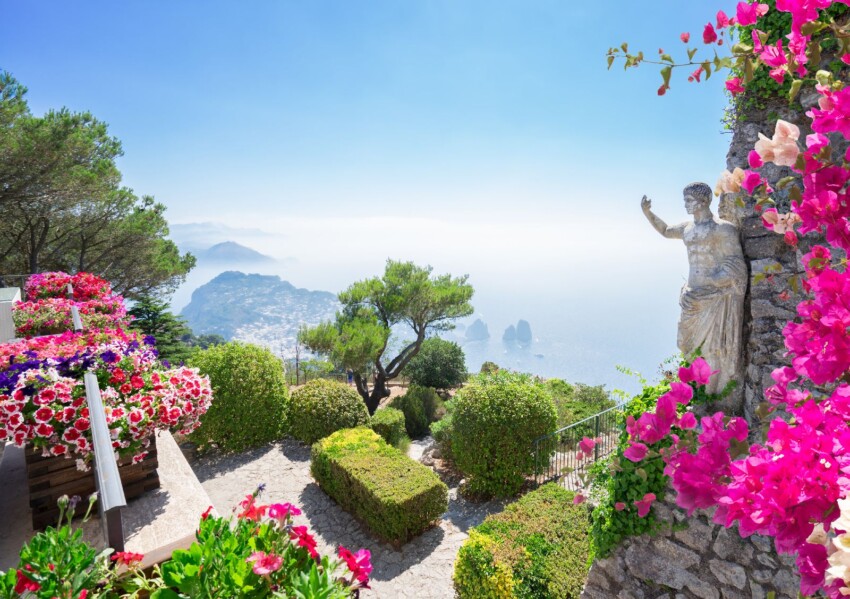
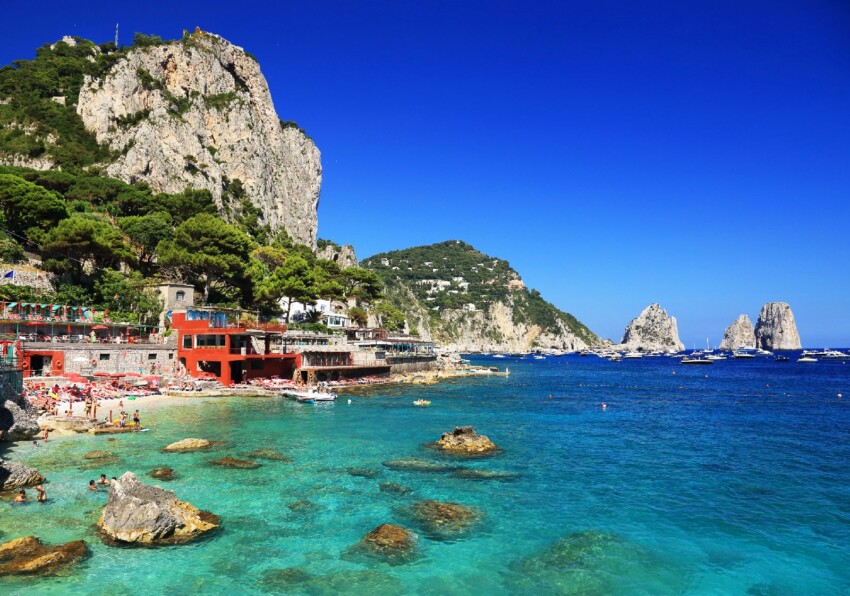
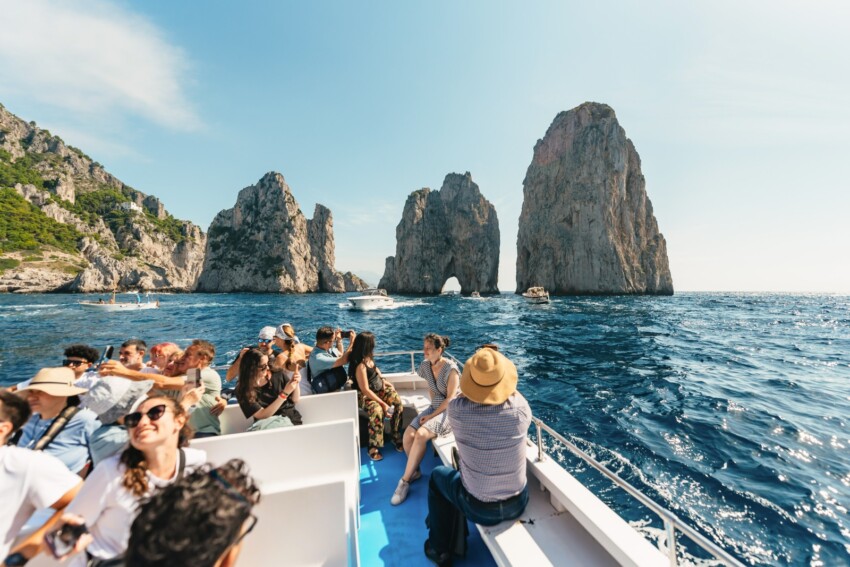
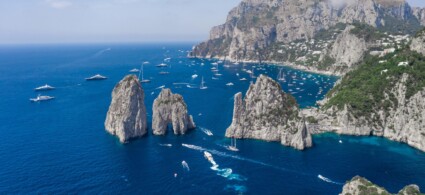
The Faraglioni are one of Capri’s most iconic symbols and landmarks of the entire Gulf of Naples: three towering rock formations approximately 100 metres high that rise from the azure waters and can only be reached by boat. Each Faraglione has its own name—the first is the Faraglione di Terra (or Stella), the highest at 109 metres, the second is the Faraglione di Mezzo (or Saetta), and the third is the Faraglione di Fuori (or Scopolo), meaning sea cliff.
Behind these formations lies the Monacone rock, a fourth Faraglione named after the Monk (or Monk Seal), a species of seal that inhabited this area until the early 20th century. Boats typically pass beneath the Faraglione di Mezzo, where couples traditionally kiss, as legend has it this brings good fortune.
For those wishing to swim in this area, there are two beach clubs, La Fontelina and da Luigi, directly facing the Faraglioni. Scopolo, the outermost Faraglione, is particularly renowned as home to the world’s only specimens of the Capri Blue Lizard, a distinctive reptile characterised by its vibrant blue colouration that mirrors the sea, providing perfect camouflage in this unique environment.
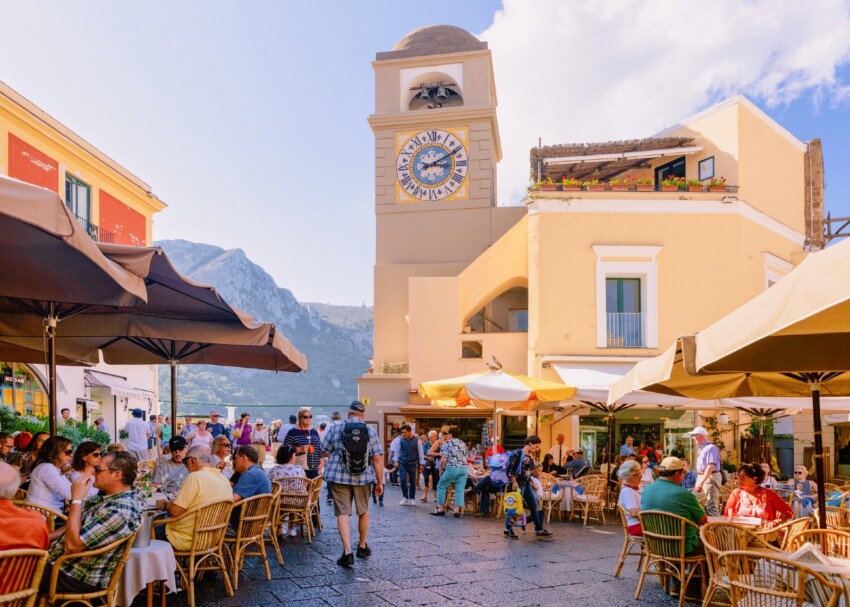
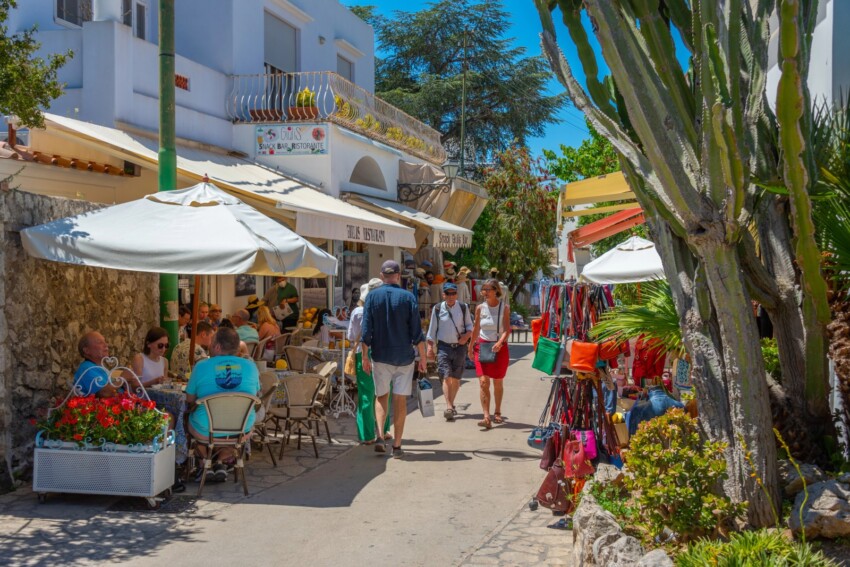
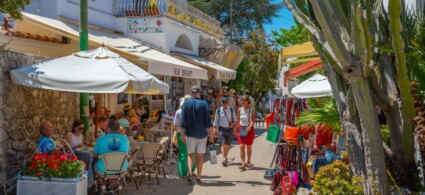
Piazza Umberto I, now known worldwide as the ”Piazzetta” due to its small size, is the heart of Capri’s social scene. If you visit Capri, you simply must experience this part of the island, which thrives with outdoor cafés, bars and restaurants that buzz with activity both day and night.
The symbol of Capri’s la dolce vita, sitting at one of the square’s bars for a coffee is an admittedly expensive but undoubtedly unforgettable experience, where you’re quite likely to spot celebrities and internationally renowned figures. From the Piazzetta, Capri’s main streets branch off, including Via Camerelle, famous for its boutiques and shops selling the world’s most prestigious international brands.
The Blue Grotto
3Blue Grotto, 80071 Anacapri, Metropolitan City of Naples, Italy
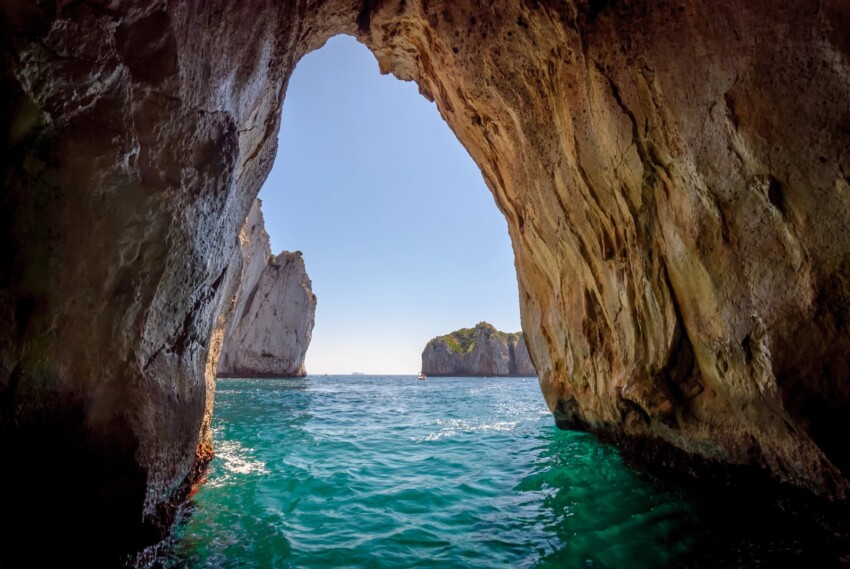
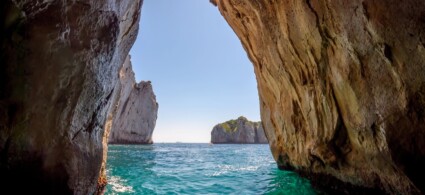
One attraction you absolutely cannot miss on a visit to Capri is the Blue Grotto: measuring 25 metres wide and 60 metres long, the cave was known to the ancient Romans and was greatly beloved by Emperor Tiberius. Entry to the grotto is ticketed, and you must board a small rowing boat that glides through the narrow entrance arch.
Visitors are permitted just five minutes inside the grotto, and swimming from the boat is not allowed. The grotto entrance can also be reached on foot or by shuttle bus from Anacapri, where you’ll find various boatmen ready to ferry you inside.
The best time to visit is between noon and 2pm, when sunlight penetrates through a second opening, making the water’s reflections appear even more luminous. The Blue Grotto is closed from November to March and during summer if the weather is poor, the sea is rough, or there’s strong Libeccio wind.
Emperor Tiberius fell in love with Capri and commissioned twelve villas here; today we can still admire the remains of Villa Jovis, dedicated to the god Jupiter. Dating to the 1st century BC, the villa sprawled across some 7 square kilometres on a promontory on Capri’s eastern side. The surviving ruins include impressive water cisterns for collecting rainwater for both drinking and use in the thermal baths, the emperor’s private chambers including the throne room, and quarters for servants and slaves.
The views from this villa are breathtaking: to the north, you can see the Gulf of Naples from Ischia to Punta Campanella, whilst the southern side overlooks the island’s centre. Unfortunately, when the villa’s first artefacts were discovered, they weren’t properly preserved, so many pieces were lost whilst others now reside in Naples’s Archaeological Museum.
Monte Solaro
5Monte Solaro, 80071 Anacapri, Metropolitan City of Naples, Italy
Monte Solaro, at 589 metres, is the island’s highest and most panoramic point: climbing to the summit rewards you with views not only of central Capri but also the Sorrento and Amalfi Peninsulas.
There are two ways to reach the summit: on foot or by chairlift. Walking from Anacapri along a marked trail takes approximately one hour, whilst the chairlift, also departing from Anacapri, whisks you to the top in about ten minutes.
Those opting to walk down can visit the charming hamlet of Cetrella, a quieter corner of Capri that’s home to the beautiful Hermitage of Santa Maria di Cetrella, dating from the 16th century. Inside this two-nave church are ancient monks’ cells and an image of the Madonna particularly venerated by local seafarers.
The Natural Arch is a rock formation dating to the Palaeolithic era that has gradually assumed an arch-like shape, attracting countless visitors curious about both its striking form and the spectacular views it commands.
Located on the island’s easternmost point, this 12-metre-wide, nearly 20-metre-high formation can be reached on foot from Capri’s Piazzetta or from Punta Tragara. From the Tragara viewpoint, you can follow the Pizzolungo path that traces the coastline to the Natural Arch, offering magnificent views of the Faraglioni.
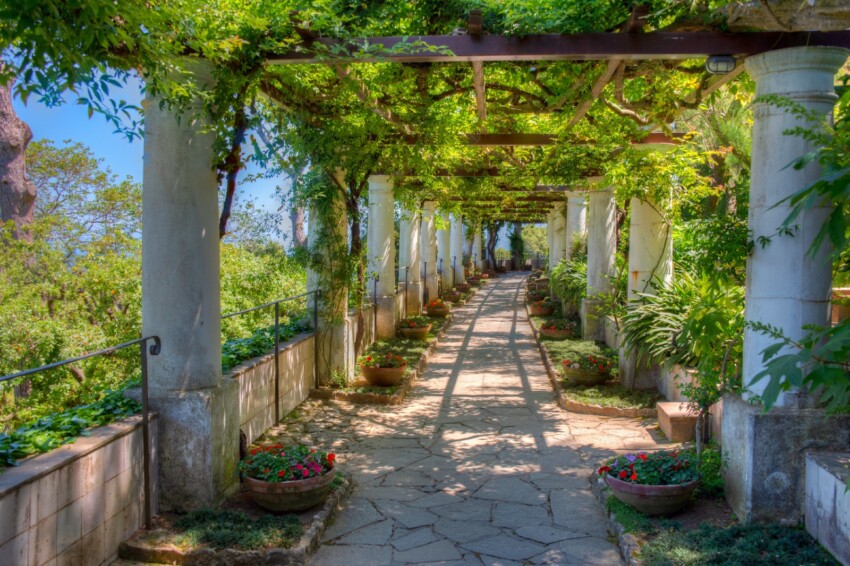
One of Capri’s essential walks begins at the Piazzetta and leads to the Augustus Gardens, which showcase thousands of plant and flower species found on the island. The gardens were once part of an estate purchased by industrialist Friedrich Alfred Krupp, owner of the famous German steel works, who sought to establish a summer residence here.
After the First World War, the gardens were renamed the “Augustus Gardens“, offering splendid views across the island and overlooking Via Krupp, the famous road carved into the cliff face by Alfred Krupp to connect central Capri with his moored boat at Marina Piccola Bay. Due to constant rockfall hazards, Via Krupp remains largely closed and can only be admired from the Gardens.
Villa San Michele was the private residence of Swedish psychiatrist Axel Munthe, who built the villa in 1885 at a remarkably panoramic spot on the island, 327 metres above sea level. The site once housed an ancient Roman imperial villa and a medieval chapel dedicated to St Michael.
The villa deserves a visit not only for its incredible position offering breathtaking views, but also for its interiors which house Roman antiquities including the head of Medusa originally positioned at Venus’s temple in Rome and a marble bust of Emperor Tiberius. During summer, Villa San Michele hosts the musical event Sunset Concerts.
One of Capri’s two municipalities is Anacapri, a locality nestling at the foot of Monte Solaro that attracts fewer tourists. Its name derives from Greek: ànà (above) and Capri, as the town sits at a higher elevation than the town of Capri itself. Anacapri is also home to one of Naples’s most emblematic Baroque churches: the Church of St Michael the Archangel.
Another must-see attraction in this area is the Casa Rossa, a distinctive red-painted house built between 1876 and 1898 by American colonel J.C. MacKowen. Today, the building houses a permanent exhibition of paintings created between the 19th and 20th centuries depicting the island of Capri and its landscapes.
The 17th-century Church of Santo Stefano is a magnificent building thanks to its elegant Baroque lines, magnificent marble floors and a statue of San Costanzo, Capri’s patron saint.
It’s also worth observing the pair of aristocrats reclining gracefully in the chapel south of the main altar, not unlike the “idlers” lingering in the cafés opposite the church. Within the northern chapel is a reliquary housing the saint’s bone which, according to local tradition, saved Capri from the plague in the 19th century.
The Certosa of San Giacomo is a 14th-century monastery that exemplifies the most distinctive Caprese style. Built between 1363 and 1371 by Giacomo Arucci, a local aristocrat and secretary to the Angevin queen of Naples, Giovanna I, it became the stronghold of the powerful Caprese Carthusian brotherhood but was closed in the 19th century by the Napoleonic army that occupied the island.
Today it houses a school, library and museum containing 17th-century paintings and major works by Karl Diagenbach, the German Symbolist painter who arrived in Capri in 1900 and died there in 1930. Inside are two cloisters—the smaller dating to the 14th century and the larger to the 16th century—and the church preserves some 17th-century frescoes. Upper-floor rooms host temporary exhibitions.
This white-washed place of worship is Capri’s oldest church: dating to the 5th century, it’s dedicated to the island’s patron saint, who settled here after surviving a hurricane whilst travelling from Constantinople to Rome.
The Church of San Costanzo was built on a site formerly occupied by Roman ruins, but the current Byzantine structure is the result of alterations carried out in the 10th century.
The Ignazio Cerio Centre Museum is housed within the 14th-century Cerio Palace, overlooking Capri’s Piazzetta. A visit to the museum takes you on a journey through the island’s past.
The display cases preserve remains of bears, panthers and hyenas dating back approximately 250,000 years, discovered during excavations for the expansion of the renowned Hotel Quisisana (1905). Also on display are numerous remains from Roman villas built on the island by emperors Augustus and Tiberius, as well as prehistoric human artefacts.
But the museum’s true star is the Capri Blue Lizard from the Faraglioni—this is the only place where you can observe it up close. The museum’s terrace also affords a breathtaking vista of the Gulf of Naples and a bird’s-eye view of Capri’s Piazzetta.
How to reach the Ignazio Cerio Museum: the ancient complex housing the museum overlooks Capri’s Piazzetta; the entrance is situated opposite the Church of Santo Stefano, at Piazzetta Ignazio Cerio, 5.
Capri’s beaches
Marina Piccola, Capri
Capri is not famous for sandy beaches but for its pebble beaches and small rocky coves surrounded by wonderfully clear waters. The island has both public and equipped beaches.
The island’s largest beach is at Marina Grande14, where you’ll find the island’s port, whilst two other beaches, Marina di Mulo and Marina di Pennauro, are located in the bay of Marina Piccola15. Legend has it that the rock separating these two beaches is where the Sirens from Homer’s Odyssey once lived.
Map
In the following map you can see the location of the main places of interest mentioned in this article.
Things to do on Capri
Island tour by boat
One of the best ways to experience the island is with a boat tour. At Marina Grande, several companies offer this service. Most tours include a stop at the Blue Grotto and visit famous spots such as Villa Jovis and the Faraglioni.
Shopping on Capri is expensive and sophisticated: big fashion names, superb jewellery shops, and local ceramics and bottles of limoncello. Along Via Camerelle you’ll find the highest concentration of luxury boutiques imaginable. Within just 100 metres, in the area between the Quisisana hotel and Via Tragara, you’ll see window displays from all the world’s biggest fashion brands.
Perfect for those who can treat themselves, or simply for window shopping.
Swimming in a secluded cove
Capri is a rocky island, so there are rocky coves and platforms for diving. Marina Grande opens onto the island’s largest beach, a pebbly bay: despite its proximity to the commercial port, the water is always clean.
On the opposite side of the island, at Marina Piccola, you’ll find two public beaches and various equipped establishments with small pebble beaches offering beautiful views of the Faraglioni.
Watch the sunset at the Lighthouse
The Lighthouse, Italy’s largest after Genoa’s, is also the best spot to watch the sun disappear into the sea on Capri.
Located at Punta Carena, it’s about an hour’s walk from the centre of Anacapri. It’s the perfect place for those who love silence and unspoilt nature.
Hiking along the Fortini Trail
This is one of the most spectacular walks on Capri: it hugs the coastline from the Blue Grotto to the Punta Carena Lighthouse, passing between rocks, headlands and turquoise bays.
Along the route you’ll find three fortifications that once defended Capri: Orrico, Pino and Mesola. Built by the English in 1806 and enlarged by the French after they took Capri in 1808, these ancient military positions are connected by a marked path with informative plaques.
The hike takes about 3 hours, so it’s wise to bring plenty of water and avoid the hottest hours of the day.
Walk the Phoenician Staircase
There are 921 steps connecting Marina Grande port with Anacapri: this was once the only way to reach the island’s higher settlement and was used to transport water, goods, building materials, mail and the trunks of early travellers arriving on Capri.
The long staircase carved into the rock is named the Phoenician Staircase because it was thought to have been built by the Phoenicians. In reality, this impressive staircase was built by the Greeks around the 7th and 6th centuries BC. The first road connecting Capri to Anacapri was built in 1874.
Nightlife on Capri
In summer, nightlife on Capri is very lively, though there are no large nightclubs or venues. After a drink at the famous Piazzetta, things move to the taverns in the town’s streets, where locals usually play live music every evening.
The action centres mainly between the Piazzetta and the Quisisana, home to the symbol of Capri’s nightlife, Taverna Anema e Core, where long queues form every night. Until dawn, tourists and locals dance to Neapolitan music.
Other nightspots on Capri include Donna Rachele, La Capannina Wine Bar, Number One owned by Peppino di Capri, Number Two, the island’s oldest nightclub, Qubè Cafè and The Queen Pub&Disco.
In Anacapri, Lanterna Verde, Maliblù and the Pianobar Capri Palace&Spa are the popular spots.
Where to stay on Capri
Capri is certainly not an economical island, but finding somewhere to stay at reasonable prices doesn’t have to be difficult. The island is divided into four areas: Capri, Anacapri, Marina Grande and Marina Piccola.
Accommodation in Capri, especially in panoramic locations or closer to the island’s trendiest areas like the Piazzetta and Via Camerelle, requires a fairly substantial budget, particularly during peak season.
Marina Grande, located on the northern side of the island, is home to one of Capri’s main beaches and where the island’s port is situated. Marina Grande is therefore chosen by those wanting to take boat trips to explore the island’s caves and coastline, or by those seeking a relaxing beach holiday.
Marina Piccola sits on the southern side of Capri and has the advantage of hosting one of the island’s quietest beaches, surrounded by turquoise-green waters with clear seabeds. Finally, the Anacapri area can be an excellent choice for those seeking a more peaceful stay, away from the busier tourist areas and nightlife, with more affordable accommodation options.
We offer best rates If you find it cheaper we refund the price difference.
Free cancellation Most properties allow cancellation without penalty.
We're available 24 hours a day For any problem call Booking.com.
Capri has no airport, so you can only reach Capri by sea by boat, with a private yacht, a fast hydrofoil or a ferry. Departures to the island are organised from the main cities:Naples, Sorrento, Salerno, Amalfi and Positano, as well as from the islands such as Ischia and Procida.
We invite you to visit the Ferries to Capri page to discover all routes from Campania’s cities to Capri.
Capri Weather
What's the weather at Capri? Below are the temperatures and the weather forecast at Capri for the next few days.
Saturday 3
18°
28°
Sunday 4
23°
25°
Monday 5
23°
25°
Tuesday 6
23°
25°
Wednesday 7
23°
24°
Thursday 8
21°
23°
Where is located Capri
The island of Capri lies in the Bay of Naples, directly opposite the Sorrento Peninsula.
 Hotel
Hotel  Budget accommodations
  Apartments
  Family Hotel
  Luxury Hotel
  Resorts