Hotel San Michele
Anacapri - Via Giuseppe Orlandi 1/3
Book now
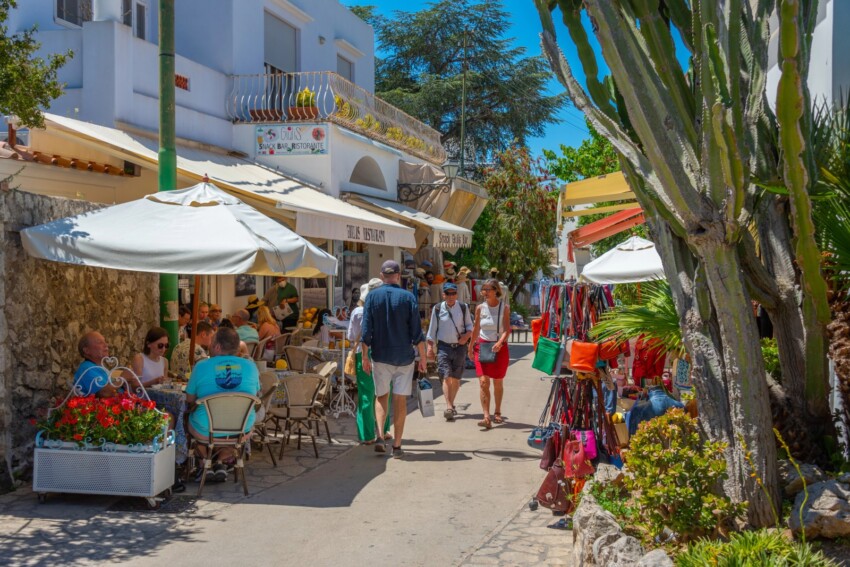
If you only know Capri through the Piazzetta, the Faraglioni and luxury shopping windows, you know only half the island.
The other half is called Anacapri, reached by a bus climbing a dizzyingly winding road, and it offers an entirely different experience: narrow, cobbled traffic-free streets, piazzas where children play without being photographed, artisans’ workshops producing hand-stitched sandals and hand-painted ceramics, and a peace that contrasts almost strikingly with the bustle of the port below.
The name itself contains a geographical clue: ana in Greek means “above” or “on high”, and Anacapri is indeed the village that sits above, separated from the island’s other municipality by a rocky barrier that for centuries could only be crossed by climbing the Scala Fenicia, 777 steps carved into the rock by Greek hands, most likely two thousand years ago.
Anacapri is not the Capri of celebrities, yachts and Michelin-starred restaurants in the most ostentatious sense. It’s the Capri of Swedish physician Axel Munthe, who chose this tranquility to build his villa-museum overlooking the gulf, and of the sunset at Punta Carena lighthouse, the only point on the island where the sun doesn’t set before five o’clock.
It’s a place that deserves at least a full day, and one that many island visitors ignore entirely, convinced that Capri is exhausted by what you see stepping out of the funicular at the Piazzetta.
Anacapri is compact and walkable in its central core, but its territory extends to the southernmost tip of the island with trails, views and sites of considerable interest. Below are the main attractions.
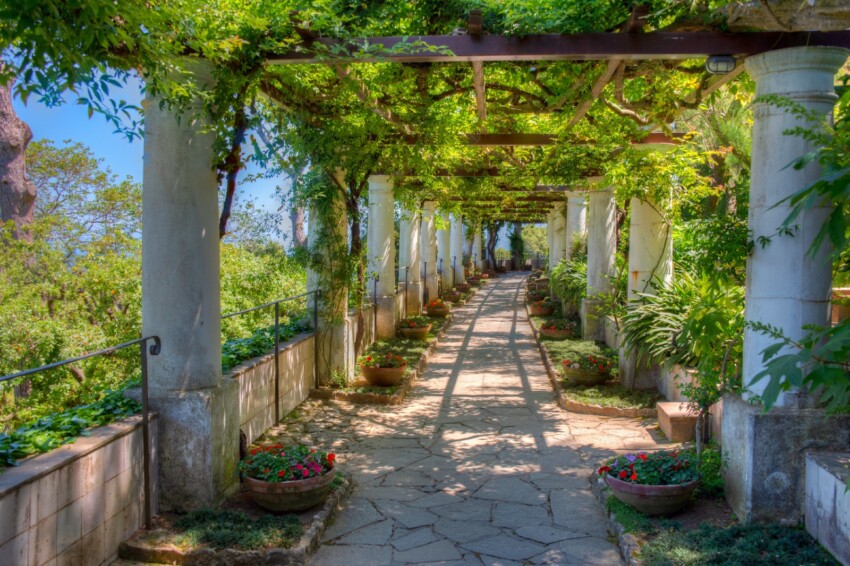
Villa San Michele is the main reason why most visitors venture to Anacapri, and it rarely disappoints. The villa, now a museum managed by the Swedish Foundation that inherited it upon its creator’s death in 1949, was built starting in 1895 by Swedish physician, psychiatrist and writer Axel Munthe (1857-1949) on the north-eastern side of Anacapri, at 327 metres altitude, on the site of one of twelve villas that Emperor Tiberius had built on the island. Munthe’s vision was clear from the start: “A house open to the sun, the wind and the voices of the sea, as in Greek times, and light, light everywhere.”
In the interior rooms are finds of exceptional value collected by Munthe over a lifetime: the head of Medusa that adorned the temple of Venus in Rome, the marble bust of Emperor Tiberius, fragments of sarcophagi, Roman pavements, columns, objects of medieval sacred art and eighteenth-century Tuscan furniture.
The most iconic piece is the Egyptian sphinx in red granite, dating from the period of Ramesses II (approximately 3,200 years ago), which dominates the viewpoint overlooking the gulf: legend has it that placing your left hand on it and making a wish whilst looking out to sea will make it come true.
The garden, winner of the award for Italy’s most beautiful private garden, exemplifies Mediterranean flora with extraordinary views over the gulf. In summer, the villa hosts the concert series Un’estate per sognare (generally late June to mid-August).
Among the villa’s historical guests before it became a museum: Oscar Wilde (1897), Henry James (1899) and Rainer Maria Rilke (1907). For updated information on opening hours and admission prices, visit the official website villasanmichele.eu.
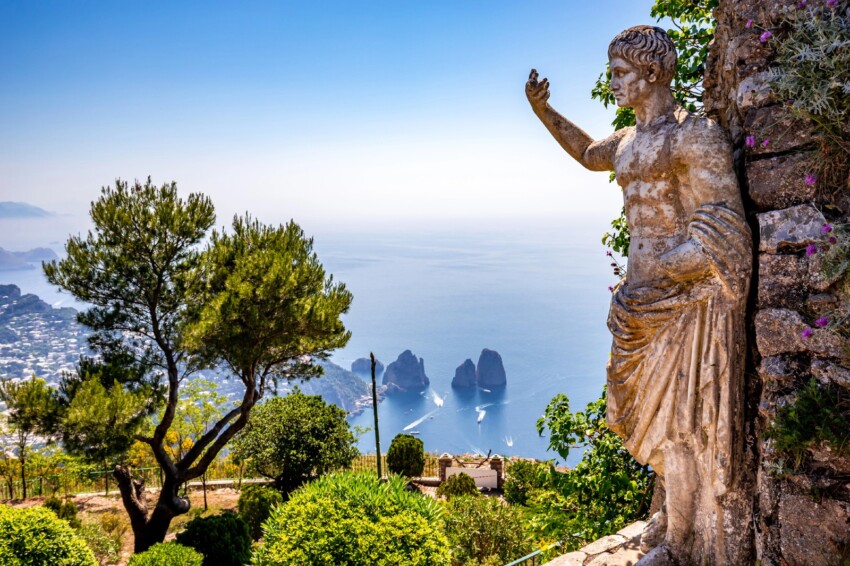
At 589 metres, Monte Solaro is the highest point on Capri, and the view from the summit is arguably the most complete and beautiful on the entire island: a full 360-degree panorama embracing the Gulf of Naples with Mount Vesuvius, the Sorrento Peninsula, the islands of Ischia and Procida, the Faraglioni, the Amalfi Coast and, on the clearest days, even the silhouettes of Sicily on the horizon.
The chairlift (single-seat, open) departing from Piazza Vittoria, the heart of Anacapri, reaches the summit in approximately 12-13 minutes: a journey suspended above Mediterranean vegetation that is itself a most pleasant experience. The chairlift is open from 9.30am to 5pm (4pm in winter); the cost is approximately €8 per journey and €11 return.
At the summit of Monte Solaro are the Hermitage of Santa Maria a Cetrella, a fifteenth-century hermitage built on an ancient temple dedicated to Venus and once a pilgrimage destination for sailors, and the Barbarossa Castle, the sixteenth-century fortress transformed today into an ornithological observatory and nature reserve. Monte Barbarossa was purchased by Axel Munthe to protect migratory birds from indiscriminate hunting, and today it is one of the most important observation points for migratory birds in the Mediterranean.
Several hiking trails depart from Monte Solaro heading towards the Belvedere di Tragara, the Natural Arch and Capri’s Piazzetta; the most evocative descends through Mediterranean scrub passing through the Valle di Cetrella.
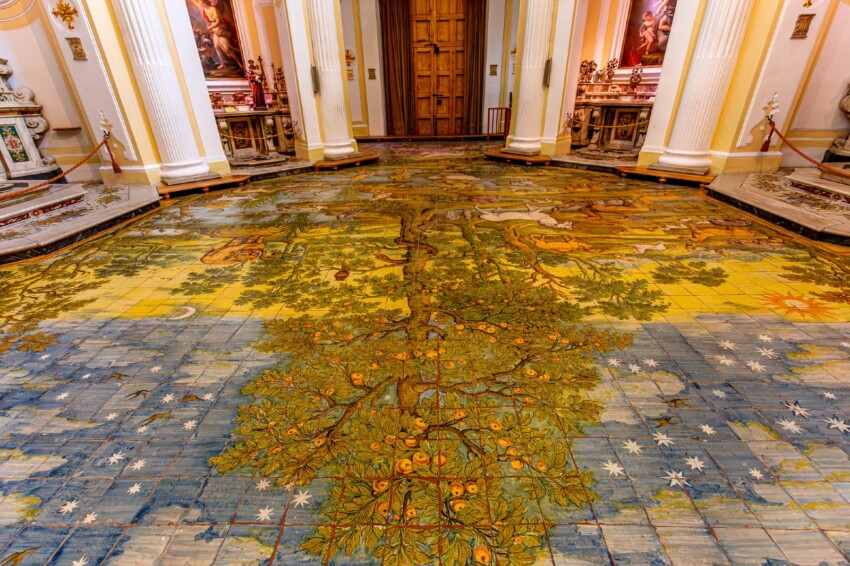
In the heart of Anacapri, steps from Piazza Vittoria, the Church of San Michele Arcangelo houses one of the masterpieces of eighteenth-century Italian ceramic craftsmanship: a majolica-tiled floor from 1761 that covers the entire floor of the nave and depicts, in thousands of hand-painted tiles, the Expulsion of Adam and Eve from Paradise.
The iconographic design was by Leonardo Chiaiese, whilst execution was entrusted to Naples’ ceramic manufacturers. The work is one of the most successful expressions of Campania’s majolica tradition applied to sacred architecture: the animals of the Garden of Eden—lions, elephants, deer, exotic birds—coexist with Adam and Eve, the figure of the Archangel Michael and a fantastical flora mixing real botany with ornamental imagination.
The floor is viewed by walking the elevated galleries arranged around the perimeter of the church: only from above does the overall design become fully legible in its entirety. The visit takes approximately 20-30 minutes. The church is open to visitors for a small admission fee.
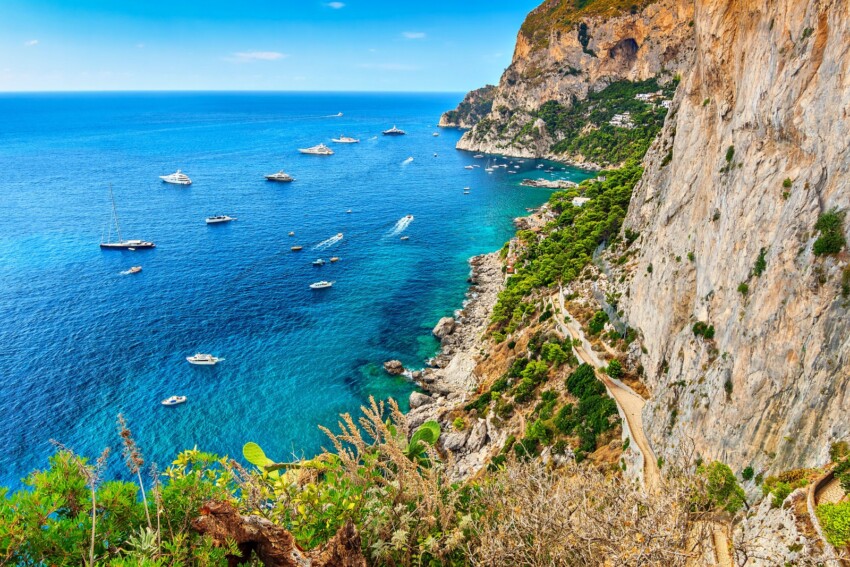
The Scala Fenicia is the oldest connection between Anacapri and the rest of the island: a staircase carved into the rock comprising 777 steps (some sources say 800) descending from the northern side of Anacapri to the area of Capodimonte, near Marina Grande and Villa San Michele.
For centuries it was the only practical access to Anacapri from outside, travelled daily by islanders carrying goods on their shoulders: before the road was built in 1874, climbing to Anacapri meant facing this staircase. Halfway down is a seventeenth-century chapel dedicated to Sant’Antonio di Padova, patron saint of Anacapri, with a small panoramic piazza offering a rest in silence.
Today the Scala Fenicia is freely accessible and represents one of the island’s most historic and evocative walking routes. The descent takes approximately 30 minutes; the climb is more demanding (45-60 minutes) and requires proper footwear and good fitness. Axel Munthe walked it for the first time at age 19—the defining moment recounted in his book—and the climb convinced him to settle in Anacapri.
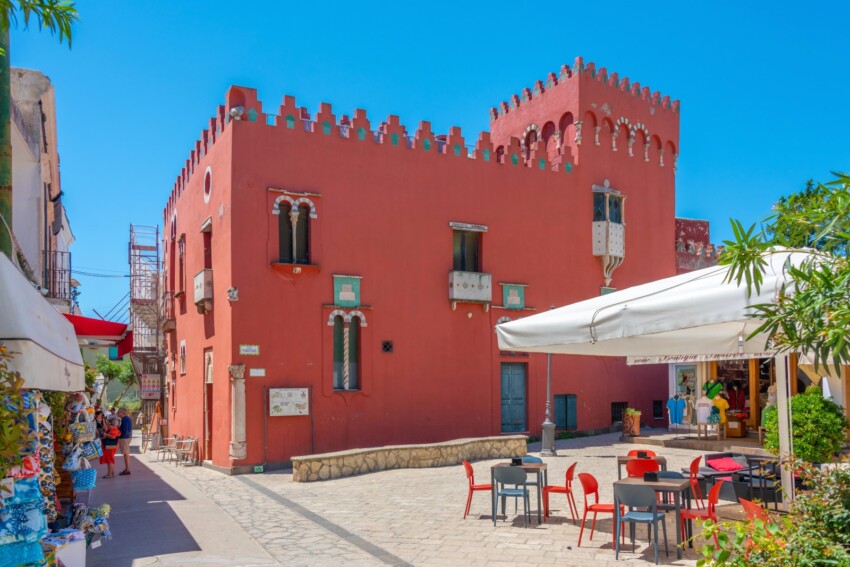
Along Via Giuseppe Orlandi, Anacapri’s main pedestrian thoroughfare, you’ll encounter one of the island’s most eccentric buildings: Casa Rossa, a late nineteenth-century construction of pseudo-castellated taste with vivid red walls, built in 1876 by eccentric American colonel John Clay MacKowen. MacKowen, enamoured of Capri, purchased the structure incorporating the remains of a sixteenth-century Spanish tower and decorated it with personal taste mixing North African, Romanesque and fantastical references.
The building today houses the Red House Museum, which preserves part of the Roman statues found in 1963 during underwater investigations in the Blue Grotto—the sea deities from Tiberius’ imperial nymphaeum that had lain on the seabed for centuries—and documents on the island’s history. The museum is open to visitors for an admission fee.
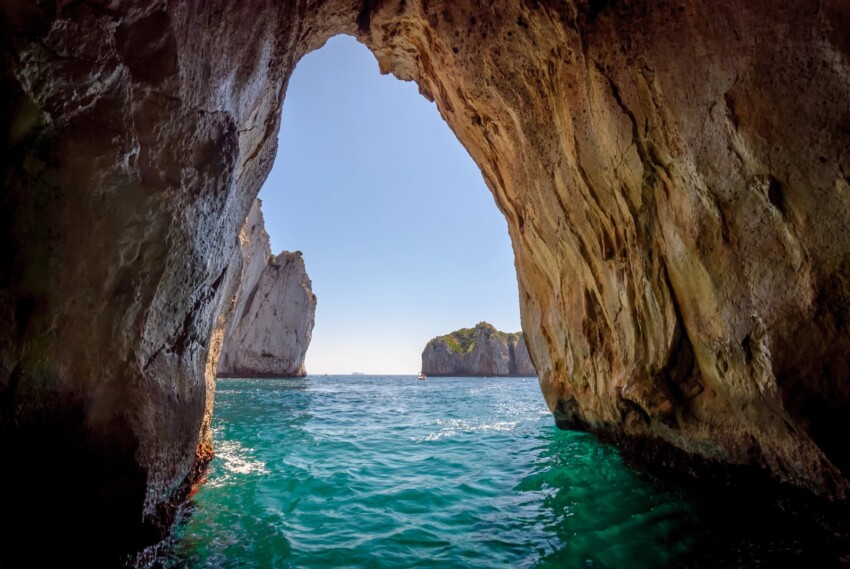
The Blue Grotto, the Roman nymphaeum of Emperor Tiberius that with its supernatural blue light has become Capri’s most famous attraction, is technically within Anacapri’s municipal territory and is conveniently reached from the town. The bus (Anacapri – Blue Grotto line) takes approximately 10 minutes from Piazza Vittoria; alternatively you can walk in approximately 45 minutes following Via Pagliaro and Via Grotta Azzurra.
Reaching the grotto from Anacapri, rather than via the more common speedboat tour from Marina Grande, allows you to avoid the inflated cost of boat transfers and arrive at the entrance with greater schedule flexibility. Near the grotto, the Gradola cliff offers the opportunity to swim directly in the sea with several beach clubs including the renowned Michelin-starred restaurant Il Riccio.
After 5.30pm, when the grotto’s ticket office closes, some dive into the cave from outside—a tolerated practice that transforms the experience into something completely different from the daytime visit.
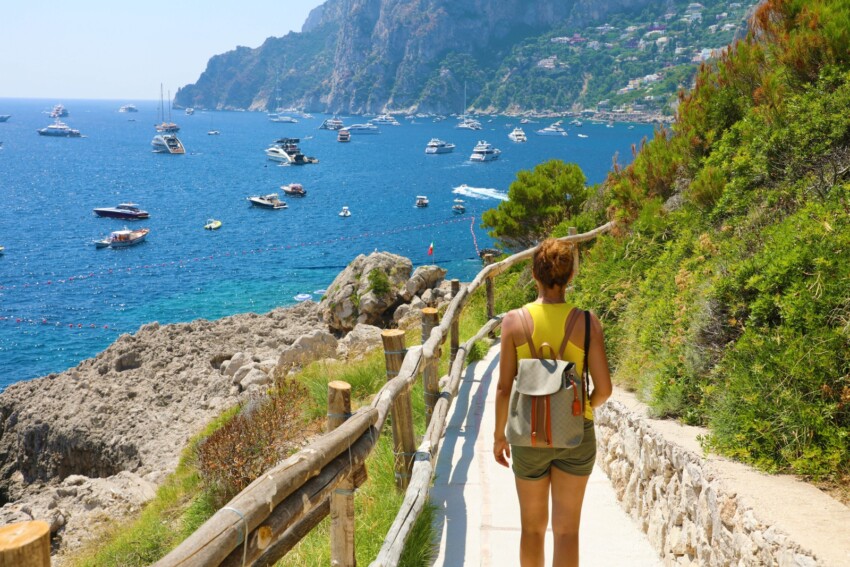
The Sentiero dei Fortini is Capri’s most spectacular trek and one of the finest on the Tyrrhenian coast: a route of approximately 5 km along the entire western coast of Anacapri, from the Blue Grotto area to Punta Carena Lighthouse, through Mediterranean scrub, sheer cliffs, inaccessible coves and the remains of Napoleonic forts built by the French in the early nineteenth century to defend the island. Capri was briefly the seat of the Kingdom of Naples during British resistance from 1806 to 1808, and the coastal forts were part of that defensive system.
The trail crosses Punta Orrico, Punta dell’Arcera, the tiny Cala di Limmo (reachable only on foot and one of Capri’s few wild beaches) and finally reaches Punta Carena. Duration is 3-5 hours depending on pace and stops; the terrain is rugged and requires hiking boots. Not suitable for small children. The view over open sea and limestone cliffs is continuously extraordinary.
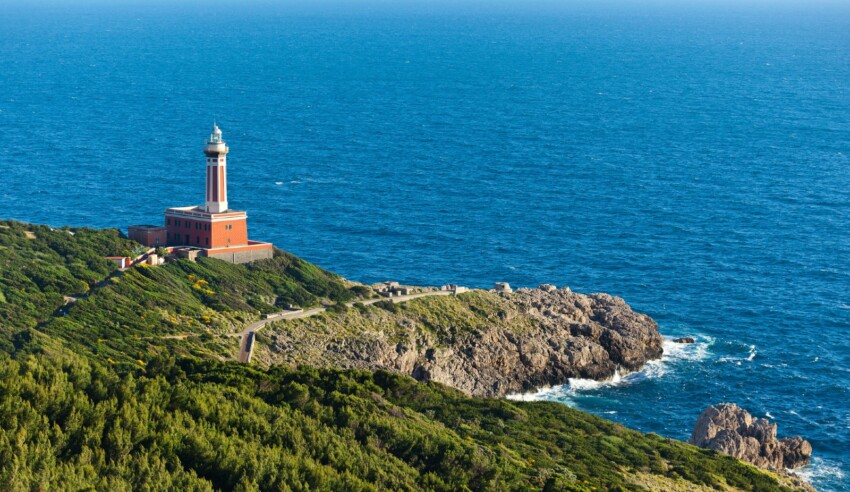
The Punta Carena Lighthouse is Italy’s second-tallest lighthouse (after Genoa’s): an octagonal white and red tower standing 28 metres high, built in 1866 and operational since 1867, dominating Capri’s south-westernmost point from a cliff 73 metres above sea level. Its light is visible up to 25 nautical miles away.
Punta Carena is the only point on the entire island where the sun is never obscured by the mountain and remains visible from morning until sunset, with the sun descending directly into the open Tyrrhenian Sea: this is why the area is beloved by Anacapri residents for afternoon bathing, and why the sunset here is considered one of all Campania’s finest natural spectacles. The waters are crystal clear and deep, ideal for swimming and snorkelling; the seabed near the shore drops to impressive depths.
Punta Carena beach has been awarded the Blue Flag. It’s reached by bus from Anacapri in approximately 10 minutes.
La Migliara is the quintessential walk in Anacapri for those who love countryside and tranquility away from mass tourism. Starting from Piazza Vittoria, you walk for approximately 30 minutes through vineyards, cultivated fields and Mediterranean scrub, along a level, shaded road leading to the Belvedere della Migliara: a natural vantage point from which you can simultaneously see Punta Carena Lighthouse, the Faraglioni, Marina Piccola bay and, in late afternoon, the sun descending towards the horizon.
Along the route you’ll encounter the Parco Filosofico, a meditative garden immersed in Mediterranean scrub with quotations from great philosophers inscribed on ceramic tiles, including the famous phrase by Immanuel Kant: “The starry sky above me and the moral law within me”. From the viewpoint you can continue to the Torre della Guardia, an ancient lookout tower descending towards the lighthouse via a steep but panoramic staircase.
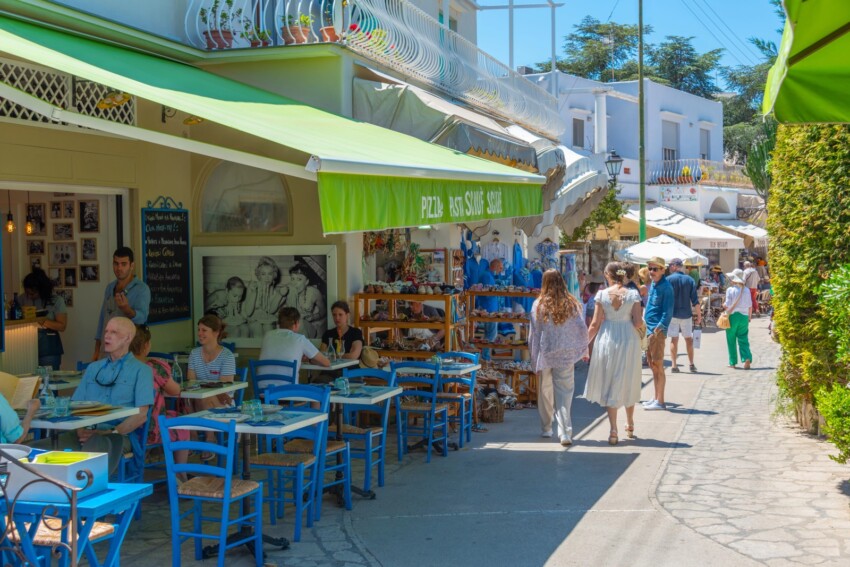
Choosing to stay in Anacapri rather than Capri is a decision many visitors repeat: you’ll sleep more peacefully, generally spend less, and wake up already in the most panoramic spot on the island, with the main attractions—Villa San Michele, the chairlift to Monte Solaro, buses to the Blue Grotto and Punta Carena—all within a few minutes’ walk.
The Piazza Vittoria area and Via Giuseppe Orlandi (the pedestrian high street) are the most convenient: they house the best hotels and B&Bs, all services, and the bus stop for the rest of the island. Those seeking complete tranquillity can choose properties in the countryside towards Migliara or Damecuta: more secluded, but with extraordinary views.
For those wanting to be near the sea, the Gradola and Punta Carena areas offer accommodation directly on the water. For a comprehensive selection, consult our guide to where to stay in Capri.
Anacapri is accessible only through Capri, which in turn is reachable exclusively by sea.
From Naples, hydrofoils and ferries depart from Molo Beverello and Mergellina heading to Marina Grande on Capri: the hydrofoil takes approximately 50 minutes, the ferry around 80.
From Sorrento, the hydrofoil reaches Marina Grande in about 25 minutes: it’s the most convenient and frequent route for those already on the Sorrento Peninsula. For all information on connections, see our guides to ferries to Capri and ferries from Naples.
Once you’ve landed at Marina Grande, you can reach Anacapri by bus (frequent service, tickets available locally): the journey takes around 15 minutes along a winding scenic road that climbs through the rock. Taxis are available but expensive.
Those wanting to relive a historical experience can walk up to Anacapri via the Scala Fenicia (777 steps, approximately 45–60 minutes), which begins near the port and ends beside Villa San Michele. Once in Anacapri, local buses connect the town with the Blue Grotto, Punta Carena, Damecuta and the centre of Capri with frequent services.
What's the weather at Anacapri? Below are the temperatures and the weather forecast at Anacapri for the next few days.
Anacapri is one of two municipalities on the island of Capri, in the Gulf of Naples, roughly 25 km from Naples and less than 5 km from the Sorrento coast.
The municipality covers the western, hilly part of the island, including the areas around the Blue Grotto and Punta Carena.
 Hotel
Hotel  Budget accommodations
  Apartments
  Family Hotel
  Luxury Hotel
  Resorts