Campania: Artecard 3-Day, 7-Day, or Gold/Lite 365 City Pass
Discover Campania and Naples with a pass to visit 40 cultural sites and use public transport (included only in the 3-day pass).
From 27,00 €
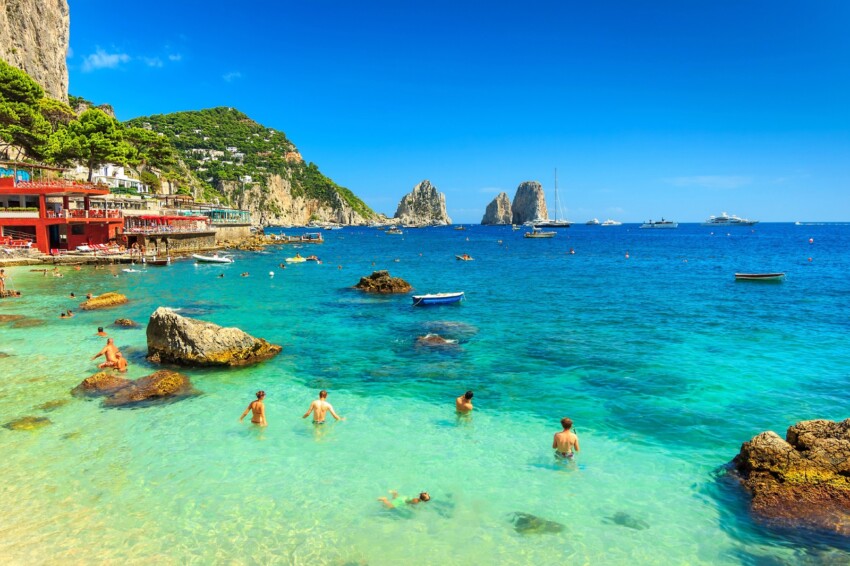
The beaches of Capri are not beaches in the conventional sense: they are cliffs dropping sheer to the sea, tuff platforms scorched by the sun, pebbles smoothed by centuries of waves, hidden coves accessible only by swimming or small boat.
Marina Grande and Marina Piccola are the island’s only proper beaches, with shingle and pebbles; everything else is living rock, and diving means plunging from above into waters that on the brightest days seem impossible—a blue that deepens progressively with increasing depth.
This peculiarity is part of Capri’s charm: going to the sea here is a deliberate act, requiring descent down steep staircases, booking sunbeds at the most exclusive lidos days in advance, deciding whether to stretch out on a rock platform or a mattress laid on the cliff.
The reward is water of a clarity rarely found elsewhere in the gulf, beach establishments with stories spanning decades and scenery, the Faraglioni, the Punta Carena Lighthouse, the Anacapri coastline, which transform a day by the sea into something you remember for a long time.
Capri’s coastline extends roughly 17 kilometres around its perimeter and offers very different conditions depending on the aspect.
The northern side, more sheltered, hosts the Marina Grande port and calm waters of the main bay; the southern side, wilder and more open, offers the most dramatic panoramas with the Faraglioni and Punta Tragara cliffs; the northwestern slope towards Anacapri is home to the Blue Grotto and Gradola; the southernmost point is Punta Carena Lighthouse, the only place on the island where the sun warms until sunset.
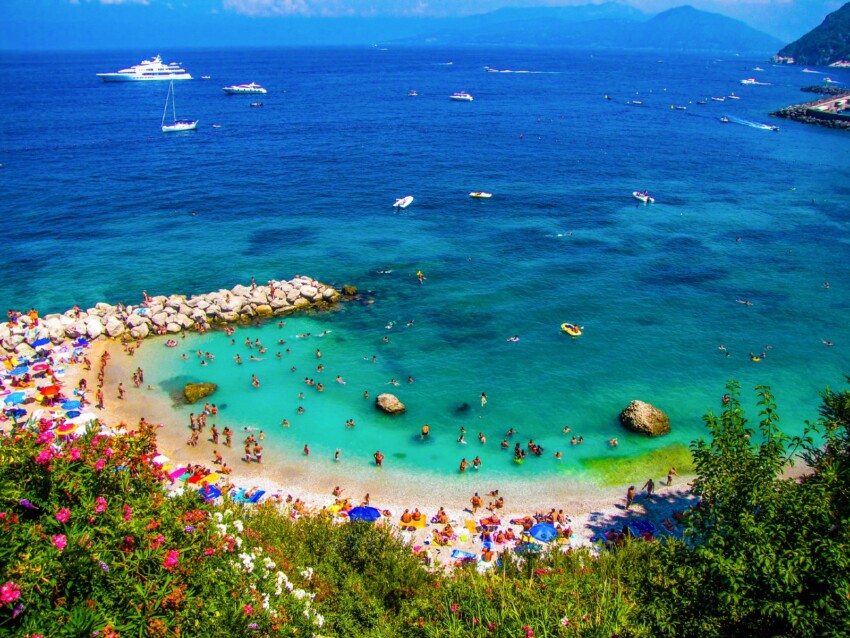
Marina Grande is Capri’s largest and most unpretentious beach: it sits immediately to the right of the hydrofoil dock, making it the first thing you see arriving by sea.
It’s a stretch of pebbles and shingle extending for a couple of hundred metres overlooking the Gulf of Naples, with views spanning towards Vesuvius and the profiles of Ischia and Procida on the horizon. The water is clean despite proximity to the commercial port, and the seabed slopes gently, making it suitable for families with children and less experienced swimmers.
The free beach lies at the bay’s far end, near the hydrofoil ticket offices; along the rest of the waterfront are equipped establishments with sunbeds, parasols and restaurants. Getting here requires no effort: a two-minute walk from the dock. The downside is that it’s also the most crowded, especially in summer months when tourists flood from the port to the sea.
A short distance from Marina Grande, reachable in minutes on foot along Via Palazzo a Mare or by traditional gozzo boat departing directly from the dock, lie the Tiberius Baths: a beach establishment with pebble beach and restaurant situated where the sumptuous imperial residence of Augustus once stood.
The remains of the Palazzo a Mare, ruins of the large late-republican and Augustan villa, with its still partially identifiable Roman fishponds close to the water, provide a striking backdrop to the bathing establishment. It’s one of the island’s few lidos also suitable for small children due to the relative calm of the waters and the presence of a small beach.
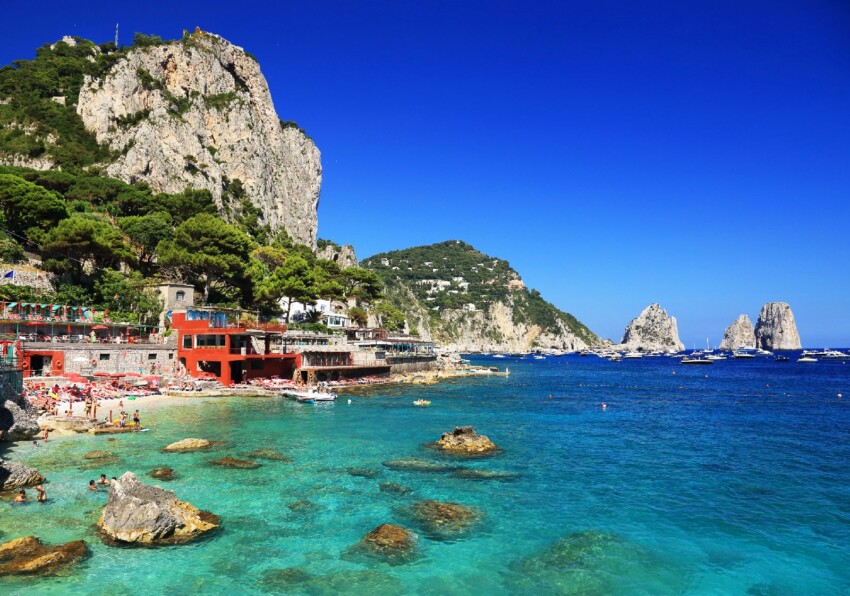
Marina Piccola is Capri’s most beautiful and dramatic beach. Situated on the island’s southern slope, protected from northern winds by Monte Solaro and open to southern sunshine, it offers a direct view of the Faraglioni, the panorama that more than any other defines the island worldwide.
The bay is divided in two by the Sirens’ Rock, a rocky promontory which according to ancient tradition was the posting place of the Sirens who tempted Ulysses with their song: the two coves opening on either side are called Marina di Mulo (west) and Marina di Pennauro (east).
Both have a beach of pebbles and small stones with a free section and one or more equipped establishments.
The main consideration for those choosing Marina Piccola is a solar one: Monte Solaro, at 589 metres, casts its shadow over the bay from early afternoon, between 2pm and 3pm depending on the season. Those wanting to spend an entire day in the sun should arrive in the morning and plan a lunch break at one of the lido restaurants, knowing the afternoon will be in shade. In compensation, the bay is particularly beautiful in the morning: the water is calm, the raking light enhances the colours of the Faraglioni, and day-trippers haven’t yet invaded the area.
Among Marina Piccola’s establishments, La Canzone del Mare stands out as one of the most iconic places in Italian beach history. Founded by British actress and singer Gracie Fields in the nineteen-fifties, the star whose presence helped make Capri an international destination of the Dolce Vita, the lido has changing facilities carved from ancient sea caves and a saltwater pool hewn from the rock. Since Gracie Fields died in 1979, the restaurant has been run by the Iacono family, the same family managing Da Luigi at the Faraglioni.
The Saracen Tower, with its ancient medieval watchtower, is another distinctive address at Marina Piccola: one of the few areas on the island where you actually find stones to lie on, making it more suitable for those travelling with children.
Marina Piccola is reached from Capri’s Piazzetta by bus (frequent, just minutes), on foot down Via Mulo (15-20 minutes downhill, steeper uphill), or by sea with a water taxi.
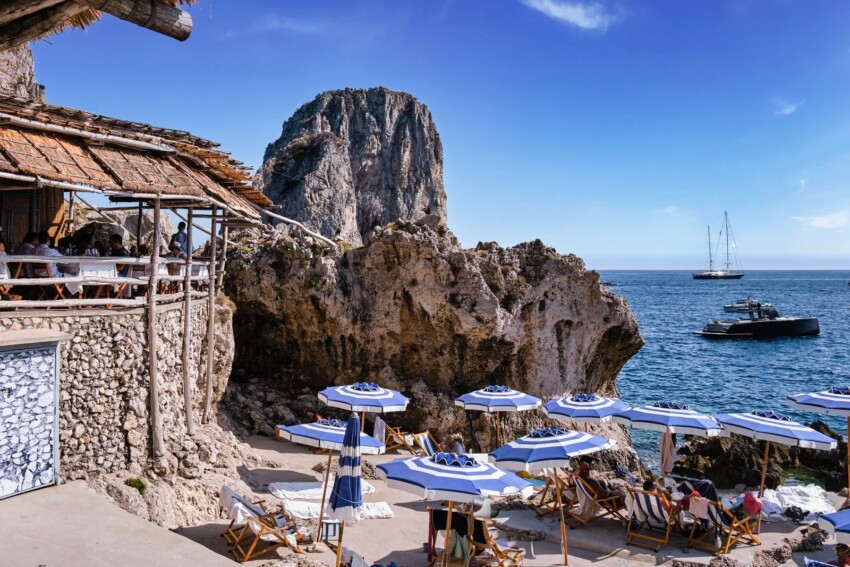
Descending from the path starting at the Punta Tragara Viewpoint, roughly 20-30 minutes’ walk through a large pine forest with about 200 steps, you reach the foot of the Faraglioni, where two beach establishments that have become integral to the Capri myth are located: La Fontelina and Da Luigi at the Faraglioni.
These aren’t beaches: they’re rocky platforms jutting into the sea with sunbeds, mattresses and parasols, with sea access via diving or descent by metal steps. The water is deep immediately and isn’t suitable for children or those uncomfortable in deep water. The view is incomparable: the three Faraglioni metres away, the sea changing colour with the light, seagulls gliding between the rocks.
The story of Da Luigi is one of the finest in Capri’s beach history. In 1932 Prince Umberto of Savoy, who would become King Umberto II, was in this area when he stepped on a sea urchin. He was helped by Luigi Albanese, who fried fish in the area for bathers. In gratitude, the prince helped him obtain the restaurant licence that had been denied him for years: thus Da Luigi was born. The lido’s character today is still that of its beginnings: mattresses instead of sunbeds on the rocks, traditional Caprese cuisine, an atmosphere mixing exclusivity with authenticity.
La Fontelina has a more elegant and structured character, with multi-level platforms and refined seafood cuisine. For both lidos booking is mandatory, especially weekends: places are limited and run out days in advance in July and August. Both organise a small boat shuttle service to Marina Piccola for the return journey, avoiding the climb back up.
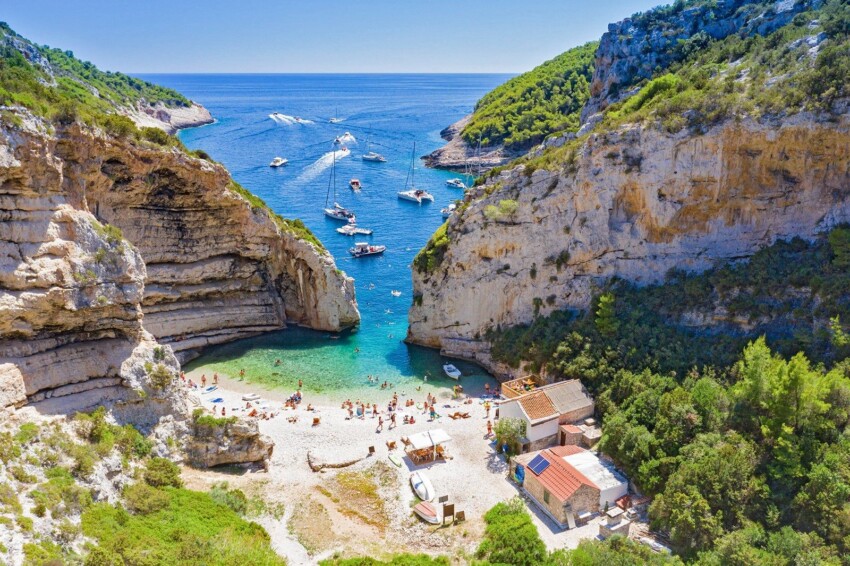
On Capri’s northwestern slope, near the entrance to the Blue Grotto, the coast offers another type of beach experience: low limestone and tuff cliffs descending directly into open sea, with free access from the rocks and a series of establishments of very different standards.
Il Riccio, part of the Jumeirah Capri Palace complex (Anacapri’s five-star hotel), is the island’s most exclusive establishment: a Michelin-starred restaurant specialising in raw seafood and contemporary Mediterranean cuisine, overlooking rocky platforms with very limited sunbeds. Sunbeds are generally reserved for hotel guests, so access for non-residents happens almost exclusively by booking the restaurant. It’s one of Capri’s most sought-after gastronomic destinations for those seeking the combination of sea views and haute cuisine.
Nearby, the Gradola establishment offers a more accessible alternative for budget and atmosphere: sunbeds by the sea, restaurant with local cuisine, access to rocks and platforms at more reasonable prices than exclusive lidos.
The Neptune establishment completes the offering with swimming pool, bar and sea access. The characteristic of this entire area is the possibility of free access directly from the cliff, without needing to pay any establishment: simply bring a towel and find space on the flat rocks. Waters here are particularly clear and the seabed drops quickly.
A note for more curious swimmers: after 5:30pm, when the Blue Grotto boat service stops, some locals swim into the cave from outside, a tolerated and very evocative practice. The area is reached by bus from Anacapri (Blue Grotto line), by taxi, or on foot from Anacapri in about 45 minutes.
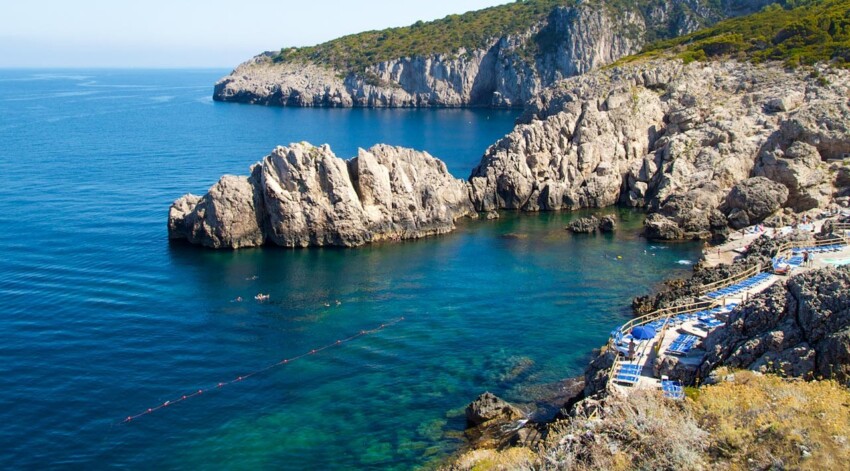
At the far southwestern tip of the island, Punta Carena is the only point on Capri where the sun remains until sunset, which is why those wanting to swim in the afternoon and not wanting to give up sunlight choose this destination.
The Punta Carena Lighthouse, Italy’s tallest lighthouse after Genoa’s, dominates the scene on a limestone cliff, and the surrounding sea has unusual geological characteristics: the seabed drops vertically to vertiginous depths (up to 600 metres in some adjacent areas), which makes this area particularly appreciated by diving and advanced snorkelling enthusiasts.
Sea access is directly from the rocks and rocky platforms, partly free and gratuitous. Metal staircases are set into the rock to facilitate descent into the water.
The beach establishments in the area, including the Faro Lido, offer sunbeds, parasols and catering on platforms with sunset views. The atmosphere here is more relaxed and less fashionable than the lidos of Marina Piccola or the Faraglioni: it’s the Capri of Anacapri locals, less frequented by passing tourists.
It’s reached from Anacapri by bus (Punta Carena line), by taxi, or on foot in about 45 minutes via a panoramic path. The best time to arrive is late afternoon, in time to settle on the rocks and await the sunset over the Tyrrhenian Sea, one of the gulf’s most beautiful natural spectacles.
In the following map you can see the location of the main places of interest mentioned in this article.
City Card allow you to save on public transport and / or on the entrances to the main tourist attractions.
 Hotel
Hotel  Budget accommodations
  Apartments
  Family Hotel
  Luxury Hotel
  Resorts