Bestseller
Capri: Island Boat Trip with Grottos
From 25,00 €
Buy the ticket
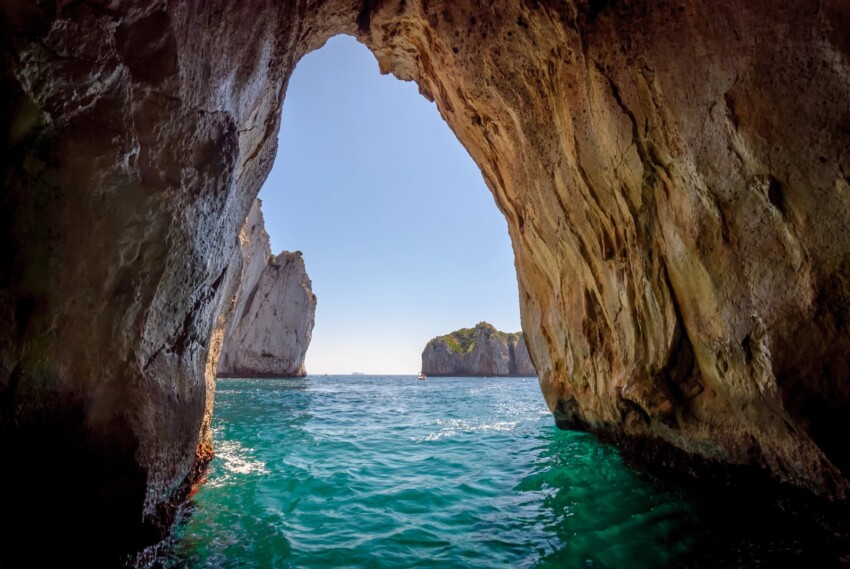
There’s a moment, just a few seconds, as the rowing boat glides beneath the stone arch barely two metres wide and sudden darkness gives way to an impossible light, when you understand why this cave changed the history of an island and made generations of travellers fall in love with the Mediterranean.
From within, the water of the Blue Grotto isn’t simply blue: it’s fluorescent, luminescent, alive, as if the seabed had its own light source. No other sea cave in the world creates a comparable effect, and no photograph, however excellent, can capture the sensation of being inside.
The Blue Grotto sits on the northwestern flank of Capri, administratively within the municipality of Anacapri, and has represented the island’s absolute symbol for nearly two centuries. It served as an imperial nymphaeum under Tiberius, a cursed cavern to medieval Capresi, a sensational discovery for romantic 1826 Europe, an essential stop on the Grand Tour and finally one of the Mediterranean’s most visited marine attractions. Fifty minutes waiting on a sun-baked boat, five minutes of absolute wonder: the ratio isn’t ideal, but no visitor who has entered the Blue Grotto has ever said it wasn’t worth it.
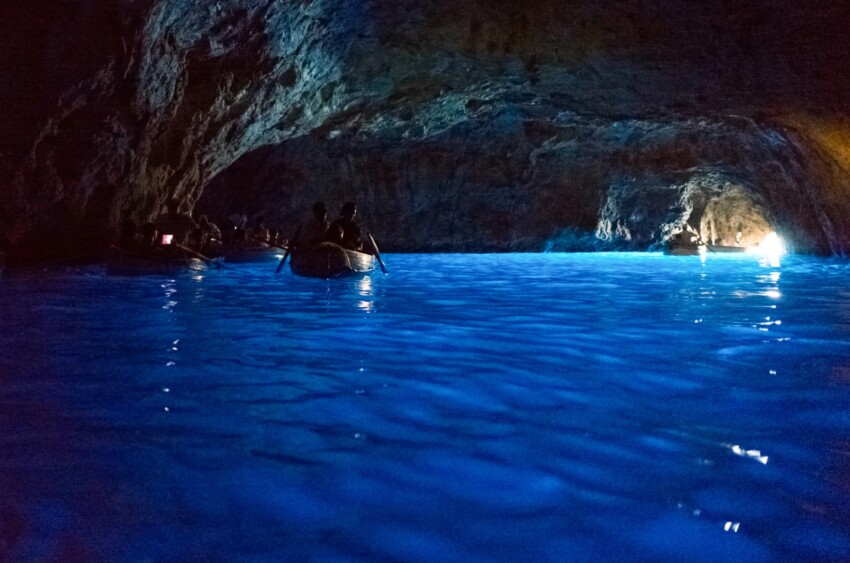
The Blue Grotto is a natural karstic cavity carved into the limestone rock of Capri’s northwestern coast, approximately 60 metres long and 25 metres wide, with a maximum internal height of around 14 metres.
There is a single entrance: a stone arch 2 metres wide and just 1 metre high, requiring you to lie flat on the bottom of the rowing boat to pass through. This natural funnel is the cause of everything: it transforms ordinary sunlight into something extraordinary.
The scientific explanation for the Blue Grotto’s colour is elegant in its simplicity, yet the effect it produces is almost impossible to believe until you see it in person.
Beneath the main entrance, that narrow stone arch through which you pass lying down, there exists a second opening, completely submerged, which connects the grotto’s interior with the open sea. It is through this underwater window that sunlight penetrates the cavity.
When sunrays enter from the submerged opening, they are filtered by the water: the warm wavelengths of the visible spectrum—red, orange, yellow—are absorbed during their passage through the water. Only the short wavelengths, those of blue and azure, pass through almost entirely and illuminate the grotto’s interior from bottom to top.
The result is a light source positioned on the seabed that illuminates the cavity with diffuse, uniform light of surreal intensity: the internal water doesn’t seem to reflect external light, but to produce it autonomously, as if the seabed were made of luminescent material.
The most striking and least known effect is what happens to objects immersed in the water: anything placed in the grotto’s water—an arm, an oar, any object—immediately appears covered with a silvery, almost metallic layer, as if coated with liquid mercury.
The phenomenon results from a thin film of air forming on the submerged object’s surface which, in the presence of this light, reflects like a mirror. The boatmen demonstrate this to visitors by immersing the oar in the water: the transformation is immediate and inexplicably beautiful.
The intensity and quality of the blue colour inside the Blue Grotto changes noticeably depending on the time of day and weather conditions.
The moment when light is most intense and the colour most saturated is around midday, when the sun is at its zenith and rays enter the submerged opening perpendicularly with maximum efficiency. Early morning and late afternoon still produce a magnificent effect, but with slightly different nuances—cooler and more silvery in the morning, warmer and more golden in the late afternoon.
Sea conditions profoundly influence the experience: with calm seas and light white haze, the sky filters light optimally; with direct sunlight and cloudless skies, the brightness can be dazzling; with rough seas, the grotto closes completely. Light cloud cover actually produces some of the most beautiful visions, as it diffuses sunlight, making it less intense but more uniform and penetrating.
There is a sonic dimension to visiting that photographs don’t convey and that visitors only discover once inside: the Blue Grotto’s acoustics are extraordinary. The smooth limestone walls and the cavity’s dome-shaped form create an echo that multiplies and prolongs every sound almost unnaturally.
The Capri boatmen, who have passed down the art of navigating these narrow spaces from father to son for nearly two centuries, are fully aware of this, and nearly every visit includes a verse or two of a Neapolitan song: O Sole Mio, Funiculì Funiculà, Torna a Surriento. The voices multiply in the stone vault and return with a resonance that, during the five minutes spent in the grotto, creates an atmosphere impossible to forget.
It’s not showmanship: it’s the tradition of these sailors, who in song found the most effective way to communicate to the visitor, bewildered by wonder, that what they’re experiencing is real.
Those seeking traces of Roman presence in the Blue Grotto will find them in two elements still visible during the visit. On the left side of the interior, partially submerged in water, survives a platform of opus caementicium, Roman concrete, which served as a landing place for boats from the imperial villa above: it is the most direct physical sign of the grotto’s use by Tiberius and his entourage.
The platform is modest, worn by centuries and water, but identifying it during the visit adds a temporal dimension that the visual effect alone doesn’t suggest: you realise you’re in the identical space where, two thousand years ago, a Roman emperor had himself transported by boat to enjoy the same light you’re now seeing.
The history of the Blue Grotto unfolds in three distinct acts: Roman use, the long medieval oblivion, and the Romantic rediscovery that made it famous worldwide.
In the Roman imperial era, the Blue Grotto was neither a secret nor an inaccessible place: it was a maritime nymphaeum, a space of aquatic pleasure integrated into the residential complex of the Villa of Gradola (or Damecuta), the residence that emperor Tiberius had built on the promontory above in the first half of the 1st century AD. A channel, or more likely a series of stairs and a landing, connected the villa to the grotto below. The cavity was decorated with statues of marine deities: one of Poseidon, another depicting a Triton, and probably other figures that ancient sources hint at but that the erosion of centuries has erased. The grotto was used for banquets on the water, for private ceremonies linked to water worship, possibly for scenic exhibitions that exploited the environment’s supernatural colour.
The statues were discovered in 1963 during an underwater archaeological survey campaign: they had sunk to the grotto’s bottom due to bradyseism that had progressively lowered the coastline over centuries. Today they are preserved in the Casa Rossa Museum in Anacapri, established by eccentric American Edwin Cerio, and in the Certosa di San Giacomo on Capri. The grotto itself, stripped of its decorations and with the water level risen due to marine uplift in the centuries following the Empire’s fall, remained physically accessible but completely abandoned.
During the medieval and Renaissance centuries, the Blue Grotto, known to Capresi as “Gradola” after the area above it, was a place to avoid carefully. The legends surrounding it were precise and terrifying: the grotto was the haunt of witches, the place where evil spirits held their nightly conclave, a portal to the world of demons that no sensible Christian should approach. The fishermen of Capri, despite navigating daily along that stretch of coast, kept clear of the entrance and passed down to their sons the warning not to venture near.
The legend had a concrete experiential basis: anyone who ventured near the entrance during daylight hours would see that blue light emanating from within, and anyone who entered, before scientific understanding of the optical phenomenon became possible, would see the Roman statues still partially intact on the seabed, illuminated by supernatural light. A chronicler reported that in the 1600s some priests had entered the grotto to exorcise it, frightened by the people’s stories, and had fled in terror: in the blue shadows and the echo amplified by the walls, the statues of Poseidon and Triton must have appeared as demonic presences, confirming rather than refuting the place’s cursed reputation. The irony is perfect: the Roman nymphaeum was protecting itself through the myths of its own dissolution.
The summer of 1826 saw Capri animated by cultured tourists and curious members of the new romantic generation of Europe. Among them were two Germans: Prussian poet and writer August Kopisch and painter Ernst Fries, both on extended stays on the island as guests of notary Giuseppe Pagano, whose accommodation was a reference point for quality visitors. Notary Pagano knew the story of the cursed grotto well and had desired for years to visit it without finding anyone willing to accompany him. On the evening of 16 August 1826, during one of the usual evening conversations, the story of the Blue Grotto emerges: Kopisch and Fries don’t need the proposal repeated twice.
On the morning of 17 August 1826, despite a last attempt by canon Nicola Pagano, the notary’s brother, to stop them by evoking the grotto’s evils, the group comprising Kopisch, Fries, Pagano, the notary’s twelve-year-old son, Capri sailor Angelo Ferraro called “il Riccio” and muleteer Michele Federico set sail from Capri aboard two small boats towards the island’s northwestern flank. They swam into the cavern to avoid risking capsizing the boats at the low entrance, and found themselves facing a scene none of them had ever imagined: that luminescent water, blue as it had never been seen anywhere else in the Mediterranean.
Upon returning, Kopisch assigned the grotto the name that would travel the world: Blue Grotto. Not “Gradola”, not “Glauca Grotto”, the name proposed by a Russian traveller on the island, but “Azzurra” (Blue), the simplest and most exact adjective to describe what he had seen. His description of the experience, published in an essay in 1838 after years of manuscript circulation, made the grotto known to educated Europe. Meanwhile, news had already spread: by 1835 Hans Christian Andersen mentioned it in the novel The Improvisatrice; other German and Anglophone writers visited and described it in their diaries. The Blue Grotto became in a few years one of the essential stops on the Grand Tour, decisively contributing to the construction of the myth of Capri as the island of dreams of Northern Europe.
During the nineteenth century the grotto was photographed among the world’s first natural attractions, was one of the preferred subjects of pioneers of plein air photography, and was visited by personalities of every kind. In 1908 Lenin also visited it, at that time a guest of Gorky on Capri. The grotto had become, within eighty years of Kopisch’s rediscovery, a space as universally famous as the monuments of Rome or the ruins of Pompeii.
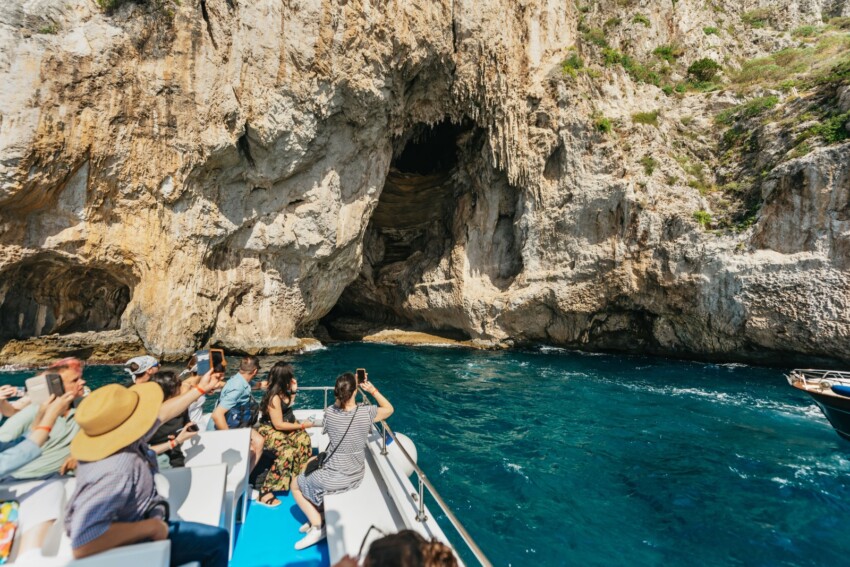
A visit to the Blue Grotto is organised in a manner unchanged for generations: no modernisation has touched the essentials, and today’s experience is not fundamentally different from what Kopisch experienced in 1826.
At the grotto’s entrance, reachable by sea or land, you’ll find rowing boats operated by a cooperative of authorised boatmen, whose access rights are passed down from family to family. Each boat carries a maximum of four visitors plus the boatman. Before entering, you pay for your ticket at the floating ticket office, a small boat moored at the entrance that serves as the cashier.
The boatman asks visitors to lie flat on the boat’s bottom and keep their heads lowered: the opening is approximately one metre above the water level, and every centimetre counts. The passage lasts just seconds, during which you hear the boatman pulling the metal chain anchored to the rock above the entrance to propel the boat inward, a precise, calibrated gesture requiring exact strength and timing. Then the light changes, abruptly, and you’re inside.
The visit inside lasts about five minutes: the boatman slowly circles the boat, shows the points of greatest colour intensity, immerses the oar to demonstrate the silvery effect on the water, and intones a verse or two of a Neapolitan song.
The time is brief, inevitably too brief, but it’s what logistics demand: dozens of boats wait outside and the system only works if schedules are maintained. On exit, the boatman watches for the right moment to slip back through the arch based on the rhythm of the waves.
Regarding tipping the boatmen: it’s an established and expected custom, not mandatory but socially binding. A sum between €2 and €5 per person is considered appropriate. Not leaving a tip after a visit of this kind, in one of the island’s oldest working traditions, would be perceived as disrespectful.
The Blue Grotto’s ticketing system is one of the most frequently misunderstood aspects for visitors, as it involves separate and overlapping costs depending on how you reach the cave. Understanding the structure before you arrive is important to avoid surprises.
The grotto entrance ticket, which includes the local rowing boat service inside, costs approximately €18 per person. This is the fee you pay at the floating ticket office at the entrance, regardless of how you got there. Discounts available: children under 6 enter free; EU citizens under 18 have free admission and pay only for the local boat service (around €12); EU citizens between 18 and 25 pay €2 admission plus the boat service, for a total of around €14.
It is impossible to purchase tickets online in advance: there is no pre-sales platform for the grotto entrance ticket, which is paid solely on-site at the time of your visit.
In addition to this, there is the cost of reaching the grotto by sea from Marina Grande: organised tours (full island circuit with a stop at the Blue Grotto) cost around €24 per person. The grotto entrance ticket is not included in this price and must be paid separately at the entrance. Those who reach the grotto overland, by bus from Anacapri or on foot, do not incur this additional cost.
The Blue Grotto is open daily from 9:00 to 17:00, with a few important exceptions. It is closed on 25 December and 1 January. From November to March opening is not guaranteed: the typically rough sea during the winter season makes entry unsafe on most days, and the grotto is “rarely open” during this period.
The fundamental element of uncertainty is weather-related: the Blue Grotto closes whenever the sea is rough, wind exceeds a certain intensity, or atmospheric conditions make passage through the low entrance dangerous or impossible. The libeccio wind in particular creates a swell that closes the grotto without warning, even when the sky is clear.
It is impossible to know in advance, not even the day before, whether the grotto will be open: only at 9:00 in the morning do the boatmen reach the entrance and check the conditions. This means that any planning is subject to last-minute changes, and anyone organising a Capri visit specifically for the Blue Grotto must be mentally prepared for the possibility of finding it closed.
To avoid queues, which during peak hours in July and August can stretch to two hours, the best strategy is to arrive at the entrance by 9:00–9:30, when the boatmen begin service. Visitor numbers increase rapidly during the mid-morning hours.
A second advantageous time is early afternoon, after 13:30, when day-trippers from the island begin returning to Marina Grande for afternoon ferries. Avoid the 10:00–13:00 window during high season months.
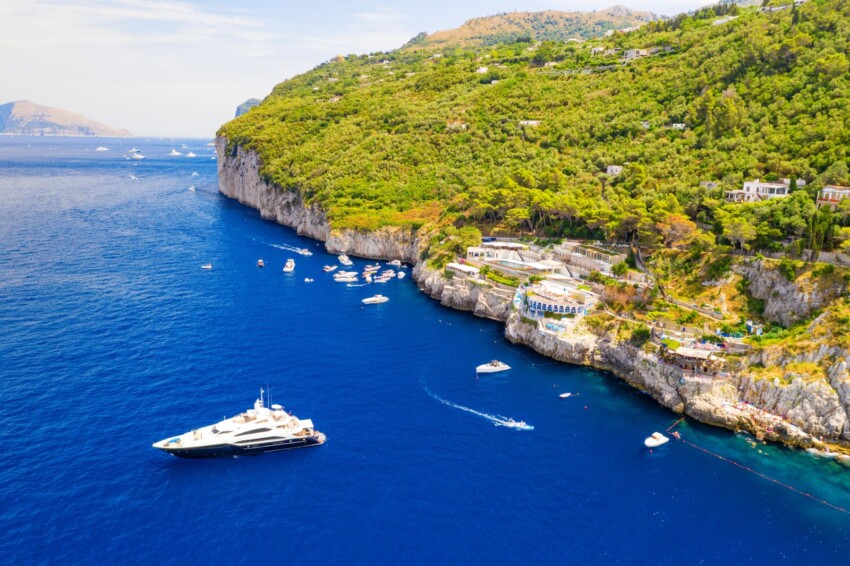
There are three ways to reach the Blue Grotto entrance, each with different characteristics.
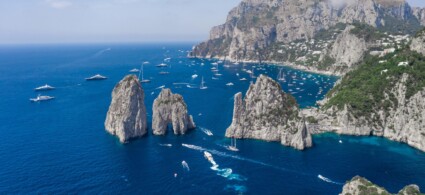
The most popular method, preferred by the majority of visitors, is the speedboat island circuit with a stop at the Blue Grotto, organised by Motoscafisti, Laser Capri and Capri Cruise from Marina Grande. The tour lasts approximately 2 hours and includes a circumnavigation of the island with stops at the Faraglioni, the Natural Arch and the main sea caves, with the Blue Grotto as the highlight.
The cost is around €24 per person (the grotto entrance ticket is paid separately). If the grotto is closed during the tour, the speedboat continues the circumnavigation without stopping at the entrance. Boarding takes place at the Molo Banchinella (Molo 23) pier at Marina Grande port.
For those who want to go directly to the Blue Grotto without doing the full island circuit, the same companies offer a return transfer from Marina Grande to the grotto entrance, without excursion. It’s the quickest and least expensive solution for those who have already visited the island before.
The lesser-known but often more economical alternative, especially for those staying in Anacapri, is to reach the grotto overland. From Anacapri’s town centre (Piazza della Pace), a bus line departs that reaches the area above the grotto in approximately 15 minutes. From the final stop, a staircase descends directly to the grotto entrance, where you can board the rowing boats.
Alternatively, you can walk Via Pagliaro and then Via Grotta Azzurra: the distance is 3.5 km entirely downhill (approximately 40 minutes), though the return climb is strenuous. This option allows you to reach the grotto without the speedboat cost from Marina Grande, paying only the grotto entrance ticket on-site.
The Blue Grotto is reached from Naples by ferry or hydrofoil to Marina Grande on Capri (approximately 50–80 minutes depending on the vessel), and from Sorrento by hydrofoil (approximately 25 minutes). For all information on maritime connections, see the guide to ferries to Capri.
Capri’s coastline is dotted with sea caves, many of which can be visited during the island speedboat circuit. None has the impact of the Blue Grotto, but some have their own distinctive features worth noting.
The Green Grotto, on the island’s southern side, takes its name from the colour of the algae covering the walls: the light penetrating from the entrance creates emerald-green reflections less intense than those of the Blue Grotto, but particularly beautiful at sunset.
The White Grotto, adjacent to the Green Grotto, features white stalactites hanging from the ceiling and water with a colder, silvery hue.
The Fra’ Felice Grotto, also called “the Thunder Grotto” for the roar that waves produce inside, is the most architecturally dramatic: it is larger than the others and the vault rises to approximately 30 metres.
All three can be visited as part of the island speedboat circuit.
No. The Blue Grotto entrance ticket cannot be booked or purchased online: it is available solely on-site, at the floating ticket office anchored at the grotto entrance at the time of your visit.
What you can purchase online in advance is the speedboat ticket from Marina Grande, but this does not include the grotto ticket. Bear in mind that even with a speedboat booking, you will have no priority access to the grotto compared to those who arrived overland.
No. The grotto closes whenever the sea is rough, wind blows from the west, or conditions do not permit safe passage through the low entrance. It is impossible to know in advance, not even the day before, whether it will be open: only at 9:00 in the morning do the boatmen check conditions and decide.
From November to March, opening is very rare. During summer months it is generally open, but a sudden libeccio wind can close it even on apparently sunny days.
Before planning your day around the grotto, check sea conditions and bear in mind that you might find the site closed despite having paid for boats from Marina Grande.
Time spent inside the Blue Grotto is approximately 5 minutes. To this must be added waiting times: during high season, the wait in the boat outside before being able to enter can last from 30 minutes to two hours. The full island speedboat circuit with a grotto stop lasts approximately 2 hours.
No. Swimming inside the Blue Grotto is forbidden during official opening hours: the rowing boats occupy all available space and safety regulations do not permit bathing.
However, every evening after 17:30, when the floating ticket office closes and the small boats leave the entrance, many locals and adventurous tourists swim into the grotto. It is not officially authorised, but it is a tolerated and deeply atmospheric practice: immersing yourself in the grotto’s blue water, in the evening, without boats and without queues, is a completely different experience from the daytime visit.
It is one of the most striking aspects of the visit, often more memorable than the blue colour itself. When an object is immersed in the grotto’s water, a thin film of air forms on its surface which, illuminated by the blue light filtered from below, reflects like a silvery metal mirror.
The boatman immerses the oar in the water during the visit to demonstrate this: the effect is immediate and inexplicable at first glance. It is a purely physical phenomenon of total internal reflection, but in that visual context it appears like magic.
Yes, but with some considerations. To enter the grotto, you must lie down on the bottom of the boat for a few seconds: it is not a frightening procedure, but it does require the child to cooperate and not struggle during the passage.
Children under 6 do not pay an entrance fee. The visit inside lasts only 5 minutes and the visual effect generally thrills even the youngest. More problematic is the wait outside, on the boat, in the sun: bring sun protection, a hat and water. For very young children (under 3) or particularly restless ones, consider whether the potential long wait is compatible with the child’s needs.
City Card allow you to save on public transport and / or on the entrances to the main tourist attractions.


 Hotel
Hotel  Budget accommodations
  Apartments
  Family Hotel
  Luxury Hotel
  Resorts