Bestseller
Capri: Island Boat Trip with Grottos
From 25,00 €
Buy the ticket
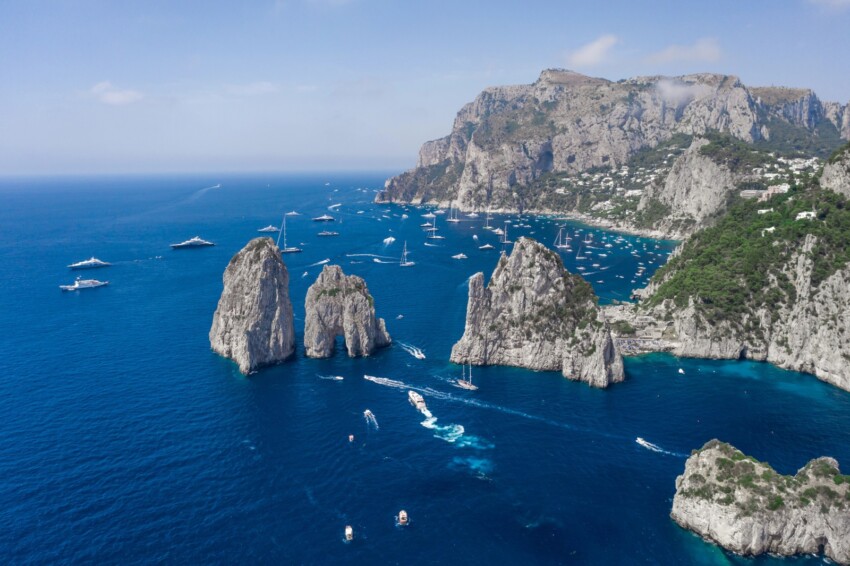
The Faraglioni are the image of Capri, but by now they are also the image of the entire Mediterranean. They appear on postcards, on bottles of limoncello, on posters of shipping companies, in films by Federico Fellini and in the poetry of Pablo Neruda. They have been painted by Corot, photographed by Cartier-Bresson, and beloved by every traveller who has stopped on this island for the past two thousand years.
They are far more than a postcard: they are a complex geological system, an exclusive habitat for one of Europe’s rarest animal species, a site that the ancient Romans dotted with villas and nymphaea, and a visual landmark that changes appearance depending on whether you view it from the top of Monte Solaro, from the viewpoint at Punta Tragara, from a boat at sea or from the rocks at their base whilst waiting for the right wave to dive.
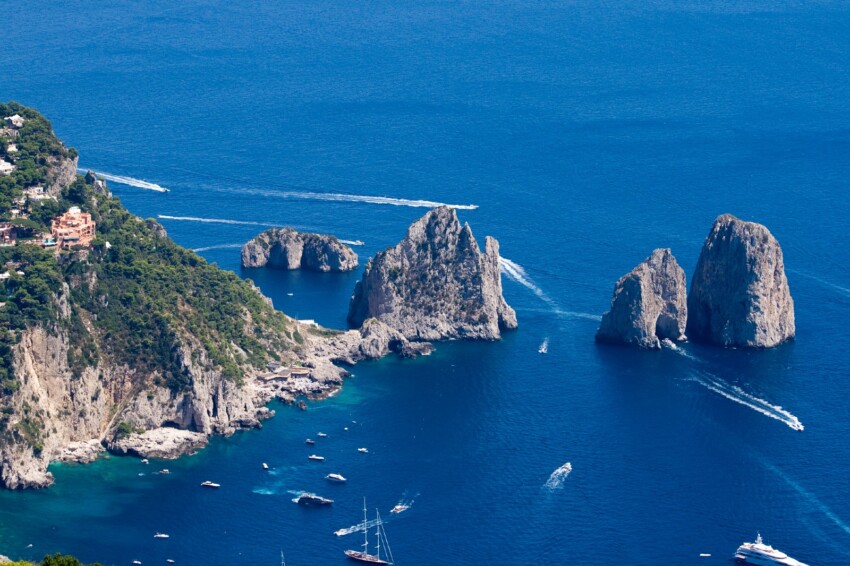
The Faraglioni are commonly referred to as three, but there are actually four distinct rock formations, each with its own name, height and characteristics. The name “faraglione” derives from ancient Greek pharos, meaning “lighthouse”, because since ancient times great fires were lit on the peaks of these rocks to guide sailors and signal the presence of dangerous obstacles along the coast.
The Faraglione di Terra, also called Stella or Saetta depending on local tradition, is the tallest of the three at 109 metres and is the only one still physically connected to the island’s coastline.
The name “Stella” probably refers to a Marian cult, the Madonna della Libera, also known as Stella Maris, to whom a 14th-century chapel on nearby Monte Castiglione was dedicated.
From the mainland, its profile rises vertically above the bay of Marina Piccola with a majesty that recalls the flying buttresses of a Gothic cathedral. It is the visual starting point of the entire sequence: from the Piazzetta, from the Gardens of Augustus and from the viewpoint at Tragara, the eye always begins here and then sweeps towards the open sea.
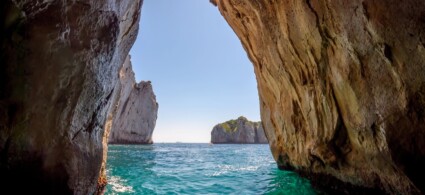
The Faraglione di Mezzo is the smallest of the three in height (81 metres) but the most celebrated for its most extraordinary feature: a natural gallery 60 metres long that passes through it from side to side, creating an arch over the sea through which light creates effects of reflection and contrast of great beauty.
This arch is the subject of the most iconic photographs of the Faraglioni, and popular tradition has made it the magical place for lovers: legend has it that exchanging a kiss while passing under the arch brings good fortune to a couple. For decades, small fishing boats and motorboats from organised tours brought visitors to pass literally under the gallery, making that moment the emotional climax of every island tour.
However, it is important to note a significant change: passage by boat under the arch of the Faraglione di Mezzo is no longer permitted, for reasons of safety and environmental protection related to the high volume of boat traffic and the fragility of the rock formation. Boats today approach at a controlled distance, still allowing a complete and close-up view of the gallery without manoeuvres that could damage the rock walls. The gallery remains perfectly visible and photographable from the outside.
The Faraglione di Fuori, also known as Scopolo, from the Greek “skopelos“, meaning headland at sea, is the outermost of the three and the second tallest at 104 metres. Separated from the Faraglione di Mezzo by an arm of open sea, it is physically the most isolated and the wildest.
It is the only habitat in the world of the blue lizard (Podarcis siculus coeruleus), one of Europe’s rarest endemic species: a reptile whose evolutionary history represents in itself one of the most fascinating chapters in Mediterranean island biology.
Those who manage to approach the Scopolo by kayak or small boat in the early morning hours, when the lizards are already active but tourists are still asleep, can observe these small blue reptiles moving over the sun-warmed rocks with the same ease as they did before Capri became the most famous island in the Mediterranean.
Hidden behind the three main rocks, visible only from the sea or from the highest altitudes of the island, the Scoglio del Monacone is Capri’s fourth faraglione, almost always overlooked by guides and organised tours.
Its name recalls the monk seal, Monachus monachus, known locally as “sea ox”, which once inhabited the marine caves of the entire Campania coast and found refuge here until the early 20th century: the last specimen was killed in 1904 near Palazzo a Mare, an event that marked the definitive local extinction of this species in the Capri area.
On the rock are remains of Roman masonry whose function is still debated: some theories attribute them to tanks for salting fish, others to accessory structures of the villa of Gradola, and others, less credible but more romantic, to the tomb of Augustus’s architect, a certain Masgaba.
The Faraglioni did not exist in their present form a few million years ago: they were an integral part of the limestone platform that forms the geological substrate of Capri. Their genesis is a long and stratified process that geologists call karst erosion: the slightly acidic waters of rain, percolating through the limestone rock for millennia, have carved out cavities and galleries down to 15 metres below the current sea level. This system of underground caves and tunnels, invisible on the surface, formed the hidden supporting structure of the Faraglioni.
The next phase was disintegration: with the rise in sea level and the intensification of marine abrasion, the vaults of the cavities began to give way one after another. Progressive collapses isolated sections of rock from the main coast and shaped the vertical forms we admire today.
The only structure to survive almost intact is the natural gallery of the Faraglione di Mezzo, which in fact expanded thanks to the same rockfall events that destroyed the surrounding structures, a geological paradox that created the most celebrated characteristic of the entire formation.
The ancient Romans recognised the southern coast of Capri, at the foot of the Faraglioni, as one of the most beautiful and desirable places in the Mediterranean. The entire area was scattered with luxurious patrician villas and imperial residences with hanging gardens overlooking the sea: the remains of some of these structures are still identifiable on the heights above Punta Tragara and along the Pizzolungo path.
The Palazzo a Mare, the Roman structures of Gradola and villa ruins identified at various points along the southern coast testify to an intense and prolonged occupation that lasted throughout the imperial period. The emperor Augustus and later Tiberius, who moved the effective capital of the Empire to Capri in the last ten years of his life, particularly loved this side of the island for the combination of protection from north-westerly winds and openness towards the gulf and the Sorrentine Coast.
Ancient literature multiplied the mythological meanings of the Faraglioni until they became a space of overlap between the real world and that of myth.
Homer in the Odyssey identifies them with the boulders hurled by the cyclops Polyphemus against Ulysses’ ship as he fled from the cave: the three rocks emerging from the sea are the result of that cyclops’ fury, impressed in stone for eternity.
Virgil in the Aeneid prefers another tradition and makes the Faraglioni the home of the Sirens, the creatures with enchanting voices that seduced sailors to their death: the Siren Leucosia is said to have inhabited in particular the Faraglione di Fuori (Scopolo), from where she sang towards the gulf.
Local legend adds a detail of domestic magic: the Faraglioni, because of their name deriving from “lighthouse” and their function of illuminating the horizon, are said to have the power to make the women of the island fertile.
During the 20th century, the Faraglioni became the privileged backdrop to the international cultural life that made Capri its summer headquarters. Painters, writers, musicians, actors and aristocrats from across Europe chose the villas of Punta Tragara or Via Tragara, with windows open onto the silhouette of the three rocks, as places of creative retreat.
The Hotel Punta Tragara, built by Le Corbusier in the 1920s as a private villa and later transformed into a luxury hotel, is perhaps the most concrete symbol of this era: from every window and the main terrace, the Faraglioni are the panorama that meets the eye.
Writers such as Pablo Neruda, who composed verses inspired by their form, and photographers such as Henri Cartier-Bresson, who immortalised them in photographs that became classics, helped construct the modern iconography of Capri.
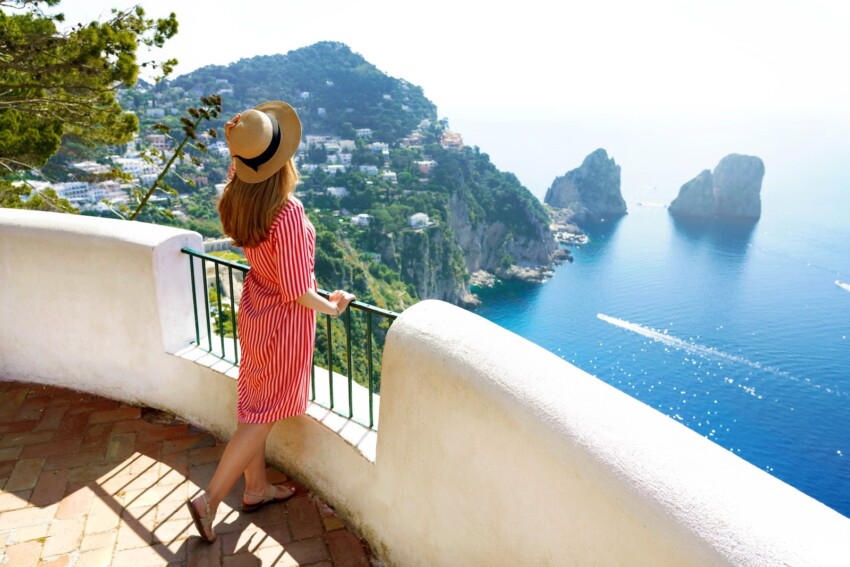
The Faraglioni can be seen from almost every point on the island, but some viewpoints offer particularly memorable perspectives and deserve a dedicated stop during your visit.
It is the most classic and most loved vantage point: Punta Tragara is reached from the Piazzetta by walking along Via Camerelle, the luxury shopping street, and then Via Tragara to the terminal viewpoint, a wide natural terrace that overlooks the three Faraglioni at almost the same level.
The distance is just right to appreciate the actual proportions of the rocks, their colours that change with the light of day and the sea that surrounds them. The walk from the Piazzetta takes about 20-25 minutes at a leisurely pace. From the viewpoint, the Pizzolungo path descends towards the coast with a scenic route that reaches, among stairways and natural terraces, the beach establishments at the foot of the Faraglioni.
The Gardens of Augustus, open to the public with a paid entrance, offer one of Capri’s most photographed terraces: from the main overlook you can see simultaneously the Faraglioni, the bay of Marina Piccola and the sinuous route of Via Krupp, the road with tight hairpin bends carved into living rock at the beginning of the 20th century by order of the German industrialist Friedrich Alfred Krupp.
When Via Krupp is open to pedestrian traffic, which depends on the state of the rock, subject to rockfalls, it offers itself a descent to Marina Piccola of great beauty, with the Faraglioni as a constant backdrop. The combination of Gardens + Via Krupp is one of the most visually rewarding routes on the island.
Those who ascend to Monte Solaro, Capri’s highest point at 589 metres, by chairlift from Anacapri see the Faraglioni as Tiberius saw them from his Villa Jovis: small, distant, yet unmistakably recognisable in their unmistakable form, with the open sea behind them and the Sorrentine Coast in the background.
The panorama from Monte Solaro embraces the entire gulf: Naples, Mount Vesuvius, the islands of Ischia and Procida, the Amalfi Coast and, on the clearest days, even Sicily. The Faraglioni, from this altitude, appear as three fragments of rock suspended between the blue of the sky and that of the sea.
A few minutes from the viewpoint at Punta Tragara, taking a less marked path, you reach the small viewpoint of Punta Cannone, what foreign painters called Maler Platte (“the painters’ table”) in the early 20th century because this was where they set up their easels to capture the view of the Faraglioni.
It is less crowded than Punta Tragara and offers a slightly different perspective: the Faraglioni appear more frontal, with fewer architectural interruptions in the visual field. For those who want to photograph them calmly and without other people’s shoulders in the frame, especially during peak hours, Punta Cannone is the simplest answer.
Marina Piccola, the small harbour and bathing area on the southern side of the island, offers the closest perspective of the Faraglioni from land: at this short distance, the rocks seem huge and almost reachable by swimming, which in fact, for the more experienced swimmers, is possible.
Marina Piccola port is reached from the Piazzetta by bus (frequent and fast) or on foot via Via Krupp when it is open. It is also the departure point for water taxis and small boats that go to the beaches at the foot of the Faraglioni.
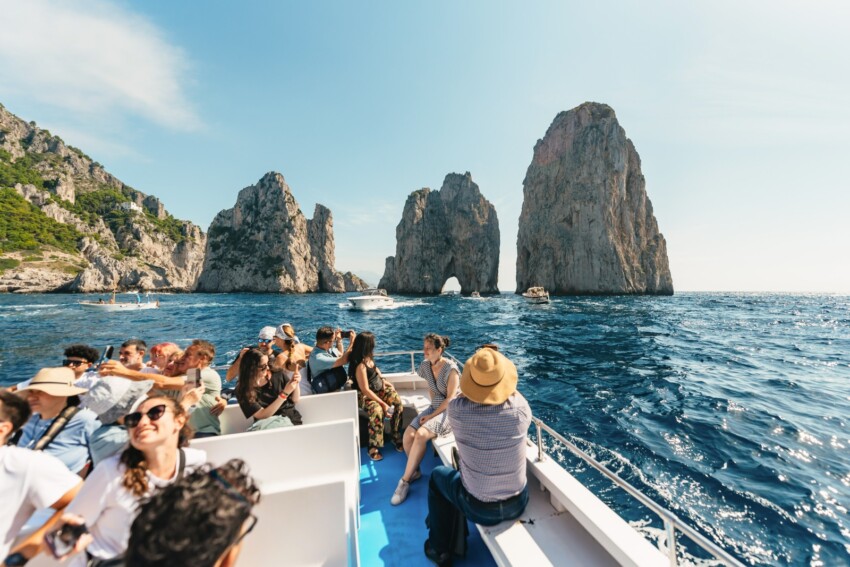
The most comprehensive and visually striking perspective of the Faraglioni is from the sea, sailing along the island’s southern coast a few hundred metres from the rocks.
A speedboat tour around the island is the most convenient and popular option: the tour lasts around 1–2 hours, passes close to the main coastal landmarks—the Natural Arch, Villa Malaparte, the Green Grotto, the White Grotto, Punta Carena Lighthouse—and stops near the Faraglioni for photographs.
As noted earlier, boats can no longer pass through the gallery of the central Faraglione, but the proximity that vessels can reach is sufficient to fully appreciate the scale and geology of the rocks.
For those seeking a more intimate and personalised experience, traditional wooden boats and private water taxis from Marina Grande and Marina Piccola allow you to choose your own schedule and route freely. Early morning, when light is still low and angled, and late afternoon, with warm golden light bathing the rock, are when the Faraglioni look their best from the sea and boat traffic is lighter.
In summer, by mid-morning, the area is crowded with dozens of boats at once. The more adventurous can hire a kayak from Marina Piccola or Fontelle beach: paddling slowly allows you to approach the rocks from angles impossible for motorboats.
At the foot of the Land Faraglione, directly on the rocky shore, are two beach clubs that became iconic landmarks in their own right over the twentieth century: La Fontelina and Da Luigi ai Faraglioni.
Both have wooden platforms on the rocks for sunbathing, direct sea access, loungers and parasols, and quality seafood restaurants. Having a plate of spaghetti alle vongole or scampi risotto with the Faraglioni just metres away and the sea stretching before you—that’s the quintessential Capri experience the world dreams of.
Getting there is part of the adventure. From Punta Tragara, a scenic trail descends towards the sea via a series of staircases and uneven sections: the route takes about 15–20 minutes downhill in comfortable, sturdy shoes suitable for rough terrain. The return journey, naturally, is more challenging and should be planned with your remaining energy and any meal consumed in mind.
Alternatively, especially for the return trip, the beach clubs organise a water taxi shuttle service to Marina Piccola: you book directly at the establishment and avoid the climb. From Marina Piccola, private water taxis reach both clubs in just minutes.
Booking parasols and restaurant tables is mandatory in summer and must be done by contacting the establishments directly, ideally several days in advance during July and August.
City Card allow you to save on public transport and / or on the entrances to the main tourist attractions.
 Hotel
Hotel  Budget accommodations
  Apartments
  Family Hotel
  Luxury Hotel
  Resorts