Pompeii: Entry Ticket with Audio Guide
13.560 reviews
Buy now
From 34,50€ per person
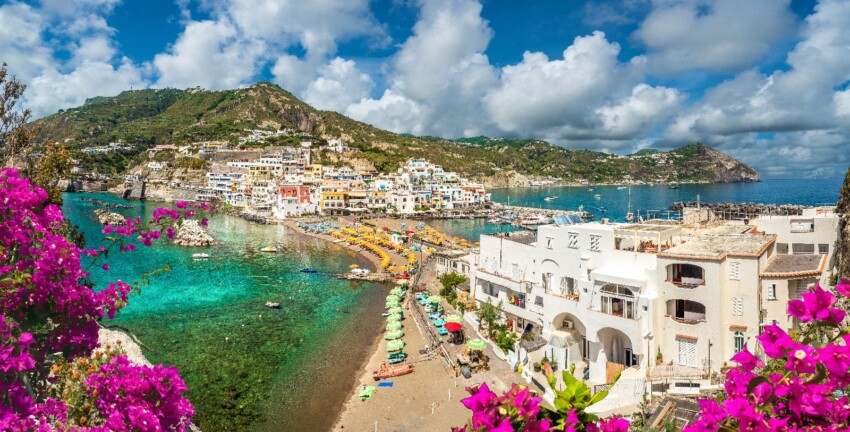
Ischia is the largest island in the Gulf of Naples, the most volcanic, the greenest and the one with the longest beaches: characteristics that set it distinctly apart from Capri and Procida and make it a destination requiring a completely different approach to visiting.
This isn’t a day-trip destination; three days is the bare minimum to truly understand it, nor can you do it justice without grasping that its true essence doesn’t lie in the port or equipped thermal spas, but in the volcanic interior, in still-authentic fishing villages, in the thermal springs that bubble freely in the sand or mingle with the sea at the base of a cove.
The island is divided into six municipalities: Ischia, Casamicciola, Lacco Ameno, Forio, Serrara Fontana and Barano, each with its own character, and exploring them all is one of the most rewarding things you can do on a three-day Campania holiday.
This itinerary is designed for those with three full days who want to see the best without wasting time: the Aragonese Castle and its cloistered secrets, free thermal springs in scorching sand, a foot ascent of Mount Epomeo, the village of Sant’Angelo at sunset, the tropical gardens of La Mortella and the white silhouette of the Church of Soccorso against the orange sky.
The first day is devoted to orientation and history: the best way to begin any visit to Ischia is to understand where it is and what it’s like before heading off to the thermal springs and beaches.
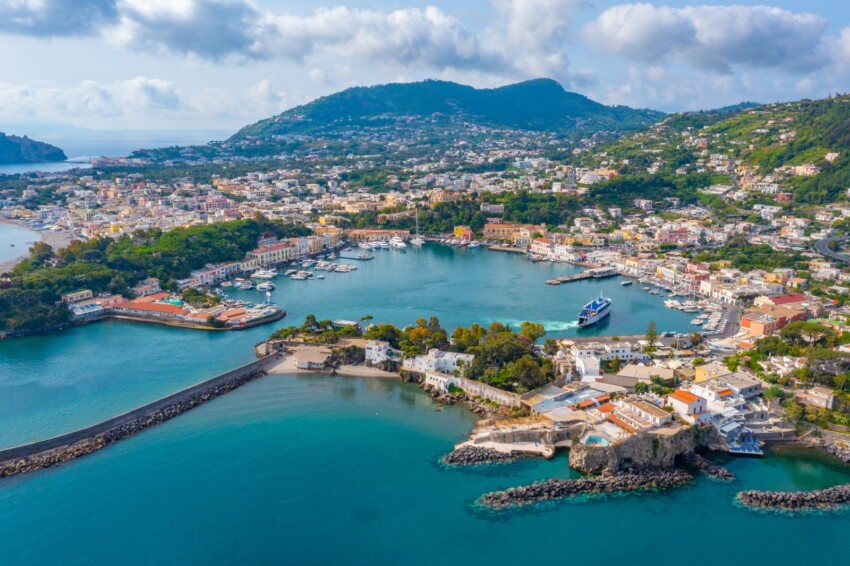
As soon as you disembark at Ischia port1, take a moment to observe the shape of the water basin you’re in: Ischia’s circular port isn’t a man-made construction, but the crater of an ancient extinct volcano, opened to the sea in 1854 on the orders of Ferdinand II of Bourbon.
Its perfectly circular shape makes it immediately recognisable from above and is one of the first things that surprises arrivals unaware of the island’s volcanic nature. Along the port’s perimeter line bars, restaurants and shops: it’s the island’s liveliest heart, noisy and colourful, ideal for a coffee and a sfogliatella before starting your day.
From Ischia Porto you can reach Ischia Ponte2 on foot in about 30 minutes along the seafront, or in a few minutes by local bus. Ischia Ponte is the oldest village on the island, the one that developed around the bridge that Alfonso d’Aragona had built in 1441 to connect the castle islet to the mainland: narrow streets, low houses painted in pale colours, a few trattorie where you can stop for lunch based on fresh fish.
The Fishermen’s Beach, nestled between the village and the rocks below the castle, is one of the island’s most picturesque and photographed spots.
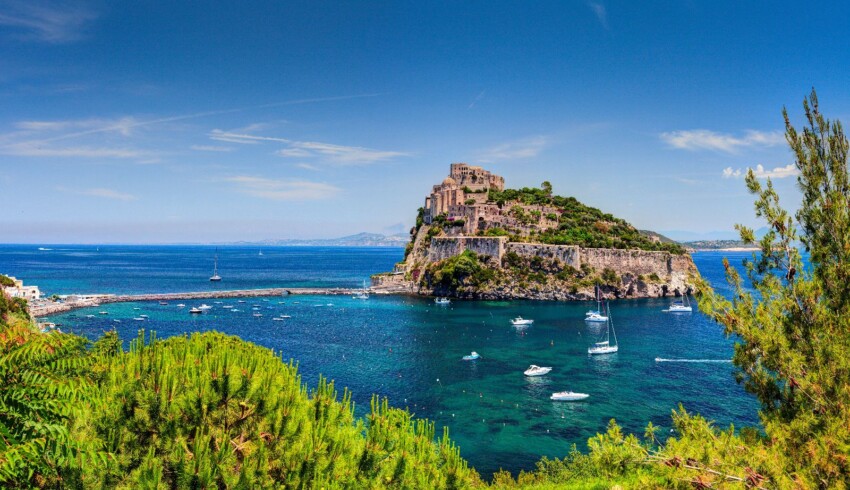
The Aragonese Castle3 is Ischia’s iconic monument and one of the gulf’s most fascinating: a fortress built on an islet of volcanic rock, connected to the mainland by a 220-metre bridge that Alfonso I d’Aragona had built in 1441, transforming a Greco-Roman ruin into one of the Mediterranean’s most powerful strongholds.
The islet’s history dates to the 5th century BC, when the Greek tyrant Hiero of Syracuse built the first defences here. Over the centuries it was conquered by Romans, then Visigoths, Vandals, Ostrogoths, Normans, Swabians and Angevins. The great eruption of Mount Epomeo in 1301 destroyed much of the island and forced the entire population to take refuge on the rock: by the early 18th century, 1,892 families lived within the castle walls, with convents, seminary, cathedral, seventeen churches, bishop and garrison.
The castle reached its cultural peak in the late 15th century, when the poet Vittoria Colonna (1501–1536) settled here: her wedding to Fernando Francesco d’Avalos, Marquis of Pescara, was celebrated in the castle’s cathedral on 27 December 1509. Over the following decades, Vittoria Colonna transformed the castle into one of Italy’s most vibrant cultural centres, frequented by Michelangelo Buonarroti, Ludovico Ariosto, Jacopo Sannazaro, Bernardo Tasso and many other Renaissance intellectuals. The bond between Michelangelo and the poet has been described by some historians as the most important of the artist’s sentimental life: Michelangelo’s Sonnets to Vittoria Colonna rank among Italian literature’s finest.
The castle tour includes more than twenty stops: the Cathedral of the Assumption (14th century, damaged by Bourbon bombardments in 1800 and left open to the elements; in summer it hosts concerts in the open-air auditorium), the Convent of the Poor Clares founded in 1575 by Beatrice Quadra, widow of Muzio d’Avalos, the Cemetery of the Nuns, the most unsettling and unforgettable stop, and the Bourbon prisons.
The Cemetery of the Nuns, also called the Putridarium, contains the so-called “scolatoi” (draining chairs): perforated stone seats on which the bodies of the Poor Clares were placed to decompose slowly, whilst the living nuns were obliged to pray beside them every day, meditating on the fleeting nature of earthly life. The nuns who spent hours in this unhygienic environment frequently fell ill and soon ended up occupying one of the draining chairs themselves. The Convent was closed in 1810 by a decree from Joachim Murat that suppressed religious orders in the Kingdom of Naples.
The castle is open year-round from 9:00am to sunset, with annual closure for maintenance from 7 January to early March. A complete visit requires at least two hours.
Ischia Ponte concentrates some of the island’s best restaurants in a more intimate and less hectic atmosphere than the port.
This is the time to try Ischia cuisine: rabbit Ischian-style, the island’s signature dish that always surprises visitors expecting fish but finding instead a hearty stew redolent with tomato, garlic, white wine, thyme and marjoram, and fresh fish of the day.
Local wines to look for on the wine list are Biancolella (an aromatic white made from native grapes grown on volcanic terraced slopes) and Piedirosso from Ischia (a fruity, light red). After your meal, don’t refuse the rucolino: the Ischian digestivo made from wild rocket, a green and peppery bitter that has become one of the island’s gastronomic symbols.
The second day is devoted to the experience for which Ischia is most famous worldwide: its thermal waters. The island is crisscrossed by a system of hydrothermal springs, a remnant of the volcanic activity that shaped its geology, delivering water with temperatures between 20 and 100°C rich in minerals, sulphides and trace elements with therapeutic properties known to the Romans and commercially exploited since the 19th century.
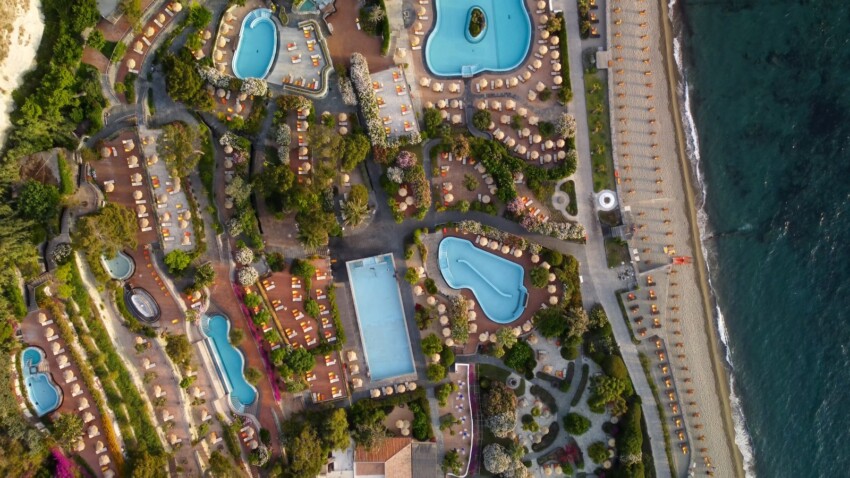
Your morning choice is between those wanting the comfort of a large equipped thermal park and those preferring the more authentic experience of free springs.
The Poseidon Gardens4, in Citara bay in Forio, is the island’s largest and most famous thermal park: over 20 thermal pools at varying temperatures set in a well-maintained Mediterranean garden, with saunas, steam baths, solarium, private beach on Citara bay, restaurants and wellness centre. It’s one of Europe’s largest thermal parks.
It’s open from late April to late October, 9:00am to 7:00pm, and booking is advised in high season. Those preferring Negombo, the island’s most refined thermal park, in the beautiful San Montano bay between Lacco Ameno and Forio, will find a more intimate and aesthetically polished atmosphere, with 12 pools carved into the rock on terraced levels overlooking the sea.
For those preferring free thermal springs, without facilities and gratis, the Forio – Sorgeto Bay5, accessible from the Panza district (Forio municipality) by descending a staircase of around 200 steps, is one of the island’s most authentic thermal experiences: a rocky cove where seawater mingles with thermal springs gushing from the seabed itself, creating a natural pool at varying temperature (around 30–35°C) with open sea ahead.
It’s particularly evocative on evenings and winter days, when steam vapour rises over dark water. Alternatively, the Nitrodi springs (in the Barano area), known to the Romans for their healing properties, gush from a rock in a wood and are freely accessible.
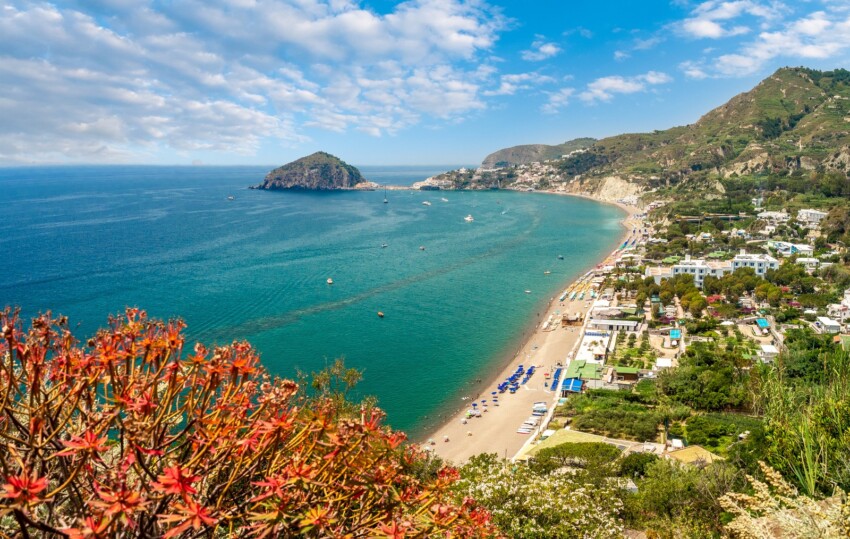
The Maronti Beach6, near the village of Sant’Angelo in Barano municipality, is Ischia’s longest beach: almost 3 kilometres of dark sand (volcanic colouration is more intense here than elsewhere) with free stretches and equipped facilities alternating.
It’s reachable from Sant’Angelo by taxi boat (frequent service, just minutes of navigation), the most convenient way, or on foot in around 20–25 minutes from the village. The water is crystal-clear and the seabed gradually slopes, making it suitable for everyone.
At the western end of Maronti you’ll find the Fumaroles: one of the island’s most spectacular thermal curiosities. In this stretch of beach, the sand is heated by geothermal energy from below to temperatures that in some spots reach 100°C.
You don’t walk barefoot, but lie on a thick towel for a free “sand sauna” that locals use for rheumatism, or take part in the island’s most curious tradition: cooking en papillote in the sand. Islanders dig a small hole in the scalding sand, place food wrapped in foil (potatoes, fish, mussels, vegetables) inside, cover it and wait: the sand cooks like a natural oven. It’s not an organised tourist attraction but a domestic and family practice, especially on summer weekends, that you can observe and, with a bit of friendliness, imitate.
Sant'Angelo7 is Ischia’s most photogenic and atmospheric village: a fishing community with houses painted in pastel colours that climb around a small piazza on the water, entirely pedestrianised and reachable from the rest of the island only on foot (the road ends a few hundred metres before the centre).
The atmosphere has something of the Sixties about it, the Italian jet-set that colonised the island in that period left here a patina of informal elegance that has never entirely disappeared, and Sant’Angelo’s piazza at sunset, with bar tables on the water’s edge and the promontory rock colouring pink, is one of the gulf’s most beautiful evening spectacles. It’s the right spot for your second day’s dinner.
The third day is the most varied and physically demanding: it begins with a climb to the extinct volcano that shaped the island and ends with one of Campania’s most spectacular sunsets.
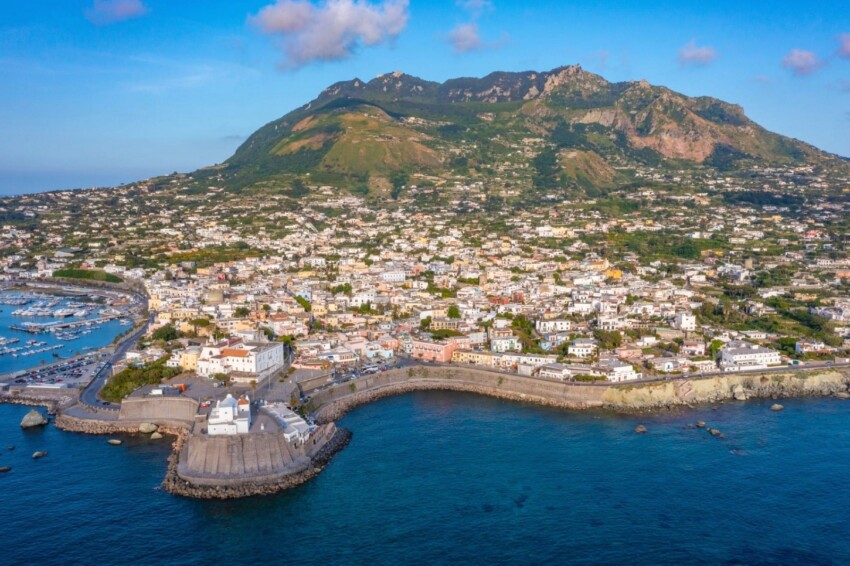
The Monte Epomeo8 is the volcano that created Ischia: a formation of green and grey tuff standing 789 metres high that dominates the centre of the island. Its last major eruption, in 1301, destroyed the medieval city of Geronda and forced the entire population to take refuge in the Aragonese Castle.
The climb up the mountain is one of the most rewarding hikes across the entire gulf. You start from the small village of Fontana, in the municipality of Serrara Fontana, reachable from anywhere on the island by local buses or taxi. From Fontana, a paved mule track ascends (you can also hire donkeys in the village to ride up) passing first through terraced vineyards that produce Biancolella and Piedirosso wines, then through cool, shaded chestnut woodland, and finally across bare green tuff rock where goats graze in the cliff faces and the first views of the island below emerge.
The climb takes around one hour at a moderate pace (the final stretch is steeper); the descent is quicker. At the summit, carved into the tuff like a medieval hermitage, you’ll find the tiny Chapel of San Nicola and the Geronimo restaurant, whose rooms are literally carved from volcanic rock: a timeless spot to stop for coffee or lunch with views spanning the entire island, Mount Vesuvius, the Amalfi Coast, Capri and, on the clearest days, the Lazio coastline.
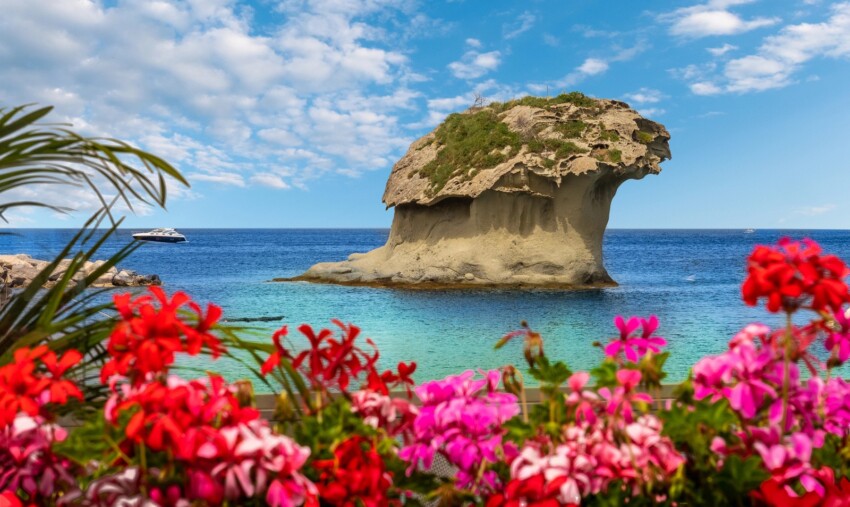
After descending from the mountain and heading back via local transport to the north-western side of the island, stop at Lacco Ameno9, Ischia’s smallest and most elegant municipality, with a sheltered waterfront dominated by the “Fungo” (Mushroom), a tuff formation shaped like a hat that rises from the sea in front of the harbour and has become the town’s bizarrely irresistible symbol.
Lacco Ameno is also home to one of the most interesting museums across all of Campania, often overlooked by tourists: the Pithecusae Archaeological Museum10, housed in the splendid Villa Arbusto (built in 1785 by Duke Carlo Aquaviva d’Atri, later purchased in 1952 by publisher Angelo Rizzoli, who transformed the island into a hub of Italian high society).
The museum preserves artefacts from the Greek colony of Pithecusae, the first Greek colony in the Western world, founded on the island between 770 and 750 BC by colonists from Chalcis and Eretria. It houses one of the most important discoveries in Mediterranean archaeology: the Cup of Nestor.
This is a modest Greek ceramic cup from the third quarter of the 8th century BC, discovered by German archaeologist Giorgio Buchner in the necropolis of Valle di San Montano. On its left side is scratched an inscription of three verses: one of the oldest examples of Greek alphabetic writing ever found, dating to Homer’s era. The text ironically alludes to the famous cup of the hero Nestor described in the Iliad: “I am the cup of Nestor, good for drinking. Whoever drinks from this cup will at once be seized by desire for fair-crowned Aphrodite.” A small terracotta cup that literally contains the dawn of the Western alphabet.
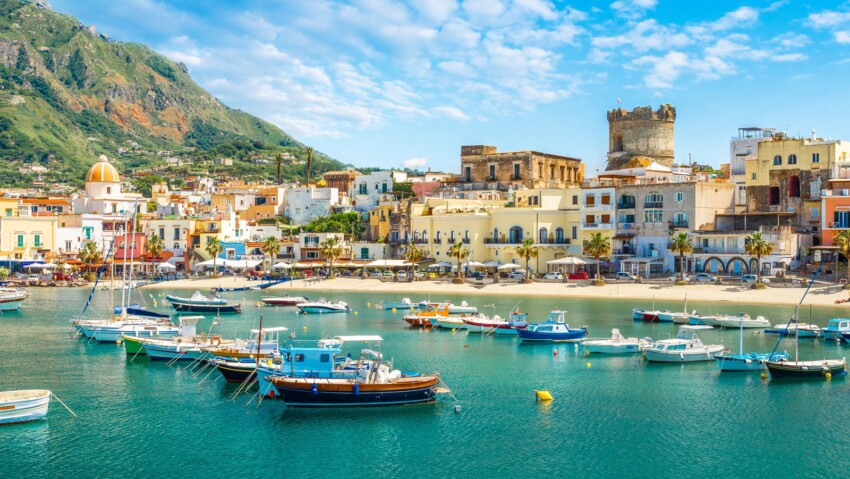
Just a few minutes by bus from Lacco Ameno, in Forio, you’ll find the La Mortella Gardens11, one of Italy’s finest private gardens and winner of TripAdvisor’s 2026 Traveller’s Choice Award. Created from 1956 onwards by Lady Susana Walton, an Argentine-born woman and wife of renowned British composer Sir William Walton, one of the 20th century’s greatest English composers, it was based on designs by celebrated landscape architect Russell Page.
The garden spans approximately 2 hectares divided into two sections: the lower garden in the Valley, tropical and shaded with tree ferns, giant water lilies and pools; the upper garden on the hillside, designed by Lady Walton after her husband’s death in 1983, featuring olive trees, agave, aloe (150 species donated in 2008), lavender and panoramic views over Forio bay. In total, the garden hosts over 3,000 plant species from around the world.
Before heading back, don’t miss the sunset from the Church of Soccorso12 in Forio: a small white church dedicated to Santa Maria della Neve, built on a promontory jutting into the sea at the point where Forio faces the setting sun. It’s one of Ischia’s most spectacular displays of colour. The white façade glows gold, then orange, then pink as the sun descends towards the Tyrrhenian Sea, and the church’s silhouette against the horizon is one of those landscapes you remember for a long time. Arrive twenty minutes early to find a comfortable spot, especially in summer.
In the following map you can see the location of the main places of interest mentioned in this article.
 Hotel
Hotel  Budget accommodations
  Apartments
  Family Hotel
  Luxury Hotel
  Resorts