Bestseller
Mount Vesuvius Excursion: Skip-the-Line Ticket and Digital Guide
From 16,00 €
Buy the ticket
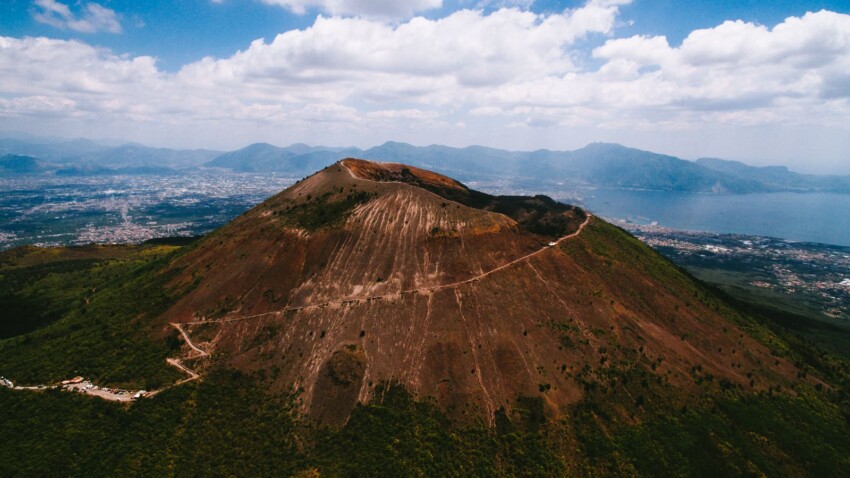
Regarded as one of the symbols that make up Naples’ past and present history, Mount Vesuvius is a volcano located within the Vesuvius National Park and stands as one of Campania’s most fascinating attractions. Known worldwide for the eruption of 79 AD, which destroyed numerous cities of the era with a rain of ash and pumice, including Pompeii and Herculaneum, which have now become important archaeological sites, Vesuvius had its last eruption in March 1944 when it destroyed the towns of Massa di Somma and San Sebastiano and blanketed much of southern Italy with ash.
The volcano, also known as Somma-Vesuvius, stands 1,281 metres high and is a typical “enclosed” volcano, as it sits within a caldera measuring approximately 4 km in diameter. Originally, the volcano comprised Monte Somma, which following a violent explosion collapsed at its summit and created a depression called a caldera. After volcanic activity resumed, the current structure of Vesuvius formed within it. The Vesuvius crater is elliptical in shape, 230 metres deep with a maximum diameter of around 650 metres.
Vesuvius is an exceptionally evocative volcano, not only because of its location but also its easy accessibility. For these reasons, there are several activities available in this area, such as arranging a fascinating visit to the Vesuvius crater or walking one of the wonderful trails through the Park, which allow you to discover the local flora and fauna.
Throughout history and owing to its geological formation, Vesuvius has been a volcano that has inspired countless stories, myths and legends. Because of this mysterious yet captivating aura, many people decide to organise an excursion to visit this remarkable place.
Due to the significant geological, biological and historical interest of this area, since 1995 Vesuvius has been part of the Vesuvius National Park, which currently features 11 routes totalling 54 km of walking paths.
The most popular excursion among visitors wanting to explore Vesuvius is the route that allows you to admire the volcano’s crater and reach the Gran Cono of Vesuvius.
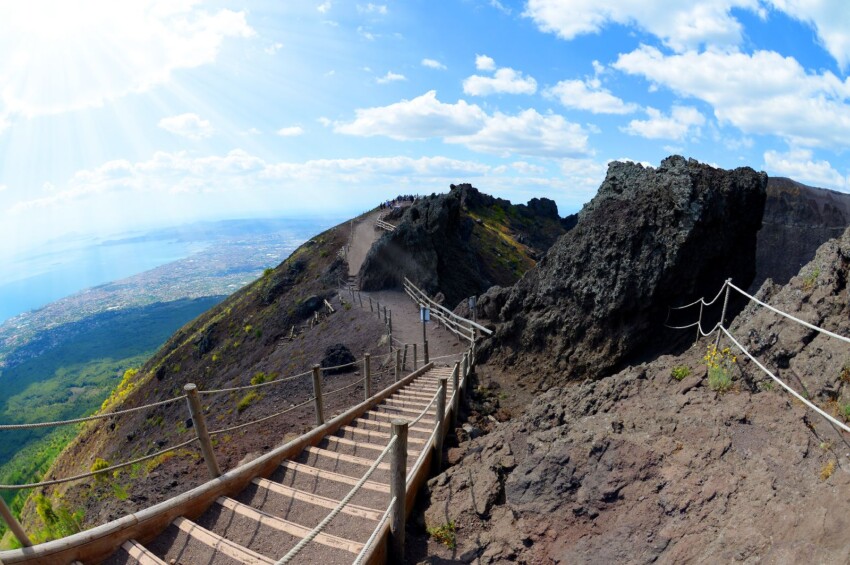
Exhilarating and highly atmospheric, a visit to the Vesuvius crater is undoubtedly an experience well worth having. Via nature trail no. 5, known as “Il Gran Cono“, you can walk the route that traces the lower rim of the Vesuvius crater.
The trail, almost 4 km long, reaches a maximum elevation of 1,175 metres and offers an incredible view over Monte Somma, the Valle del Gigante, which in spring turns yellow with broom vegetation, and across the entire Gulf of Naples. The crater and its unique substrate also provide the ideal habitat for various bird species including the black redstart, black-capped redstart, wheatear and finch.
The excursion begins from the Piazzale at 1,000 metres above sea level in Ercolano, at the end of the Ercolano-Vesuvio Provincial Road, a location that already offers a splendid view of the northern slopes of Monte Somma, where Punta Nasone is located. At 1,132 metres altitude, this peak represents the summit of the ancient volcano.
The trail can only be walked accompanied by authorised Alpine and Volcanological Guides approved by the Campania Region, and requires payment of an entrance fee.
Opening times for crater visits:
The Vesuvius crater can be visited throughout the year, however it’s advisable to avoid winter when adverse weather conditions sometimes make the excursion impossible.
Summer is a suitable season for visiting the crater, though temperatures can be quite high, which may make the walk challenging. For this reason, we recommend that those planning to undertake this adventure during the summer months do so in the early morning or late afternoon to avoid the highest temperatures.
The best seasons to visit the volcano are therefore spring and autumn, when the weather is mild and nature displays spectacular colours.
Entrance tickets for the Gran Cono visit are available exclusively online, up to a maximum of 30 days in advance. We recommend completing your purchase before arriving at the Park entrance to avoid any potential connection issues.
To ensure safety and environmental protection, access is limited to groups of 60 people every 10 minutes.
Visiting the Vesuvius crater is a unique and unforgettable experience, which is why we recommend booking a guided tour online with expert and professional staff who will allow you to explore this mysterious volcano in depth.
To reach the starting point for the Vesuvius excursion by car, take the A3 Naples-Salerno motorway and then exit at Ercolano.
Once you’ve exited, follow the SP144 until you reach the car park at 800 metres altitude.
From the car park, you need to reach the Piazzale Quota 1000 m platform, which can be done in two ways:
Alternatively, you can take the train to Ercolano Scavi station, from where taxis or private shuttles depart for the Park entrance, or to “Pompeii – Villa dei Misteri” station where the EAV bus service is available, which also goes to the Park entrance.
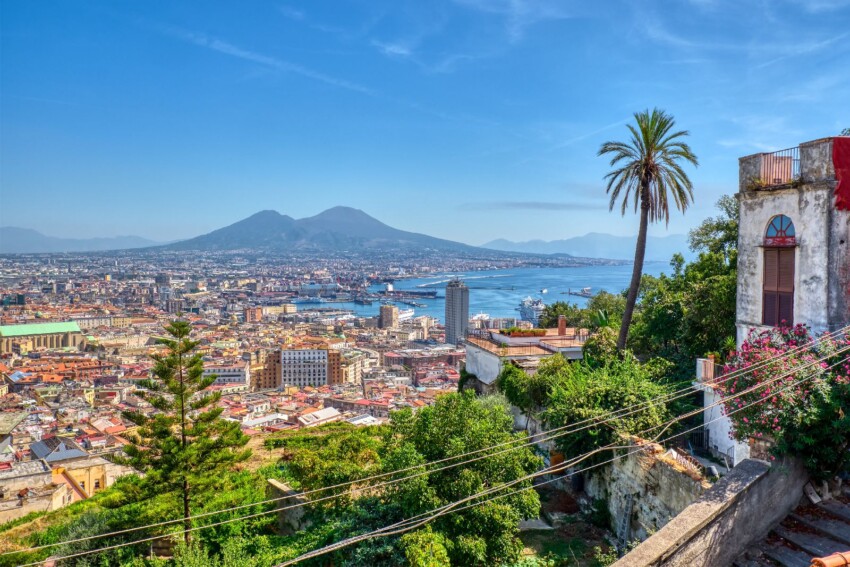
Vesuvius is certainly one of the attractions you cannot miss during a trip to Campania, and for this reason you’ll find numerous accommodation options in its vicinity. Both within the Park and in the immediate surroundings, you can find various facilities such as bed and breakfasts, small inns and even more luxurious hotels.
Bear in mind that it’s also possible to make a day trip to the volcano from the area’s main cities such as Naples, Pompeii, Herculaneum and Sorrento. Therefore, you may want to consider staying in one of these locations where accommodation options are extensive and prices are often very competitive.
Interesting fact: along the Caracciolo waterfront in central Naples, there is a luxury hotel named after the volcano: the Grand Hotel Vesuvius, from which you can admire a magnificent panorama.
The routes you can follow within the Vesuvius National Park are numerous and encompass points of both natural and historical interest.
Trail no. 1, almost 12 km long, is considered one of the longest trails in the Park and begins with hairpin turns that cross the Vallone Tagliente before continuing along a path that winds first through a pine forest and then through mixed woodland of chestnuts, Neapolitan alders, maples and many other species. The walk is a truly emotional experience as it allows you to admire the eruptive vents that formed between the 1800s and 1900s and the lava dome from 1937.
The route continues along the Valle dell’Inferno, which is characterised by majestic walls of lava rock inhabited by cliff-dwelling birds such as the raven and peregrine falcon. After crossing the valley, you climb again along the Cognoli di Levante where you can see channels carved by lava. Although the maximum elevation reached is below 1,000 metres above sea level, the shape of the terrain makes this one of the most challenging routes within the Park.
One of the most beautiful and panoramic routes in the Park is certainly Trail no. 2, which offers stunning views. The route allows you to reach Largo Angelo Prisco, dedicated to a young finance officer killed by poachers in 1995, and then traverses forested areas alternating with lava rock terrain. After a steep section, you reach the Cognoli di Ottaviano, which represents the highest point.
From a fauna perspective, this area is home to numerous bird species including the lesser spotted woodpecker. The trail, just over 8 km long, reaches a maximum elevation of 1,112 metres above sea level and is a particularly atmospheric route that offers views of the imposing Punta Nasone, the Gran Cono of Vesuvius and the Atrio del Cavallo flooded by the 1944 lava flow.
Known as Trail no. 3, this route takes you to Punta Nasone, which at 1,132 metres is the highest peak of Monte Somma. This enchanting circular route is 7.65 km long overall and offers beautiful panoramas: on one side across the Gulf of Naples and the Campanian Plain, and on the other over the Tirone-Alto Vesuvio Reserve and the Cognoli di Ottaviano.
After a climb, which can be quite demanding in places, you reach Punta Nasone, which overlooks the Valle del Gigante and offers a view of a branch of the 1944 lava flow. At the summit you’ll find small refreshment points, a cross and a chapel dedicated to the Madonna.
Covering an area of approximately 1,000 hectares, the Tirone-Alto Vesuvio Forest Reserve consists of dense domestic pine woodland and is home to a plant known as “Venus’s Navel”, which owes its name to its distinctive round leaves characterised by a central cavity. You can also find various animal species here, including the rare saettone or Aesculapian snake (a large and harmless serpent), whilst during spring numerous species of wild orchids bloom.
The trail you can walk is approximately 11 km long and offers glimpses of the azure sea of the Gulf of Naples as well as views over the slopes of the imposing Gran Cono. Here too you can find a vantage point to observe a secondary branch of the 1944 lava flow.
Mount Vesuvius is located 25 km south-east of Naples, within the Vesuvius National Park, approximately 23 km from Pompeii, 13 km from Herculaneum and less than 50 km from Sorrento.
City Card allow you to save on public transport and / or on the entrances to the main tourist attractions.



 Hotel
Hotel  Budget accommodations
  Apartments
  Family Hotel
  Luxury Hotel
  Resorts