From Naples: Pompeii Ruins & Mount Vesuvius Day Tour
14.104 reviews
Buy now
From 67,20€ per person
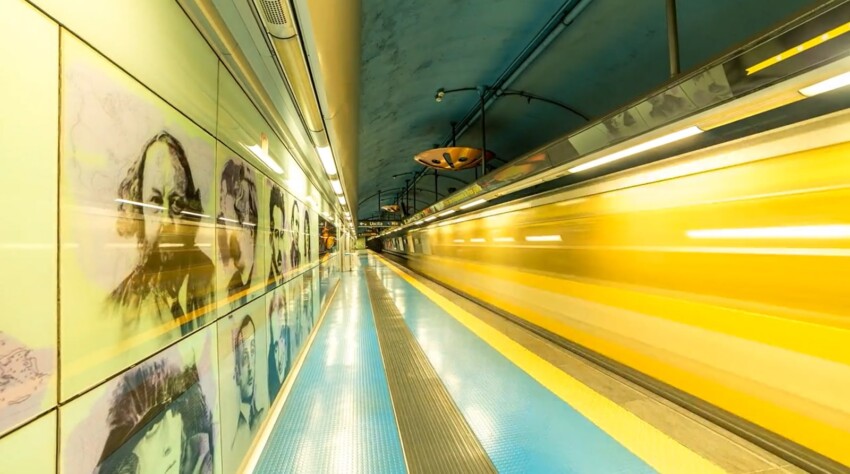
Chaotic and heavily congested, Naples boasts an extensive public transport network that, after Rome and Milan, makes Naples Metro the third largest metropolitan system in Italy. Naples Metro comprises two urban lines: Line 1, which opened in the early 1990s, and Line 6, which reopened to the public on 17 July 2024 with the completion of the new stretch to Piazza Municipio. Both of these lines, along with four funicular railways, are operated by ANM, Azienda Napoletana Mobilità, the public company owned by the City of Naples.
The stations on Line 1 are part of the Art Stations circuit, where the public transport environment blends with contemporary art elements, and the line is interconnected with three city funiculars, Line 2 operated by Trenitalia, the former Circumvesuviana and the Rainbow Line (which connects Naples – Giugliano – Aversa).
Line 2, also known as “Metropolitana FS”, was inaugurated in 1925 by the fascist regime and has been in continuous development ever since. The line runs across Naples from west to east along the city’s railway bypass. These metro lines are complemented by the Cumana, Circumflegrea and Circumvesuviana lines managed by the Ente Autonomo Volturno (EAV).
Here, then, is a useful guide to the metro lines of Naples with information, stops, timetables and fares.
By clicking the button below you can download the Naples public transport map, showing the routes of all Naples metro lines, funiculars, urban, suburban and regional railways.
Naples Transport Map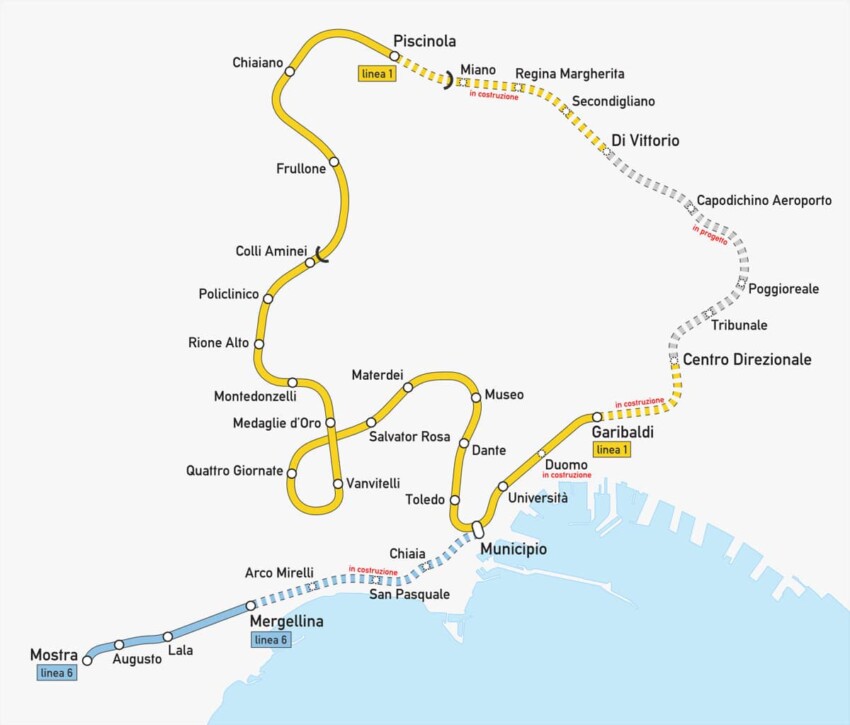
Also known as the “hill metro”, Line 1 connects the eastern terminus at Centro Direzionale with the northern terminus at Piscinola/Scampia, passing through the centre of Naples. Line 1 is considered the fastest and one of the busiest metro lines, as it allows access to central areas such as Piazza Cavour, Piazza Municipio, Naples Harbour and Corso Umberto I.
The line currently has 20 stations and stretches for 20.7 km with a total journey time of approximately 34 minutes.
Line 1 opened in March 1993 with an initial section from Vanvitelli to Colli Aminei and continues to develop. Following the opening, the addition of Tribunale station in 2026, the connection between Centro Direzionale and Capodichino Airport is being developed, which will make it possible to travel from the airport to the city centre in approximately 9 minutes by metro by 2027. An extension of the northern terminus from Piscinola to Di Vittorio is also planned, with new stations at Miano, Regina Margherita and Di Vittorio, which will close the line in a circular metro ring.
The stations on this stretch are also part of the Art Stations circuit, a Naples city council project designed to promote knowledge and awareness of contemporary artists’ works. Many of the stops have been designed by leading architects such as Gae Aulenti, Dominique Perrault, Oscar Tusquets and the EMBT studio founded by Enric Miralles and Benedetta Tagliabue.
On weekdays, approximately 242 services run daily with a frequency during peak hours of approximately 6–9 minutes and a speed of 32 km per hour.
The Line 1 stops, from east to north, are:
Under construction: Poggioreale stop between Centro Direzionale and Capodichino.
The following stations are also equipped with interchange car parks: Montedonzelli, Policlinico-Cardarelli, Colli Aminei, Frullone-San Rocco, Chiaiano-Marianella, Piscinola-Scampia.
The timetable for Line 1 of Naples Metro (always check updates on anm.it for any changes due to works):
On Friday and Saturday the timetable is extended:
A single journey ticket for Line 1 costs €1.50 (fare updated as of May 2024).
The daily ANM company ticket, valid for unlimited journeys until 24:00 on the day of validation, costs €4.50. The integrated 3-day ticket (valid on all ANM, EAV and Trenitalia services) costs €10.80 and is particularly useful for tourists.
There is also a 10-journey carnet (€13.50), a seven-day pass (€13.50, valid until 24:00 on the sixth day), a monthly pass (€35.00) and an annual pass.
Tickets can be purchased at authorised retailers UnicoCampania, ANM Points, automatic ticket machines in stations and via the ANM Go and UnicoCampania apps. Many stations also offer contactless payment directly at the turnstiles.
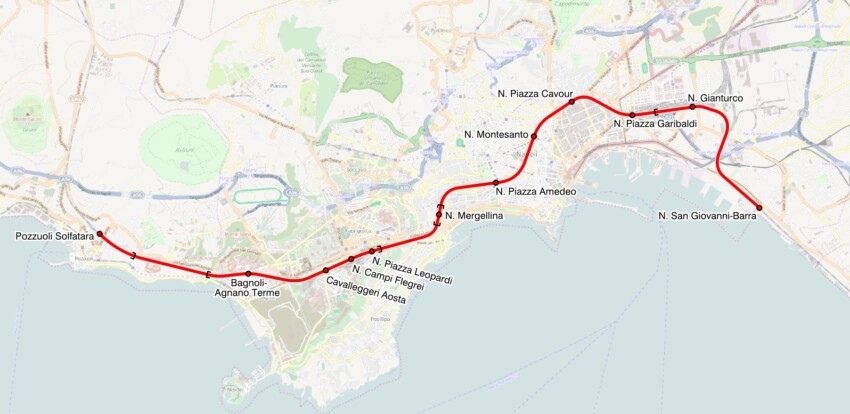
Considered one of the city’s most important transport arteries, Line 2 of Naples Metro connects the eastern area (Naples San Giovanni Station) with Pozzuoli, passing through central points such as Piazza Garibaldi, Piazza Cavour, Montesanto and Piazza Amedeo. Also known as “Metropolitana FS”, this line, inaugurated by the fascist regime in the 1920s, is still operated by Trenitalia and comprises 12 stops with a journey time of approximately 45 minutes from one terminus to the other.
The Line 2 stops are:
On weekdays, approximately 182 services operate with the following timetables:
The average is one service every 13 minutes on the stretch from Naples Campi Flegrei to Pozzuoli Solfatara, whilst between Naples Campi Flegrei and Naples San Giovanni-Barra the average is one service every 10 minutes.
A ticket for Line 2 of Naples Metro costs €1.50 and is valid for one journey. The integrated 90-minute ticket, which allows for one journey on the line plus one journey on all other consortium services within 90 minutes, costs €1.80.
Line 6 of Naples Metro, operated like Line 1 by ANM, reopened to the public on 17 July 2024 with the completion of the stretch to Piazza Municipio, after over a decade of closure for extension works. The line connects the Fuorigrotta district (Mostra terminus) with Piazza Municipio in the centre of Naples, covering approximately 5.5 km in 16 minutes. It has 8 stations (Mostra, Augusto, Lala, Mergellina, Arco Mirelli, San Pasquale, Chiaia, Municipio) and all are part of the Art Stations circuit. Municipio station, designed by Portuguese architects Álvaro Siza Vieira and Eduardo Souto de Moura, is the interchange hub with Line 1.
The three interchange hubs on Line 6 are: Municipio (Line 1 and ferries/hydrofoils to the islands), Mergellina (Line 2 and Mergellina Funicular), Mostra/Augusto/Lala (Cumana railway). From 2026, 22 new Hitachi Rail trains ordered by ANM will be progressively put into service, which will make it possible to increase frequency to one train every 4–5 minutes. Further extension towards Bagnoli and Posillipo is under study.
The stations on Line 6 are: Mostra, Augusto, Lala, Mergellina, Arco Mirelli, San Pasquale, Chiaia and Municipio.
A single journey ticket for Line 6 costs €1.50, the same as Line 1.
Completing Naples’ metro network are other lines operated by the Ente Autonomo Volturno (EAV) that are designated in the Municipal Transport Plan as: Line 3, Line 4 and Line 5.
What is defined as Line 3 according to Naples’ Transport Plan actually corresponds to the San Giorgio – Poggioreale – Naples section of the Circumvesuviana line. This section connects the centre of Naples with districts in the eastern area, terminating at San Giorgio a Cremano. On weekdays, trains run hourly with additional services every half hour during peak times, whilst weekend services are reduced.
The timetable for the first and last services are:
The Line 3 stops are:
Line 4 is identified as the urban section of the Circumvesuviana Naples – Ottaviano – Sarno line that runs from Naples Porta Nolana station to Vesuvio de Meis stop. On weekdays trains run hourly with service intensified at peak times to every half hour.
The timetable for the first and last services are:
The Line 4 stops are:
Line 5 is the urban section of the Circumflegrea line that connects Naples to Pianura. Trains on this line depart every twenty minutes from the Montesanto terminus and all continue towards Licola.
Service on this line is active from 5:12 to 22:08.
The stops in the urban area of Line 5 are:
Whilst the stops outside the urban area are:
Art Stations is a project conceived by the City of Naples to make metro stations more welcoming and pleasant, offering all passengers the chance to admire the work of renowned architects and appreciate some of the finest examples of contemporary art.
The stations on lines 1 and 6 were designed by internationally acclaimed architects who, through their creative genius, have transformed these spaces into veritable museums. With the reopening of Line 6 in July 2024, the four new stations (Arco Mirelli, San Pasquale, Chiaia and Municipio) have also joined the Art Stations circuit: the Municipio L6 station, the terminus and interchange hub with Line 1, was designed by Portuguese architects Álvaro Siza Vieira and Eduardo Souto de Moura. The new Centro Direzionale station on Line 1 (opened April 2025) is also part of the circuit, designed by the EMBT studio of Enric Miralles and Benedetta Tagliabue.
The appeal of these stations has been recognised internationally, with Toledo station being hailed as Europe’s most beautiful metro stop and ranking second in the worldwide list of the most beautiful metro stations, whilst Materdei station was described by The Daily Telegraph as one of Europe’s finest stations.
The Art Stations on Line 1 include: Vanvitelli, Materdei, Quattro Giornate, Salvator Rosa, Museo, Cavour, Dante, Toledo, Municipio, Università and Centro Direzionale. All eight stations on Line 6 are part of the circuit.
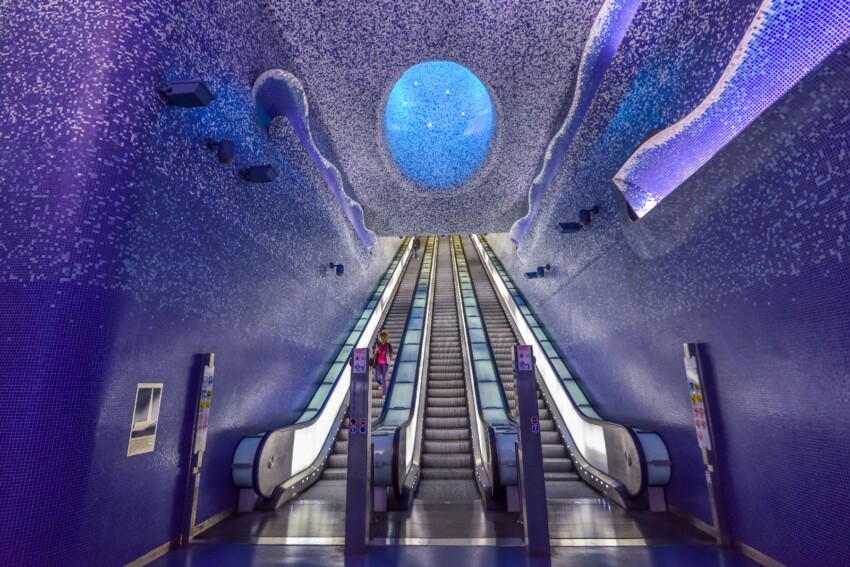
The Toledo station, designed by Catalan architect Oscar Tusquets Blanca, is one of the most beautiful metro stations in Naples. During excavations for the metro construction in the current underground level, remains of an Aragonese-era city wall were discovered and have been harmoniously integrated into the station’s architectural design.
The various levels are characterised by coverings in different colours, from the yellow that recalls the warm tones of Naples, down to level 0, sea level, where azure-coloured mosaics can be found, becoming increasingly intense as you go deeper.
The street level connects to the spectacular atrium, built 40 metres underground, via the Crater de luz, a large cone that cuts through all levels of the station and is surrounded by Robert Wilson’s work “Relative light”. Here thousands of azure-coloured LED lights create mesmerising light displays and make this station truly magical. The second exit from Toledo station on Largo Montecalvario, also designed by Oscar Tusquets, also houses artworks by internationally renowned artists.
Piazza Dante station, inaugurated in 2002, was designed by Italian architect Gae Aulenti, who also oversaw the urban redevelopment of the square. At the station entrance are two canvases by Carlo Alfano from the 1980s entitled “Luce-Grigio” and “Frammenti di un autoritratto anonimo”.
The interior of Dante station features white glass panels with steel studs and showcases works by leading figures in contemporary art. Notable artists include Joseph Kosuth, who used white neon tubes to “write” a passage from Dante’s Convivio, and Nicola De Maria’s stunning abstract composition “l’Universo senza bombe, regno dei fiori, 7 angeli rossi”.
Located near the National Archaeological Museum, Museo Station was also built to a design by architect Gae Aulenti. During excavation work for Line 1, particularly at Municipio, Toledo, Università and Duomo stations, various archaeological finds were unearthed. These were subsequently placed in the “Stazione Neapolis” section, a free exhibition located along the corridor connecting the metro stop to the Archaeological Museum.
The interiors of Museo Station, like those of Dante station, are characterised by white glass cladding and steel finishes. The station atrium houses a fibreglass cast of the Farnese Hercules, created by the Naples Academy of Fine Arts, whilst the upper entrance features a bronze reproduction of the Laocoön, cast by the historic Chiurazzi foundry from an ancient plaster mould preserved in the Academy of Fine Arts’ Gipsoteca.
The Materdei station was designed by Atelier Mendini and opened in 2003. The entrance is highly theatrical, covered in mosaic tiles and crowned with a large green and yellow star. The stairs leading to the lower levels feature a relief mosaic in ceramic created by Luigi Ontani, depicting fantastical creatures, Neapolitan street urchins and Pulcinella swimming in sea depths.
At platform level are elegant drawings by Domenico Bianchi on wooden panels and vibrant Wall Drawings by Sol LeWitt, the father of minimal art. Finally, the platforms are decorated with colourful screenprints by Mathelda Balatresi, Anna Gili, Stefano Giovannoni, Innocente and George Sowden.
The stop named after the adjacent square was designed by architect Domenico Orlacchio and inaugurated in 2001. Located approximately 44 metres underground, Quattro Giornate Station was dedicated to the days when Neapolitans rose up to liberate the city from Nazi occupation. To commemorate this event, the station entrance displays bronze reliefs and paintings by Nino Longobardi inspired by Neapolitan Resistance.
Along the stairs leading to the platforms are hunting scenes and “warriors” by Sergio Fermariello, a crumpled aluminium sheet sculpture by Baldo Diodato, and Anna Sargenti’s work “Sabe que la lucha es cruel”. As you ascend, you’ll encounter Marisa Albanese’s creation “le Combattenti”, where four white female sculptures pay homage to the resistance during Naples’ Four Days.
In the following map you can see the location of the main places of interest mentioned in this article.
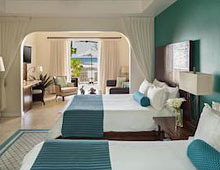 Hotel
Hotel 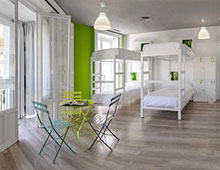 Budget accommodations
 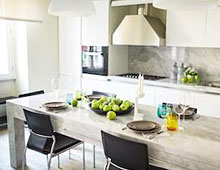 Apartments
  Family Hotel
 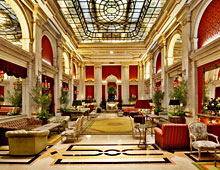 Luxury Hotel
  Resorts