Bestseller
Naples: Capodimonte Museum small group tour
From 38,50 €
Buy the ticket
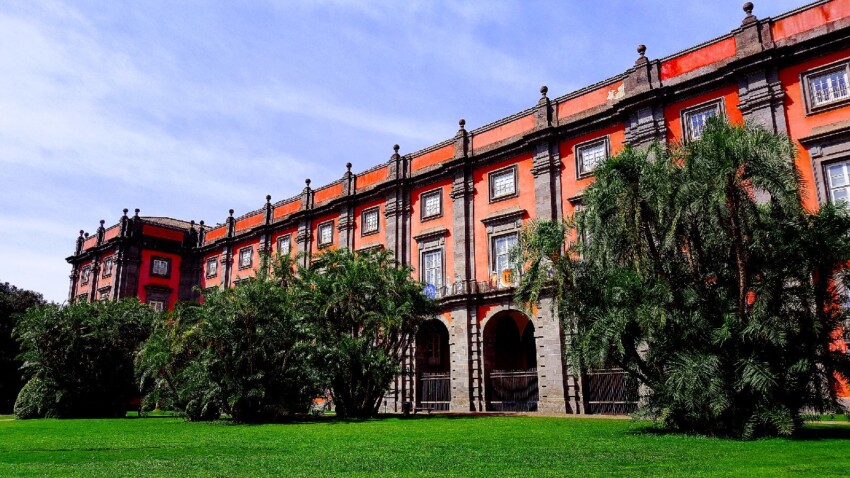
The National Museum of Capodimonte sits within the magnificent Capodimonte Palace and houses collections of both ancient and contemporary artworks by some of Italy’s greatest masters. The palace was originally conceived as a home for the Farnese collection, but subsequently became the historic residence of the Bourbons in Naples, followed by the Bonapartes and Murats, and finally the House of Savoy.
In 1734, Charles of Bourbon, King of Naples, decided to find a worthy home for the artworks inherited from his mother Elisabeth Farnese, which were scattered across various locations in Rome and Parma. The king initially chose to transfer some of the works to the Royal Palace of Naples, but in 1738 he ordered the construction of a palace on the Capodimonte hill to serve as a museum for displaying the collections. Surrounded by the verdant Capodimonte Woods, the palace rooms began hosting artworks from 1758 onwards, while the museum was officially inaugurated and opened to the public in 1957.
Today the museum houses the Royal Apartments and works primarily linked to two collections: the Farnese Collection, featuring works by great masters such as Raphael, Titian, Ludovico Carracci and Guido Reni, and the Neapolitan Gallery, which preserves works from religious buildings in Naples and the surrounding area.
Capodimonte Museum occupies three floors of the palace, though only the Royal Apartments retain period furnishings, while the remaining rooms on the first and second floors (originally used by servants) now house museum exhibitions.
The ground floor contains the entrance with various facilities including the ticket office, cloakroom, bookshop and café, while the mezzanine floor houses the Cabinet of Drawings and Prints and the Nineteenth-Century Private exhibitions. On the first floor you can admire the Farnese Gallery, the Borgia collection, the Royal Apartments and the Farnese and Bourbon armoury, whilst the second floor hosts the Neapolitan Gallery, the D’Avalos collection, and the contemporary art section. The third floor contains the Nineteenth-Century Gallery and the photographic gallery.
The Royal Apartments are the section of the palace that hosted royal families during the various dynasties that ruled from the mid-18th century onwards. The palace acquired its appearance as a royal residence thanks to Caroline Bonaparte, who restructured the apartments according to imperial court tastes, whilst Joachim Murat built the connecting road between the palace and the city centre and brought important artists to Capodimonte, such as Antonio Canova, who created the plaster bust of Letizia Ramolino Bonaparte.
The rooms contain not only paintings by important masters but also numerous precious furnishings. The main hall is the one that served as the bedroom of Francis I and Maria Isabella of Bourbon, displaying not only frescoes reminiscent of those found in the excavations of Pompeii and Herculaneum but also fine tapestries from San Leucio. In the opposite wing stands the Cradle Hall, which features marble flooring from Villa Jovis (a Roman villa in Capri) and was named for the cradle gifted by Neapolitans to the royals on the birth of Victor Emmanuel III of Savoy. The apartments also contain the Festivities Hall, which was used to receive guests and for other formal occasions and has retained its original neoclassical style with marble floors and crystal chandeliers. This area is completed by the Porcelain Room, which houses over three thousand pieces of porcelain, and the Camuccini Hall, named after the numerous works created by Vincenzo Camuccini.
Transferred to Naples by King Charles of Bourbon, son of Elisabeth Farnese, the Farnese Collection lends its name to the gallery located in the eastern wing of the palace’s piano nobile. The collection was started by Alessandro Farnese (later Pope Paul III), who gathered works by artists such as Raphael, Titian and Guglielmo della Porta, and was later expanded by other family members who enriched it with creations by Correggio, Parmigianino, Giulio Clovio, Salviati and many others.
Works donated by Fulvio Orsini, historian and adviser to the Farnese family, were added to the collection, along with those confiscated in the late 16th century by Ranuccio I Farnese, Duke of Parma and Piacenza, from some of his rebellious feudatories. In 1693 the collection of Margherita Farnese, Ranuccio’s sister, was also added, and the entire legacy subsequently passed to Elisabeth, mother of Charles of Bourbon, who as King of Naples transferred all the works to Naples along with other valuable objects in amber, bronze and rock crystal.
Over the years, however, the Farnese Collection was moved to various museum locations in the city until after the Second World War, when following a reorganisation of Naples’ museums, the paintings were placed at Capodimonte Palace whilst the sculptures (from archaeological finds in the Rome area) were transferred to the National Archaeological Museum of Naples. The works were arranged according to various schools of painting, with collections by Flemish and German artists such as Joos van Cleve, Joachim Beuckelaer and Pieter Bruegel the Elder added.
An entire room of the Gallery allows you to admire portraits of prominent figures from the Farnese family, such as the Portrait of Paul III and the Portrait of Paul III with his nephews Alessandro and Ottavio Farnese by Titian. Also on display are paintings by Raphael, such as the Portrait of Cardinal Alessandro Farnese, by Giorgio Vasari, by Andrea del Sarto, and sculptures by Guglielmo Della Porta.
A room is finally reserved for the Gallery of Rare Things, which was a wonder room furnished with the aim of astonishing visitors with rare, precious or exotic objects. In this room, alongside paintings, rare and unusual works have been collected, such as the Farnese Casket with engraved crystals created by Manno Sbarri, small bronzes from various Italian and European schools, coins and ivory objects such as a tray and pitcher by Johann Michael Maucher, Renaissance medals by Pisanello, Urbino majolica, and foreign artefacts and finds such as a stone frog from Mexico and a statuette of Huitzilopochtli, the Aztec god of war.
On the second floor of the museum is the Neapolitan Gallery, which displays paintings, sculptures and tapestries created by important Neapolitan or Italian artists from the 13th to the 18th century. The first rooms in particular house the Gallery of the Arts, which tells the story of Neapolitan art through a chronological journey comprising works from the 1200s to the 1700s. The works gathered here, by both Neapolitan and southern Italian artists, span around six centuries during which Swabian, Angevin, Aragonese, Spanish viceroys, and finally the Bourbons held sway. Many of the canvases come from churches, acquisitions made by the Bourbons, or confiscations following the suppression of certain monastic orders.
The first part of the exhibition features works from the Swabian and Angevin periods, followed by works by local artists alongside creations by “visiting masters” such as Pinturicchio, Vasari, Sodoma and Titian. This section also includes the Flagellation of Christ by Michelangelo Merisi, known as Caravaggio, who was a major source of inspiration for the local painting school.
The second part is dedicated to the 1600s, considered the “golden age” of Neapolitan painting, and the 1700s, with canvases by Battistello Caracciolo, Carlo Sellitto, Aniello Falcone and Giuseppe Recco. Finally, the Tapestry Hall houses tapestries executed between 1528 and 1531 depicting the historic Battle of Pavia. Woven in Brussels, as evidenced by the signature of tapestry maker William Dermoyen, these precious masterpieces were gifted by the States General of Brussels to Holy Roman Emperor Charles V of Habsburg.
This section concludes with the D’Avalos Collection, a private collection begun in the 17th century by the Prince of Montesarchio, Andrea d’Avalos, and donated to the Italian State in 1862 by Alfonso d’Avalos. The works on display here concern historical, mythological and literary themes, executed by artists such as Pacecco De Rosa, Luca Giordano and Jusepe de Ribera, whose masterpiece Apollo and Marsyas we can admire.
The first Contemporary Art works arrived at Capodimonte Museum in the late 1970s thanks to a solo exhibition by Alberto Burri, who created the Grande Cretto Nero (a particular panel in majolica and enamel). In subsequent years the museum began collaborations with both local galleries and internationally renowned artists such as Andy Warhol, who in 1985 exhibited a series of paintings depicting an erupting Vesuvius. From that year onwards the museum has continued to host exhibitions by artists such as Gino De Dominicis in 1986, Mario Merz in 1987, Carlo Alfano and Sol LeWitt in 1988.
The large Risorgimento canvas “The Breach of Porta Pia” by Michele Cammarano divides the contemporary art section from the Nineteenth-Century Gallery. The selection of 19th-century works comprises creations from the Bourbon and post-unification period acquired at the behest of the House of Savoy, which wanted to gather works purchased or donated in the period immediately following Italian unification.
As the intention was to shape a national figurative language, this area features both Neapolitan artists and those from other parts of Italy such as Domenico Morelli, Filippo Palizzi and several artists belonging to the Resina School, such as Marco De Gregorio and Federico Rossano.
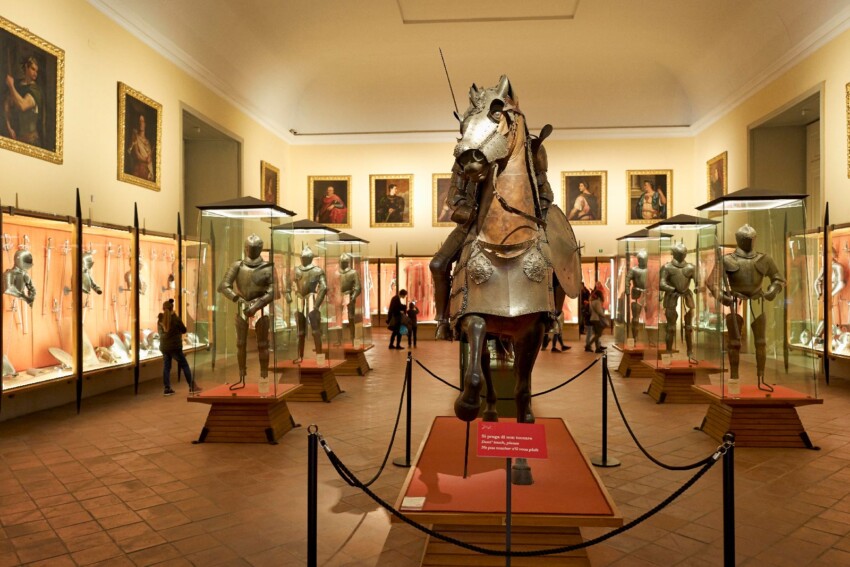
The museum’s armoury at Capodimonte comprises a Farnese section, dating from the 15th to 17th centuries, and a collection left by the Bourbon family, dating from around the 18th and 19th centuries.
The Farnese nucleus is the older section and includes firearms, defensive weapons, swords, daggers, war and tournament armour that belonged to members of the House of Farnese and its garrisons. This collection includes finely crafted weapons from Milan.
The Bourbon section, meanwhile, contains both hunting weapons and firearms. Some of these were brought to Naples by Charles of Bourbon himself from Madrid, whilst others were made by the Real Fabbrica d’Armi at Torre Annunziata to meet the needs and requirements of the Bourbon army.
Originally created as a hunting reserve for the Bourbon family, the Royal Capodimonte Woods extend around the palace for approximately 134 hectares and are home to around 400 different plant species. Today this green, unspoiled area is a public park with free access.
Considered one of Italy’s largest parks, the Royal Capodimonte Woods were designed in 1734 by Ferdinando Sanfelice, one of Naples’ greatest late Baroque architects. The original design comprised two distinct areas: a hunting woods and a garden adjacent to the Palace where one could stroll and enjoy views over the Gulf of Naples. Throughout the park pathways you can still see 17 historic buildings such as residences, workshops, stores and churches, as well as fountains, statues, vegetable gardens and orchards.
In the early 19th century work was carried out thanks to botanist Friedrich Dehnhardt, who not only introduced the classic English garden style with flower beds all around the palace at Capodimonte, but also brought rare plants such as Thuja and eucalyptus. Throughout all the subsequent periods of rule, attention to the garden never waned, and it was always maintained by important botanists who frequently brought rare and exotic species here, such as camphor and camellias from Asia, eucalyptus from Australia and magnolias from the Americas.
The Royal Woods currently comprise four main areas: the Landscape Garden, with Canary Island palms and a striking fountain, an Anglo-Chinese Garden that still retains the layout given to it by Friedrich Dehnhardt, the Late Baroque Garden and the Pastoral Landscape Garden, which includes the old Porcelain Factory, the Church of San Gennaro and agricultural buildings.
Capodimonte Museum is open every day except Wednesdays from 8.30am to 7.30pm. The last entry is at 6.30pm.
The museum is closed every Wednesday, 1 January and 25 December.
On 24 December and 31 December, the museum operates with reduced hours: 8.30am–2.00pm. The last entry is at 1.00pm.
Museum admission is free for under-18s.
Capodimonte Museum is one of the attractions included in the Campania Artecard, the Campania region’s tourist pass, which also covers must-see attractions such as the Royal Palace of Caserta, the Pompeii Archaeological Park, those at Herculaneum and Paestum, and other Naples attractions including the Royal Palace.
Capodimonte Wood follows these opening hours:
Capodimonte Wood is closed on Easter Monday.
Capodimonte Museum is easily accessible by public transport. From Naples city centre, you can take:
Capodimonte Museum is also served by Line A of the Citysightseeing bus service.
If you prefer to drive, take the ring road and exit at Capodimonte.
The Museo Nazionale di Capodimonte is located in Capodimonte, a hilltop neighbourhood in Naples situated in the northern part of the city, away from the historic centre.

 Hotel
Hotel  Budget accommodations
  Apartments
  Family Hotel
  Luxury Hotel
  Resorts