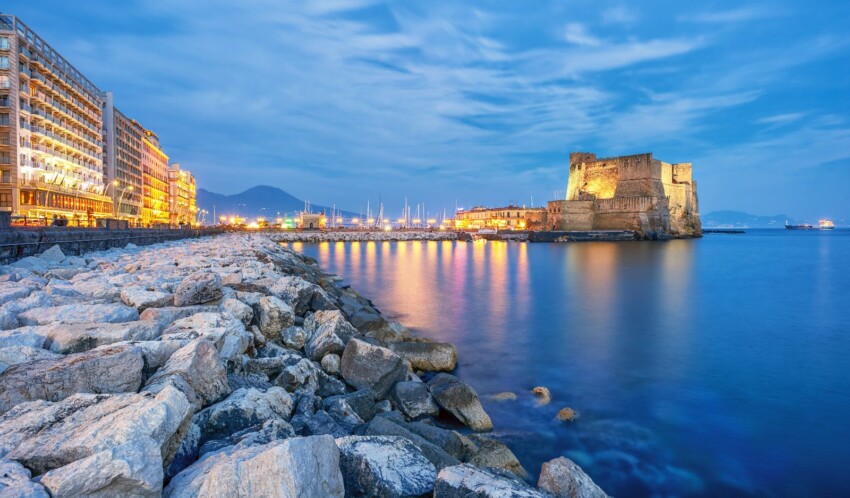
Built in 1128 on the islet of Megaride, comprising two rocky outcrops joined by a grand arch, Castel dell’Ovo is a magnificent fortification that has served not only as a defensive stronghold over the centuries, but also as a monastery, prison and royal residence. Regarded as one of the symbols of Naples, Castel dell’Ovo is the oldest castle in the city.
According to ancient legend, it was on this very islet that the siren Parthenope landed, lending her name to ancient Naples, which was founded by a group of Greek colonists from Cumae around the 8th century BC. Castel dell’Ovo stands within the historic Santa Lucia neighbourhood, and today its halls host exhibitions, conferences and events, while externally the castle offers one of the finest views across the entire Gulf of Naples. At its base lies the charming harbour “Borgo Marinari”, characterised by restaurants, bars and the headquarters of some of Naples’ most historic nautical clubs.
Near the main entrance is a tufa chamber known as the Prison of Queen Giovanna, which originally served as cells before being converted into a room for storing State archives. Among the castle’s finest spaces is the Hall of Columns, which once served as the monks’ refectory and is divided into various aisles by columns resting on pointed arches. From the period when monks inhabited the fortress, the “hermitages” remain—cells carved into the tufa rock and discovered in the early 20th century.
Inside Castel dell’Ovo are several beautifully frescoed rooms used for events, conferences, meetings and gatherings, including the Hall of Italy, with its magnificent vaulted ceiling, the Hall of the Siren, carved from tufa rock, and the Grotto of Virgil, which comprises a main hall and two smaller rooms. The Church of San Salvatore is also exquisitely frescoed with late Byzantine works, resting on granite columns with Roman capitals.
Externally, the Cannon Terrace represents the castle’s highest point, where visitors come especially at sunset to enjoy a breathtaking view across the entire Gulf of Naples.
Admission to the castle is free, and minors may only enter if accompanied. A visit typically takes around 1 hour and 30 minutes.
Castel dell’Ovo is open to the public during the following hours:
Castel dell’Ovo is situated in a central area of Naples, surrounded by numerous restaurants, bars and some of the city’s most luxurious hotels.
The best way to reach the castle is certainly on foot, as it lies less than a kilometre from Piazza del Plebiscito and approximately 1.5 km from Maschio Angioino. Alternatively, you can take the metro, Line 1, alighting at Toledo station, or one of the numerous buses.
Those arriving from Naples Capodichino airport can reach the castle via the Alibus shuttle service, getting off at Municipio stop, while from Naples Centrale railway station you can take Line 1 of the metro from Garibaldi station to Toledo station and then walk approximately 700 metres.
During Roman rule, between the islet of Megaride and the mainland, the wealthy Roman consul Lucius Licinius Lucullus constructed a sumptuous residence that reportedly extended to present-day Piazza Municipio. In this villa, known as the Villa of Lucius Licinius Lucullus, Lucullus not only amassed an impressive library for the study of art and philosophy, but also hosted lavish banquets featuring refined and exclusive cuisine, accompanied by performances and light shows. It is from this type of extravagant celebration that the adjective “Lucullian” originated, still used today to denote something refined and sumptuous.
Following Lucullus’ death, the villa came under imperial control, and under Emperor Valentinian III (419–455), the building was fortified and later became the place of exile for Romulus Augustulus, the last Western Roman Emperor, who died here in 476.
From the 5th to the 10th century, this building became a hermitage for monks from Pannonia who, in time, adopted the Benedictine rule and established an important scriptorium, aided by the ancient manuscripts left behind by Lucullus. In the 10th century, due to repeated attacks by Saracens, the Dukes of Naples transformed the villa into a fortress to defend the city from enemy raids, forcing the monks to abandon the building.
With the arrival of the Swabians, Castel dell’Ovo was further fortified, and in 1222, Frederick II had the Tower of Colleville, the Master Tower and the Middle Tower constructed. During this period, the castle served as both a royal residence and state prison. Under Alfonso of Aragon, new areas were created that transformed the building into a proper prison housing Carbonari, Jacobins and liberals, as well as the philosopher Tommaso Campanella.
After Italian Unification, the fortress’s defensive role became obsolete, and after prolonged consideration of its demolition, the castle fell into neglect until restoration work in 1975, when Castel dell’Ovo passed first under the management of the Ministry of Cultural Heritage and subsequently to the Municipality of Naples.
One of the most ancient legends recounts that the name Castel dell’Ovo derives from an egg that Virgil allegedly hid inside a cage in the castle’s underground chambers. The location of the egg was sealed and kept secret because “all the deeds and fortune of the Marine Castle hung upon that egg“.
The castle’s fate, and indeed that of the entire city of Naples, were thus bound to that of the egg, which was never actually found. According to the legend passed down through the centuries, should the egg ever break, grave catastrophes would befall the city of Naples.
During the reign of Queen Giovanna I, a storm surge struck the castle, causing considerable damage, and to prevent panic spreading through the city, the queen was forced to admit she had replaced the egg. In reality, it appears the name Castel dell’Ovo owes its origin to the fact that Roger I the Norman built the fortress on pre-existing ruins, giving it an ovoid shape.
Castel dell'Ovo sits on the islet of Megaride in the historic Santa Lucia district, nestled between the neighbourhoods of San Ferdinando and Chiaia, facing via Partenope.

 Hotel
Hotel  Budget accommodations
  Apartments
  Family Hotel
  Luxury Hotel
  Resorts