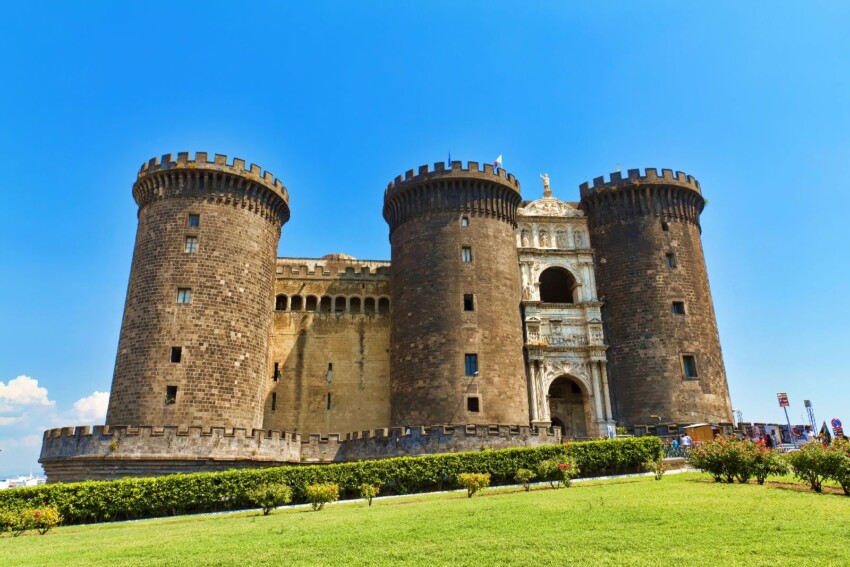
The Maschio Angioino, also known as Mastio Angioino or Castel Nuovo, is one of the symbols of Naples and is a historic castle commissioned in 1266 by Charles I of Anjou. After defeating the Swabians, Charles I ascended the throne of the Kingdom of Sicily and then decided to move the capital from Palermo to Naples, ordering the construction of the Maschio Angioino, a fortress designed to protect the city from enemy raids.
In particular, this complex was built in a strategically important location to strengthen the city’s defensive system, which already comprised the Castel dell’Ovo, which was considered obsolete by then, and Castel Capuano, which was in a poorly strategic position and far from the sea. Since Castel dell’Ovo and Castel Capuano were fortresses built years earlier, this new complex was named Castel Nuovo to distinguish it from the other two structures. The name Maschio Angioino, on the other hand, is a term of medieval origin derived from the Florentine word “mastio”, which referred to the largest and most secure tower in a fortress in case of military attacks.
Visiting the Maschio Angioino is like taking a journey through time and retracing Naples’ history. Inside the Maschio Angioino you’ll find lavishly decorated rooms, chapels, ancient frescoes and Roman archaeological finds, as well as the wonderful Civic Museum with works ranging from the XV to the XX century.
The Triumphal Arch marks the main entrance to the castle and was built between 1453 and 1468, drawing inspiration from Roman triumphal arches to celebrate King Alfonso of Aragon’s entry into the capital after defeating René of Anjou. Located between the “Middle” tower and the “Guard” tower, here you can admire an arch with a frieze depicting Alfonso’s triumphal procession seated on a chariot driven by Fortune and surrounded by family members and high officials of the kingdom. Above this is an upper arch adorned with Ionic columns and niches hosting statues of the four virtues (Temperance, Justice, Fortitude and Magnanimity), crowned by a semicircular ornament with a statue of Saint Michael on top.
The only surviving element of the fourteenth-century Angevin castle is the Cappella Palatina, which was commissioned by the Angevins in the XII century and, despite being damaged by an earthquake in the XV century, was later restored and over the years has managed to maintain its original appearance intact.
Inside, the building is in Gothic style with paintings by Florentine artist Maso di Banco, whilst numerous sculptures present, such as “the Tabernacle with the Madonna and Child” belong to Domenico Gagini, a pupil of Donatello and Brunelleschi. The interior of the Cappella Palatina was certainly also frescoed by Giotto, who created a cycle of frescoes depicting Stories from the Old and New Testament. However, Giotto’s work was almost entirely lost during raids that occurred between the XV and XVI centuries.
Also called Sala Maior or Sala del Trono, the Sala dei Baroni is the main hall of the castle and was commissioned by Robert of Anjou, a patron king who welcomed artists and men of letters such as Boccaccio and Petrarch, and painters like Giotto who also frescoed part of this room’s walls, to his court. Alfonso I of Aragon, with the intention of enlarging and embellishing the hall, called the Spanish architect Sagrera to Naples, who restructured the hall and built the splendid octagonal star-shaped vault.
The name of the hall derives from the fact that around 1486 some barons had organised a conspiracy against King Ferrante I, who discovered the plot and invited the barons to the castle under the pretext of attending his niece’s wedding. In reality, the king had organised a trap: the barons gathered in this hall were arrested and sentenced to death.
Unfortunately, in 1919 the structure was struck by a fire that destroyed almost all the sculptural decorations, but among the works still present in the halls, you can still admire the two-sided marble portal created by Domenico Gagini with bas-reliefs depicting Alfonso V of Aragon and his triumphal entry to the castle.
Located to the left of the Cappella Palatina, the Sala dell’Armeria housed the weapons arsenal that was present at the Maschio Angioino. More than for its role, the hall is known because during some restoration work on the castle, important Roman archaeological finds dating from the I century B.C. to the V century A.D. were discovered here. The remains found can now be admired thanks to a transparent glass floor.
It is believed that the Cappella delle Anime del Purgatorio stands on the site where the fourteenth-century chapel of San Martino di Tours once stood. The chapel was built in the XVI century by Spanish viceroys who ordered several modifications to the castle.
The interior is in Baroque style with frescoes and paintings on panel enclosed in gilded wooden frames, whilst on the high altar is a canvas depicting the Madonna of Carmine with Saint Sebastian, Pope Gregory I and some souls in purgatory. The chapel was the place where it was customary to administer the sacraments to those condemned to death before they were executed.
Dating back to the XV century and consecrated in 1668 after a restoration that gave it Baroque style, the small chapel of San Francesco owes its name to the fact that it hosted Saint Francis of Paola during his journey to Paris.
Original to the period, you can still admire some gilded stucco decorations and two frescoes on the left wall, whilst the fifteenth-century vault, designed by Guillerm Segreram, was destroyed during the Second World War.
The underground chambers beneath the Cappella Palatina house two halls that over the years were used as prisons and were named after the “del Miglio” prison and the “dei Baroni” prison.
According to legend, during Aragonese rule the del Miglio prison, also known as the crocodile pit, was actually a grain store where some prisoners were sometimes locked up. Unfortunately, some of the inmates locked here disappeared without a trace and for this reason more guards were posted for surveillance. It was soon discovered that a large crocodile entered through an underground opening inside the prison and took the inmates with it, dragging them out to sea. Once this was discovered, the rulers decided to send here the most troublesome victims they wanted to execute secretly or without too much fuss.
The Baroni prison, on the other hand, which is directly connected by a staircase to the Cappella Palatina, preserves four coffins with no inscriptions that are most likely those of the nobles killed during the Conspiracy of the Barons in 1486.
The Maschio Angioino also houses the Civic Museum inside, which spans the Sala dell’Armeria, the Cappella Palatina, the first and second floors of the fortress.
On the first floor there are frescoes and religious paintings from the period dating from the XV to the XVIII century, whilst on the second floor are preserved paintings from the nineteenth and twentieth centuries now owned by the Municipality of Naples that depict patriotic, nationalist and revolutionary themes.
These spaces are complemented by the Sala Carlo V and the Sala della Loggia where exhibitions and cultural initiatives are organised.
To visit the Maschio Angioino you can choose between different types of tickets depending on the route you wish to take:
Rooms and spaces you can visit: Piazza d’Armi, Sala dell’Armeria, Sala dei Baroni, First floor: Art from XV to XVIII century, Second floor: 19th Century Naples, Third floor: 20th Century Naples, Terrace overlooking Molo Beverello.
The Maschio Angioino is open every day with the following times:
The best way to reach the Maschio Angioino is by metro, taking Line 1 and getting off at Municipio station. Alternatively, you can take the R2 bus (main stops: Central Station – Piazza Trieste e Trento) to Piazza Municipio or urban bus line 202 (main stops: Corso Umberto – Via De Pretis). From Piazza Vittoria, you can take tram 1 to Piazza Municipio stop.
From the Vomero area, you can take the Funicolare Centrale to Augusteo stop and then walk from there for about 5 minutes to Piazza Municipio. If you wish to reach the destination by train, you need to arrive at Piazza Garibaldi railway station then take the Metro Line 1, or take the R2 bus to Piazza Municipio.
In the XIII century Charles I of Anjou decided to entrust architect Pierre de Chaule with the work to build a castle that was to be not only a fortress but also a new court palace for the rulers. The king decided to build a new and powerful structure near the sea since until then the royal residence in Naples had been Castel Capuano, an ancient Norman building that was judged inadequate for the purpose.
Charles I of Anjou, however, never stayed in the castle he had commissioned. After the Sicilian Vespers, the castle remained unused until the arrival of King Charles II the Lame, who decided to restructure and enlarge Castel Nuovo and move the court there. During the reign of the Angevins, Castel Nuovo hosted important figures of the time such as Giotto, who executed works in the Cappella Palatina, and men of letters Francesco Petrarch and Giovanni Boccaccio.
In the XV century Alfonso of Aragon decided to make Castel Nuovo a royal palace capable of competing with the court of Lorenzo the Magnificent in Florence and for this reason called Aragonese architects to Naples with the objective of restructuring the complex. The castle was thus rebuilt with the layout we can still admire today: giving the building a more defensive imprint and following Gothic-Catalan taste.
Between the XV and XVII centuries, however, the castle was repeatedly plundered and lost its role as a court to become a simple military garrison. During these years there were successive dominations that, with the intention of eliminating the memory of the Angevin and Aragonese kingdoms, suppressed or modified some parts and various ornaments.
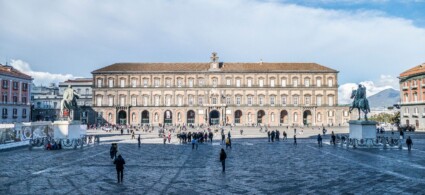
During the reign of the Bourbons, the Maschio Angioino lost its status as a royal residence in favour of other complexes such as the Royal Palace of Piazza del Plebiscito, the Capodimonte Royal Palace, the royal villa of Portici and the Caserta Royal Palace and was converted to an artillery arsenal. In the twentieth century, the complex underwent restoration work that removed buildings erected between the XVII and XIX centuries alongside the castle and restored part of its original style to the fortress.
The Maschio Angioino stands in Piazza Municipio, close to Naples' port area and just a short walk from the San Carlo Theatre and the Royal Palace.

 Hotel
Hotel  Budget accommodations
  Apartments
  Family Hotel
  Luxury Hotel
  Resorts