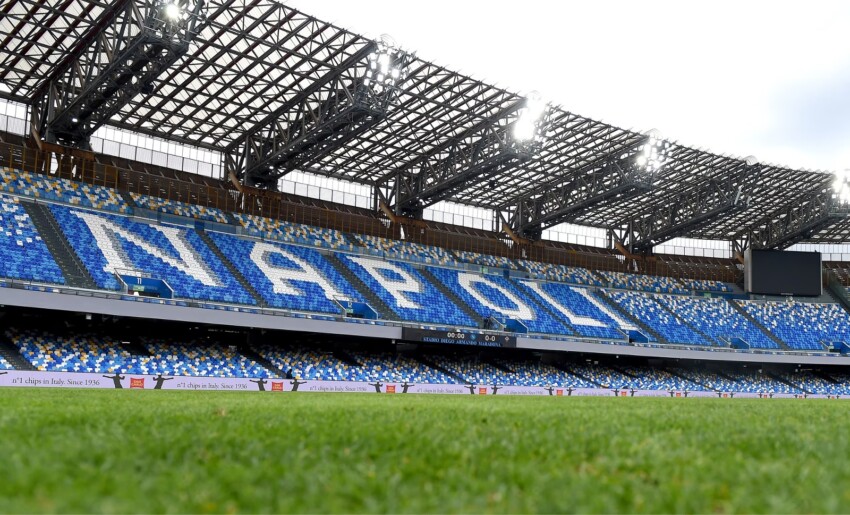
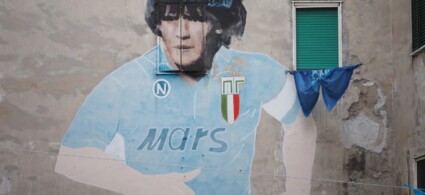
The Naples Stadium was known as the San Paolo Stadium until 2020, when it was named after Diego Armando Maradona (1960–2020), one of the greatest footballers in history who played for Naples from 1984 to 1991 and became an undisputed idol in the city.
The Maradona Stadium is actually a multipurpose sports facility owned by the municipality that also features an 8-lane athletics track, three multifunctional gymnasiums, a boxing gymnasium, a freestyle wrestling and oriental martial arts gymnasium, and a fitness area.
Over the years, the venue in Fuorigrotta has also hosted numerous non-football events including athletics competitions, boxing events, concerts by musical artists, and a meeting between young people and Pope John Paul II.
For practical information about the stadium, to plan a trip or purchase match tickets, visit the more comprehensive page on the Diego Armando Maradona Stadium in Naples on the Stadi.online website

The Diego Armando Maradona Stadium is home to SSC Napoli, one of the most supported football teams in the world.
Since the 1960s, the Stadium has hosted other sporting events in addition to football competitions, including boxing matches and various official athletics championships, among them the Italian National Championships. To these can be added the IV Mediterranean Games in 1963 and the XXX Universiade from 2 to 14 July 2019.
The facility is also a venue for musical concerts, and among the artists who have performed here are The Rolling Stones, U2, Frank Zappa, Jovanotti, Lucio Dalla, Pino Daniele, Claudio Baglioni, Vasco Rossi, Gigi D’Alessio and Nino D’Angelo. On 10 November 1990, moreover, the venue was chosen as the location for a meeting between Pope John Paul II and young people during the Pontiff’s pastoral visit to Campania, with approximately one hundred thousand people attending the event.
The Maradona Stadium is located west of Naples city centre, in the Fuorigrotta district. You can reach it using various forms of transport.
By train, take the Naples metropolitan railway line 2 and get off at Campi Flegrei station.
By metro, you can use line 1 or line 2 of the Naples metropolitan and change at Garibaldi or Cavour station to take line 2 towards Pozzuoli, or you can use the EAV Cumana railway and get off at Mostra station.
By bus, you can take the 151 ANM line from Piazza Garibaldi or Molo Beverello and get off at Piazzale Tecchio, or you can take the Alibus line from Capodichino airport and then change at Piazza Garibaldi to take the 151 ANM line or the M1 EAV line.
By car, you can exit the Naples ring road at exit 10 towards Naples Centre and follow the signs for the stadium, or you can take the junction and exit at Fuorigrotta, or you can continue from Vomero through Soccavo and from there to Fuorigrotta.
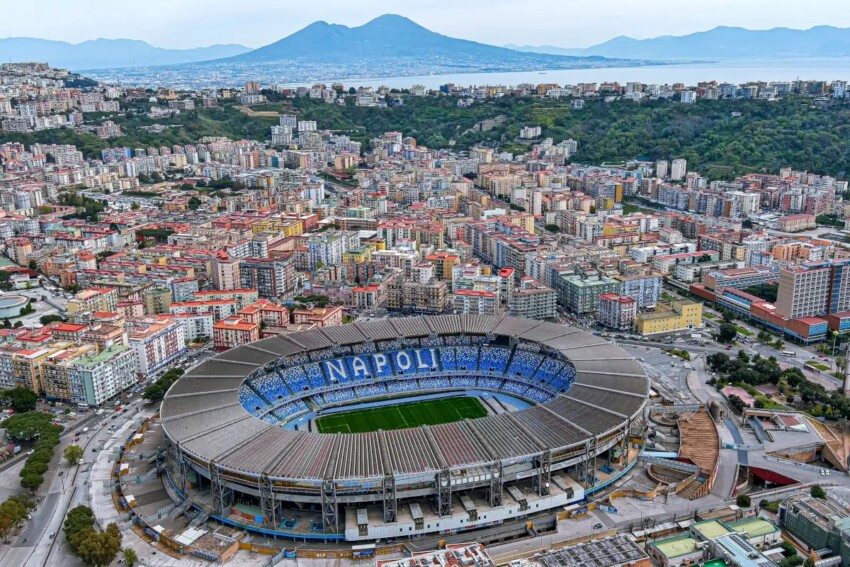
The origins of the Maradona Stadium in Naples date back to the post-war period, when the previous Partenopeo stadium, having been bombed during the Second World War, was declared unfit for use. The Naples football club therefore decided to adopt the Vomero stadium as its new home, though it was soon deemed too small to accommodate all the fans. For this reason, the city administration decided to construct a new sports facility and chose a site in the Fuorigrotta district, an area that in the 1950s was undergoing significant urban development.
The project was assigned to architect Carlo Cocchia and work began on 27 April 1952 with a ceremony attended by Prime Minister Alcide De Gasperi. The new pitch, which could accommodate up to 90,000 standing spectators, was inaugurated on 6 December 1959 with the match between Naples and Juventus, won 2-1 by the Naples side. From the 1960s onwards, the facility opened to international events and in particular in 1960 hosted the Rome Olympic football tournament, whilst in September 1963 it hosted numerous matches and the final of the football tournament of the fourth edition of the Mediterranean Games.
On 15 December 1974, during the Naples versus Juventus match, 90,736 spectators were recorded at the stadium, a figure that marks this as the football match with the highest attendance in Serie A history. Over time, the stadium has hosted over 20 matches involving the Italian national football team, including the semi-final of the 1968 European Championship and matches from the 1980 European Championship. The stadium was also the venue for several matches during the 1990 World Cup, including the semi-final on 3 July, in which Italy lost to Argentina on penalties in the presence of almost 60,000 spectators.
The facility underwent several renovation works carried out especially in connection with important football events. The first modernisation projects were executed before the 1980 European Championship when the lighting system was upgraded and a two-storey building was erected at the numbered stand (today the Posillipo stand). When Italy won the 1990 World Cup, further work was carried out on the then San Paolo Stadium, which had been designated to host some important matches. In particular, on that occasion the roof and the new press stand with 330 seats were built and adjustments were made to comply with FIFA safety requirements, which required all-seating accommodation.
Other interventions carried out in the 1990s, after the World Cup, included the construction of a third tier, thanks to which the stadium capacity reached 72,810 seats. Between the 1990s and 2000s, however, the third tier was closed several times and the stadium had its licence to operate revoked on occasion, as restoration work was needed due to damage caused in part by bad weather. In 2008, moreover, with Naples’ return to European-level competitions, further improvements were introduced and in the summer of 2011 the stadium had to comply with UEFA regulations required for participation in European cups.
In the summer of 2019, the San Paolo hosted the XXX Universiade games and for this reason the complex underwent a radical redesign that included not only the renewal of the athletics track, but also the modernisation of the seats, changing rooms, audio and lighting systems. The works carried out reduced the stadium capacity to the current 54,726 seats, of which 20,455 are in the lower tier and 34,271 in the upper tier. Today the Diego Armando Maradona Stadium is Italy’s third largest stadium by capacity after the San Siro in Milan and the Olimpico in Rome.
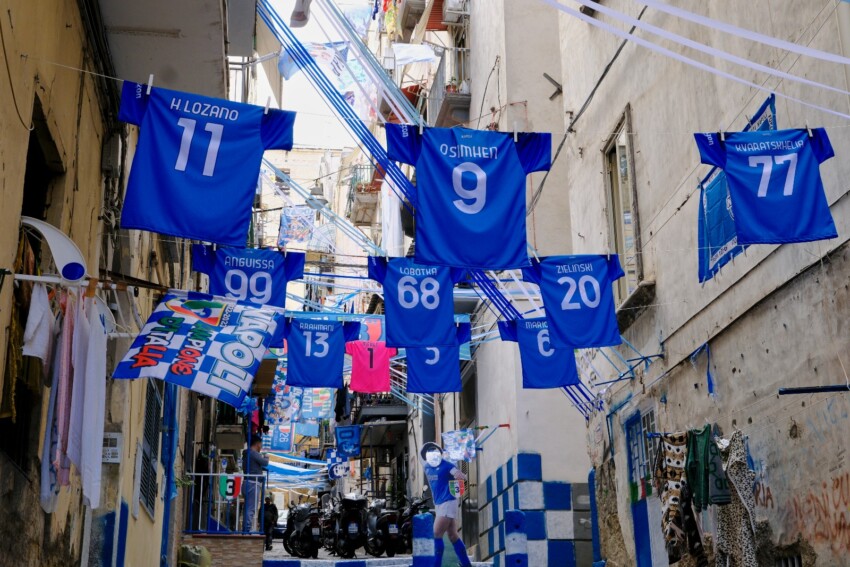
Initially the facility was known as the Partenopeo Stadium, but it later changed name, first becoming the Stadio del Sole and then in 1963 the San Paolo Stadium to commemorate the tradition according to which Paul of Tarsus is said to have reached Italy by landing in the Fuorigrotta area.
On 26 November 2020, the day after Diego Armando Maradona’s death, mayor Luigi De Magistris announced that a procedure had been started to name the Stadium after the former Naples captain and great football champion. Thanks to this initiative, the Stadium has been called the Diego Armando Maradona Stadium since December 2020.
The Maradona Stadium is located in Naples, in the Fuorigrotta district, just a few kilometres west of the city's historic centre.
 Hotel
Hotel  Budget accommodations
  Apartments
  Family Hotel
  Luxury Hotel
  Resorts