Bestseller
Naples: Fontanelle Cemetery with Entry Ticket
From 10,00 €
Buy the ticket
Carved into the yellow tufa hillside behind the Rione Sanità, just a short walk from Totò’s birthplace and above the Catacombs of San Gennaro, the Fontanelle Cemetery is one of Naples’ most singular, moving and misunderstood places.
An enormous ossuary, approximately 40,000 visible remains, millions of bones crammed into the walls of the quarry, which for nearly three centuries was the stage for a popular cult without precedent in Christian Europe: that of the anime pezzentelle, the “poor souls” of Purgatory, to whom Neapolitans dedicated prayers, votive shrines and daily care in exchange for favours, revealing dreams and, occasionally, winning lottery numbers.
It’s not a reassuring place, and you don’t visit the Fontanelle to be reassured. You go to understand something profound about the Neapolitan character, that peculiar relationship with death which is neither macabre nor superficial, but familiar, everyday, affectionate, and to come face to face with thousands of skulls arranged on shelves and in niches, some with a story, almost all anonymous, all gazed upon by generations of devotees who considered them company and confidants.
Cardinal Corrado Ursi closed the site in 1969, judging the cult too pagan. In 2026, fifty-seven years later, the Fontanelle Cemetery reopened, after nearly seven years of restoration, better maintained and more organised.
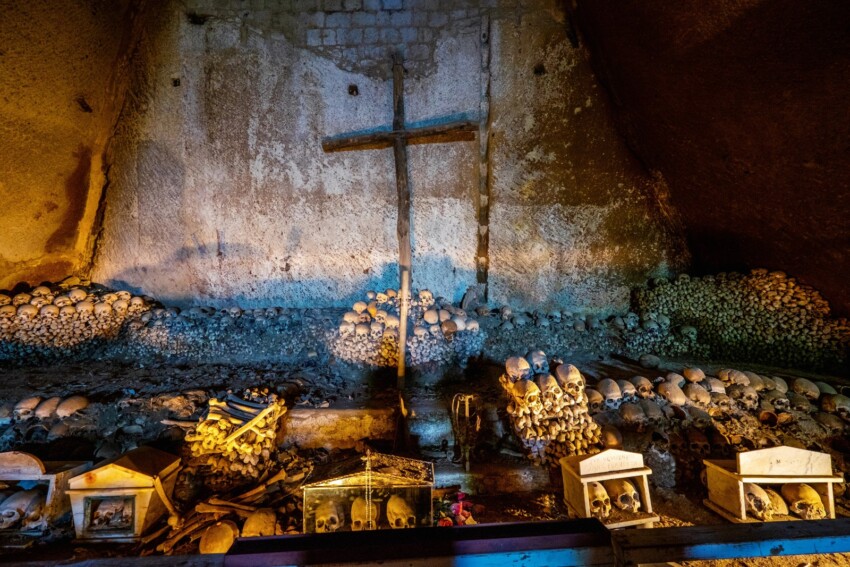
The visit takes place inside an ancient tufa quarry carved into the hillside separating the Rione Sanità from Vomero: it’s not an underground site in the strict sense (the ceiling is open to the sky in some places and the site is at street level), but a cavernous space, tall, humid, crossed by light filtering from the entrance and the far end of the route, leaving the centre in permanent shadow.
The route is divided into three parallel aisles carved into the rock, organised in 1872 by the canon Don Gaetano Barbati, who was the first to impose order on the chaos of bones accumulated over centuries. Each aisle is dozens of metres long; the side walls are bare tufa; the remains are stacked with a logic that seems brutal to us today but which in nineteenth-century Naples represented the maximum dignity available to those who had no individual burial.
The visual impact upon entry is immediate and unlike anything the visitor may have seen before.
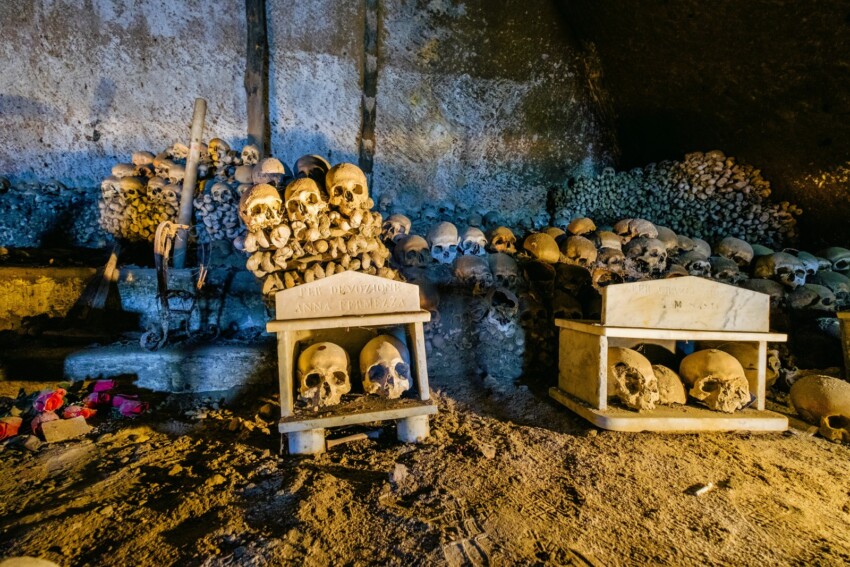
The walls of the first aisle are literally covered with skulls and long bones stacked in order: skulls arranged in overlapping rows, separated by layers of femurs arranged in a herringbone pattern, as if someone had designed wallpaper from the materials of humanity.
There’s no exhibitionism, no scenic intention: it’s simply how Don Gaetano Barbati organised the space so everyone had a place. Along the aisles, lateral niches open up, some closed by iron grates, others accessible, which hold the densest concentrations of remains.
The second aisle is where the majority of still-active votive shrines are concentrated: small spontaneous structures built around a specific skull, a glass case, a votive light, a rosary, a photograph, sometimes a note with a request for a favour. These arrangements are not historical testimonies but living practices: even today, devotees come to the Fontanelle to pray for the souls they have “adopted” and to ask for protection, although the formal cult has been remodulated since the 2026 reopening in a more regulated form.
The third aisle converges towards the depths of the quarry, where a main altar marks the point of greatest depth of the site and where the light is dimmest. The overall effect—three corridors of bone and tufa, with the silent weight of 40,000 people around you—is one of those moments when tourism ceases to be tourism and becomes something else.
Among thousands of anonymous skulls, some have over the centuries acquired an identity, a legend, a specific devotion.
The most famous of all is the one known as the “Captain”, or in some variants o cap’e morte d’o Capitano, a skull around which one of the most representative legends of the Fontanelle cult was built. According to oral tradition, a local woman had adopted this skull, tending it with great devotion; the Captain appeared to her in a dream, revealed the lottery numbers to her and she won. But instead of honouring the pact by returning thanks and prayers, the woman sat on the skull to thank it irreverently. The Captain appeared in a dream again, furious, and the woman died. The story, repeated in dozens of variations, encapsulates the entire informal theology of the Fontanelle cult: souls in Purgatory can help the living, but the relationship is one with mutual obligations, not a supernatural cash dispenser.
Another legendary figure is that of the bride’s skull, wrapped in a white veil and surrounded by artificial flowers: according to popular history, it supposedly belonged to a young woman who died the day before her wedding, her soul left in a limbo of pain. Devotees bring her white flowers and tell her the neighbourhood news as if she were still a neighbouring resident.
Then there are skulls that “sweat,” a condensation phenomenon on the damp tufa that for the faithful is a signal of contact, and skulls that “communicate” through dreams to the devotees who have adopted them, asking for specific prayers or revealing imminent dangers.
With the reopening on 18 April 2026, the site also took on the name “Museum of the Capuzzelle”, capuzzelle in Neapolitan means “little heads,” the affectionate term devotees have always used for the skulls they adopted. This dual identity, ossuary/museum, reflects the tension that has always characterised the Fontanelle Cemetery: on one hand, a place of living popular worship; on the other, a site of extraordinary historical, anthropological and archival interest.
The new management entrusted to the La Paranza Cooperative, the same one that manages the Catacombs of San Gennaro, has sought to maintain both dimensions: Monday and Friday mornings are reserved for the faithful for worship in the sacred zone, whilst regular hours welcome visitors with guided tours or audio guides.
The restoration has also introduced an audio guide system downloadable via the IntoRioneSanità app, which allows you to hear the site’s story in the voices of neighbourhood residents—not an academic guide, but a choral narrative made up of family memories, legends, anecdotes and testimonies of lived devotion.
The history of the Fontanelle Cemetery is, in miniature, the history of Naples: a story of demographic crises, overlapping powers, popular devotion and institutional conflicts. The tufa quarry from which the ossuary originated was already used as a necropolis in the Greek era, when Naples was still the Chalcidian colony of Neapolis and this area lay outside the city walls.
Greek and Roman burials found in the deepest levels of the site have been partially investigated but largely remain unexplored: the Fontanelle Cemetery is literally stratified over three thousand years of the dead.
The event that defined the site’s modern appearance is the devastating plague epidemic of 1656, which in just a few months killed between 50 and 60 per cent of Naples’ population, by some estimates more than 300,000 people in a city of just under half a million. There were so many bodies that existing churches and cemeteries weren’t enough: the Fontanelle quarry, already sporadically used as a place to deposit the dead, became the principal receptacle for the plague victims.
In the following decades came bones from other scourges, the cholera of 1836, which killed tens of thousands of Neapolitans, and floods that periodically inundated churches and burial grounds, bringing remains to the surface, and Napoleonic ordinances that banned burial inside churches and mandated the transfer of all cemetery remains outside the city walls.
The decisive moment in the site’s cultural history came in 1872, when the canon Don Gaetano Barbati systematically organised the ossuary: he had the bones arranged in the three aisles, built the main altar, opened the site to public worship. It was during this period that the cult of the pezzentelle souls exploded: Neapolitans from the Rione Sanità and surrounding neighbourhoods began to adopt skulls, give them names, build shrines, pray and dream. The site became a place of community life as much as a place of death: women from the neighbourhood would spend their mornings there, exchanging news from one skull to another, discussing the latest favours they’d received. For nearly a century, the Fontanelle was a social space as much as a sacred one.
The break came in 1969, when Cardinal Corrado Ursi ordered the site’s closure. The official reason was the excessive paganism of the cult: the practices of skull adoption, the mediation between the living and the dead through dreams, the association with the lottery and the autonomous management of devotion outside ecclesiastical structures were deemed too far from orthodoxy to be tolerated during a post-conciliar period of renewal.
The site remained closed for years, then reopened intermittently in controlled form, consistently attracting more visitors. In 2020 it was closed again for structural safety reasons, initiating restoration work that concluded with the reopening on 18 April 2026, accompanied by a community march starting from Largo Totò and welcomed by Mayor Gaetano Manfredi and Archbishop Don Mimmo Battaglia.
Following the 2026 reopening, the Fontanelle Cemetery can be visited in two distinct ways.
The self-guided visit includes entry with an audio guide downloadable on the IntoRioneSanità app: cost €6 per person, maximum duration 40 minutes. The guided tour, led by guides from the La Paranza Cooperative who accompany the group telling about the cult of the pezzentelle souls and the stories of the site’s legendary characters, costs €8 per person, same duration.
For devotees wishing to access the prayer area on early opening days (Monday and Friday, 9:00-10:00), entry is free.
With a Fontanelle Cemetery ticket you receive a 15% discount on other sites in the Rione Sanità cultural network: the Catacombs of San Gennaro, the Catacombs of San Gaudioso, the Jago Museum, the Basilica of San Severo Fuori le Mura and other neighbourhood sites. Tickets are purchased exclusively online: booking is compulsory for any type of visit. Without a booking, it’s theoretically possible to buy remaining tickets on site, but you risk waiting a long time or finding no availability. We recommend booking at least two or three days in advance, especially at weekends.
For organised groups of more than 20 people, booking is required through the dedicated section of the website or by emailing scuole@cimiterodellefontanelle.it for school groups. External tour guides with fewer than 20 participants can choose the self-guided option by purchasing a ticket for each participant, with an additional “tour guide” ticket available per slot.
From 19 April 2026, the Fontanelle Cemetery is open six days a week, with closure on Wednesdays and 25 December. Regular hours are from 10:00 to 18:00, with last entry at 17:15. On Mondays and Fridays it opens early at 9:00, but the 9:00-10:00 slot is reserved for devotee access for worship in the sacred area, with free entry and staff present.
Entries are staggered every 15 minutes, with a maximum of 25 people per slot and a total of 75 concurrent visitors in the site. The maximum permitted stay is 40 minutes. These limits are necessary to ensure the structural safety of the site and the quality of the visit experience: the Fontanelle is a delicate environment and strict capacity control is the condition set for reopening. We recommend arriving at least 15 minutes before your booked time and downloading the IntoRioneSanità app before entering, as mobile signal inside the quarry is poor.
A complete visit of the site—three aisles, main altar, lateral niches—can comfortably be done within the more than half hour allowed. Those wishing to extend the experience can combine a Fontanelle visit with the Rione Sanità tour organised by the La Paranza Cooperative, which also includes the Catacombs of San Gennaro, Palazzo dello Spagnolo and other neighbourhood sites. The best time for a visit is morning on weekdays, when the site is less crowded and the light filtering from the entrance creates particularly striking atmospheres. Avoid spring and summer weekends unless you’ve booked at least a week in advance.
The Fontanelle Cemetery is located at Via Fontanelle 80, in the heart of the Rione Sanità neighbourhood, just a few hundred metres from the Basilica of Santa Maria della Sanità and the entrance to the Catacombs of San Gennaro. The area is physically separated from the historic centre by 19th-century bridges that span above it: entering Rione Sanità means descending to the city’s oldest level, a lively working-class neighbourhood that remains largely untouched by mass tourism.
The most convenient option is Line 1 of the underground, Materdei station: from there, the Fontanelle Cemetery is accessible on foot in 10–12 minutes along Via Materdei and Via Fontanelle. The Museo station (Lines 1 and 2) is about 15–20 minutes away on foot through Rione Sanità, but the route is worthwhile as it takes you through the neighbourhood from top to bottom, passing under the bridges.
Alternatively, several bus lines serve the Rione Sanità area. From Capodichino Airport or Central Station, bus C63 runs directly to Via Fontanelle. Bus 168 connects Piazza Garibaldi to Rione Sanità.
Finally, from Spaccanapoli or Piazza Dante, the Fontanelle Cemetery is reachable on foot in 20–25 minutes by heading down towards Rione Sanità through the narrow alleys of the Via Anticaglia area. The walk is atmospheric but requires comfortable shoes: the neighbourhood is on multiple levels with frequent stairs. A car is not recommended, as Via Fontanelle is narrow and parking is virtually non-existent nearby.
The maximum permitted time at the site is 40 minutes. This limit is set for structural safety reasons and to allow subsequent groups to enter. The time is sufficient to walk through the three naves, observe the main votive shrines and listen to the audio guide in the main sections. Those wanting to explore further can combine the visit with a guided tour of Rione Sanità.
The cult of the pezzentelle souls, literally “poor souls”, is a popular Neapolitan religious practice that developed around the Fontanelle ossuary from the 18th century onwards. The faithful would “adopt” an anonymous skull from among those in the site, clean it, build a small shrine with candles and rosaries, and pray for that soul in Purgatory. In return, the soul would manifest itself in dreams, request specific prayers and, once “satisfied”, grant the devotee a blessing, protection, healing, or the revelation of lottery numbers. The relationship was understood as a genuine exchange, with precise obligations on both sides.
Cardinal Corrado Ursi, Archbishop of Naples, decreed the closure of the site in 1969, deeming the practices of the pezzentelle soul cult incompatible with Catholic doctrine in the post-conciliar era. In particular, the mediation between the living and the dead through dreams, the adoption of skulls, the association with lotteries and the autonomous management of devotion outside Church structures were considered too far removed from orthodoxy to be tolerated. The cult nonetheless continued in reduced and clandestine form, and the site reopened periodically over the following decades.
A visit to the Fontanelle Cemetery is not recommended for very young children (under 6–7 years old) due to the nature of the site and the large number of human remains. For school-age children, the visit can be educational and fascinating if properly prepared, and the La Paranza cooperative organises specific educational routes for school groups. Parents bringing children should assess their child’s sensitivity to the subject of death and approach the site as an opportunity to discuss Neapolitan history and culture.
Yes, photography is permitted inside the Fontanelle Cemetery for personal use, with respect for the site. The place has a strong spiritual value for many visitors and the faithful: discretion is recommended, particularly in the votive shrine areas and during the hours reserved for worship (Monday and Friday, 9:00–10:00). The use of powerful flash or invasive professional equipment should be reported in advance to the site management.
Yes. With the reopening in 2026, the site was declared free from architectural barriers with facilitated access routes for visitors with mobility disabilities. The restoration specifically included the removal of obstacles that made access difficult for wheelchair users or those with mobility difficulties. For specific requirements, it is advisable to contact the site management before your visit through the official website.
The Catacombs of San Gennaro and the Fontanelle Cemetery are managed by the same cooperative (La Paranza) and are just a few minutes’ walk from each other in Rione Sanità. Many visitors combine the two sites in a half-day dedicated to the underground Naples of the neighbourhood. With a ticket to the Fontanelle you receive a 15% discount on the Catacombs and other sites in the Rione Sanità network: it is advisable to check the opening hours of both before planning your route, as the Catacombs also require booking.
These are two very different experiences, often confused with each other. Naples Underground is a system of tunnels and Greek cisterns excavated beneath the historic centre, accessed from Piazza San Gaetano, and tells the story of the city’s water management and defensive history; it contains no human remains. The Fontanelle Cemetery is an ossuary in an ancient tufa quarry in Rione Sanità, not underground in the strict sense, that tells the story of epidemics, popular devotion and the cult of the dead. They are about 20 minutes’ walk from each other and can be visited on the same day, but they are complementary and distinct experiences.
Rione Sanità is one of Naples’ densest neighbourhoods for little-known attractions. The Catacombs of San Gennaro, Naples’ most important paleochristian site with frescoes from the 2nd to 6th centuries AD, are just a short walk away and can be visited with the same cooperative.
The Jago Museum, atelier-museum of contemporary sculptor Jago (Jacopo Cardillo) who chose Rione Sanità as the base for his work, houses extraordinary works including the “Veiled Son”, a marble sculpture inspired by San Martino.
The Basilica of Santa Maria della Sanità houses masterpieces of 17th-century Neapolitan painting and beneath its foundations lies the Catacombs of San Gaudioso. Largo Totò, the small square dedicated to the great comedian Antonio De Curtis, born here in 1898, is the neighbourhood’s focal point.

 Hotel
Hotel  Budget accommodations
  Apartments
  Family Hotel
  Luxury Hotel
  Resorts