Bestseller
Naples: Private Boat Tour With Swim Stop And Scenic Views
From 29,00 €
Buy the ticket
A boat tour is one of the best ways to see the Gulf of Naples and its islands, as well as to discover stretches of coastline inaccessible by land, sea caves, hidden coves, transparent waters and villages that reveal themselves only from the sea. Options are numerous and suited to every need: from a short evening cruise along the Posillipo coast to a full day at Capri touring the Faraglioni, from an Amalfi Coast sea voyage to a nature excursion in the Gaiola Submerged Park. Boats depart mainly from Naples harbour, Molo Beverello and Mergellina, but also from Pozzuoli, Sorrento and the Amalfi Coast ports themselves.
In this guide you’ll find everything you need to choose the right tour: the main routes available, types of vessel, approximate prices, the best time to sail and practical tips for making the most of your experience.
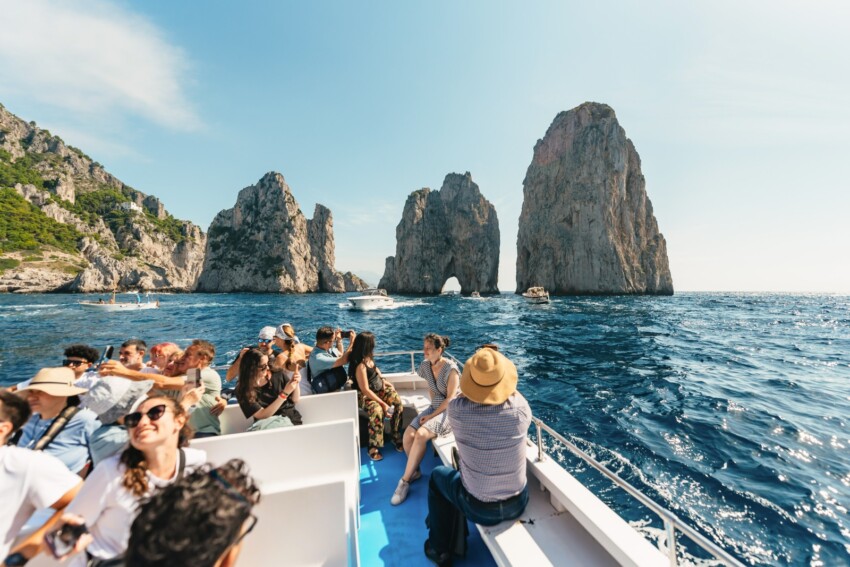
The Gulf of Naples is one of the richest and most varied marine basins in the Mediterranean: within a few hours’ sailing you pass from Naples’ urban coastline to the Phlegraean Islands, from Capri’s Faraglioni to the cliffs of the Amalfi Coast. Below are the main routes, ordered by duration and distance from the city.
The shortest and most accessible tour hugs Naples itself, from the Santa Lucia waterfront to the tip of Posillipo. From the sea, the city looks completely different: Castel dell’Ovo on the islet of Megaride with the Borgo Marinari at its foot, the nineteenth-century palaces on Via Partenope mirrored in the water, the silhouette of the Maschio Angioino and, in the distance, Mount Vesuvius rising towards the sky with its unmistakable curve.
Moving westward, you enter the Gulf of Pozzuoli: the Posillipo coast opens into a sequence of aristocratic villas and tufaceous inlets, with Palazzo Donn’Anna, unfinished and romantic, suspended over the water, as the climax of the visual journey.
The most interesting stops on this tour are Trentaremi Bay, a natural tufa amphitheatre accessible only by sea where you’ll find the submerged structures of the imperial villa of Pausilypon, and Gaiola, with its two islets and the Submerged Park below: the crystal-clear water allows you to glimpse Roman remains on the seabed with the naked eye.
Some operators offer swimming and snorkelling stops in these protected waters, with the possibility of a guided underwater tour. This tour is available year-round, but best conditions are found from May to October. Duration varies from 1.5 to 3 hours depending on the operator and route chosen.
The sunset tour along the Naples and Posillipo coast is one of the most romantic experiences the gulf can offer. You depart in the late afternoon, usually between 5pm and 6:30pm depending on the season, and sail westward as the light changes colour from orange to violet: the tufa cliffs of Posillipo light up, Mount Vesuvius becomes a dark silhouette against the sky, and the illuminated villas reflect in the evening breeze-rippled water.
Some operators include an aperitif on board with Campania wines and local products, transforming the tour into something even more memorable. It’s the ideal option for a special evening, a birthday, an anniversary, a moment to remember, and also one of the most accessible in terms of duration and price.
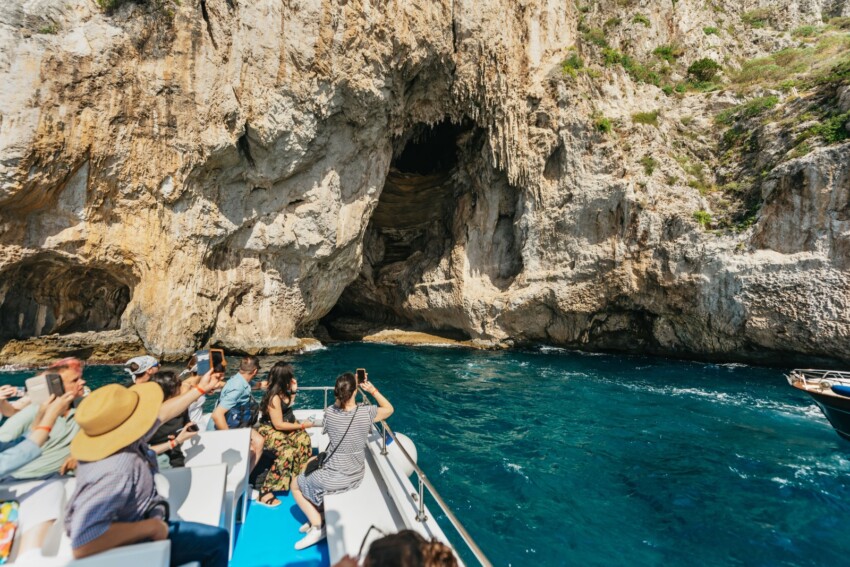
The boat tour to Capri is the most popular excursion in the Gulf of Naples and one of the most spectacular in the Mediterranean. The classic route involves departure from Naples (Molo Beverello or Mergellina) or Sorrento, sailing along the southern coast of the Sorrento Peninsula and arriving at Capri for the complete circumnavigation of the island: the three Faraglioni, three limestone spires jutting into the sea up to 109 metres, are Capri’s most iconic sight and from the sea assume proportions and profiles unimaginable from land; the Natural Arch, a window in the rock opening onto the open sea; the Green Grotto, the White Grotto and Fra’ Felice’s Grotto, marine caves navigable by boat; Punta Carena Lighthouse, Italy’s tallest lighthouse after Genoa’s, surrounded by one of the island’s most beautiful stretches of sea.
The Blue Grotto merits separate mention as an attraction in its own right: a sea cave where sunlight enters refracted by water, creating a supernatural blue illumination that made Capri famous worldwide. Access is possible only when the sea is calm (even gentle waves make entry impossible) and occurs exclusively with small rowing boats taking you inside one at a time: entry to the grotto (approximately €18) is paid separately from the boat tour and is not included in any package.
Full-day tours typically also include 2–3 hours of free time on shore to visit the Piazzetta, Augustus Gardens and the island’s shops. Advance booking is highly recommended from June to August, when places sell out weeks ahead.
The Amalfi Coast is a UNESCO World Heritage site and one of the world’s most celebrated coastal landscapes: seen from land, negotiating the hairpin bends of the SS163, it’s already extraordinary. Seen from the sea, it’s a different and for many a more intense experience: the limestone cliffs plummeting vertically into the water, villages clinging to the rock hundreds of metres above the waves, lemons cultivated on terraces, coastal caves opening at the base of cliffs – all this is better appreciated from a vessel moving slowly along the coast.
The classic tour from Naples covers the most spectacular stretches with stops at Positano, with white, pink and yellow houses cascading to the sea, and Amalfi, with its Romanesque-Arab cathedral dominating the port square. Along the way you see the Emerald Grotto near Conca dei Marini (accessible only by sea or by lift from the road), where the light creates green reflections like those of Capri’s Blue Grotto; the Li Galli Islands (also called the Sirens’ Rocks), three legendary skerries where according to Homer the Sirens dwelt who tempted Ulysses; the coast of Praiano, Cetara and Maiori.
The complete Amalfi Coast tour takes a full day (8–10 hours) and includes swimming stops in the most beautiful bays and free time in the main villages. Those departing from Sorrento save about an hour’s sailing compared to leaving from Naples.
Procida is the smallest and least touristy of the gulf’s islands, and a boat tour around its perimeter reveals its beauty with an intensity impossible to achieve on land. The pastel-coloured houses of the Corricella village, Italy’s most photographed fishing village, built directly on the water, are seen in their entirety only from the sea, with the blue dome of the church standing out against the green tufa cliff.
The tour circumnavigates the island showing the coastal caves, Chiaiolella Beach with its crescent shape protected by rocks, Marina Grande with moored boats and the fishermen’s jetty, and the series of coves on the southern coast where the sea reaches emerald and turquoise colours.
Half-day tours (4–5 hours) are the most common and include circumnavigation with swimming stops in the most beautiful bays. Full-day tours add free time on shore to visit the historic centre of Terra Murata and Corricella on foot.
Procida is also reachable independently by ferry or hydrofoil from Naples in approximately 35–40 minutes, but the boat tour allows access to coves and caves unreachable by scheduled services.
Ischia is the largest of the Phlegraean Islands and offers the most varied coastal panorama: on a complete tour you see the Aragonese Castle at Ischia Ponte, a medieval fortress on a rock linked to the island by a stone bridge, Cartaromana Bay with its natural thermal waters heated by the submarine volcano, the rocky coast of Sant’Angelo with its characteristic fishing village on the promontory, and the long Maronti Beach, the island’s largest, reachable by sea or by local water taxis. Along the south-western coast are the Sorgeto fumaroles: natural geothermal springs heating the sea water to temperatures of 40–50°C, creating one of the Mediterranean’s most spectacular hydrothermalism phenomena.
A full-day boat tour (8–9 hours) allows you to circumnavigate the island with stops of your choice in the most beautiful bays, bathing in Sorgeto’s thermal waters and, on organised tours, a few hours on shore to visit Ischia Porto or Forio. Alternatively, half-day tours cover the most scenic stretches without fully circumnavigating the island.
Ischia is reached from Naples in 45–50 minutes by hydrofoil or approximately 1.5 hours by ferry.
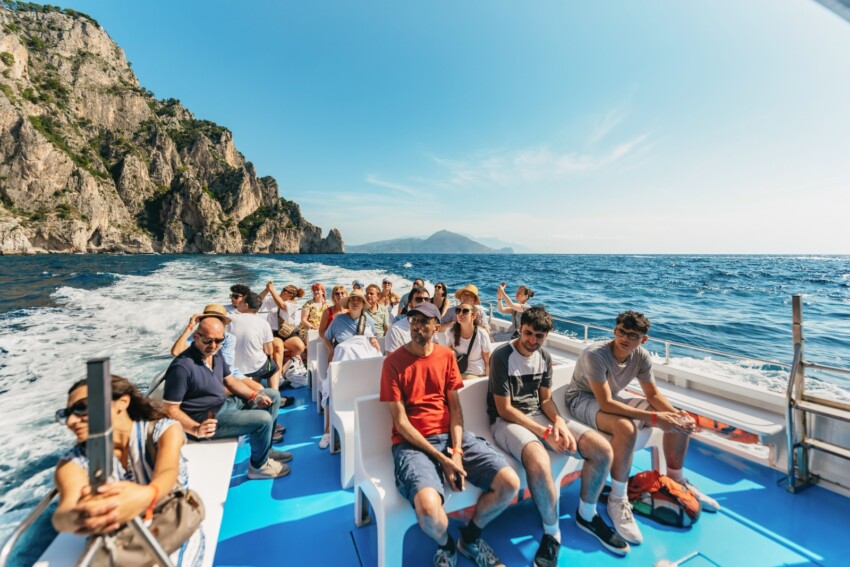
The choice between a group tour and a private boat is primarily a matter of budget, flexibility and personal preferences.
Group tours, with 8 to 20–30 participants, are the most economical and most widespread formula: the per-person price is significantly lower than private charter, the route is fixed and timings predetermined. They’re ideal for those travelling solo, as a couple or in small groups unwilling to organise from scratch, and for those on a tight budget. Group tours with smaller vessels (8–12 people) offer a good compromise between contained costs and quality experience.
The private tour is instead the choice for those wanting complete freedom: you choose the destination, timings, stops and pace of the day. The captain (or skipper) accompanies your group with no other passengers. It’s the ideal solution for families with children, groups of friends, private events (birthday, marriage proposal, anniversary) or simply for those wanting to experience the sea without sharing it with strangers.
Charter costs are divided among all participants: an 8–10 person vessel typically costs between €500 and €1,200 for half a day and between €900 and €2,000 for a full day, depending on boat size, destination and operator. Divided among participants, the cost often becomes competitive with group tours.
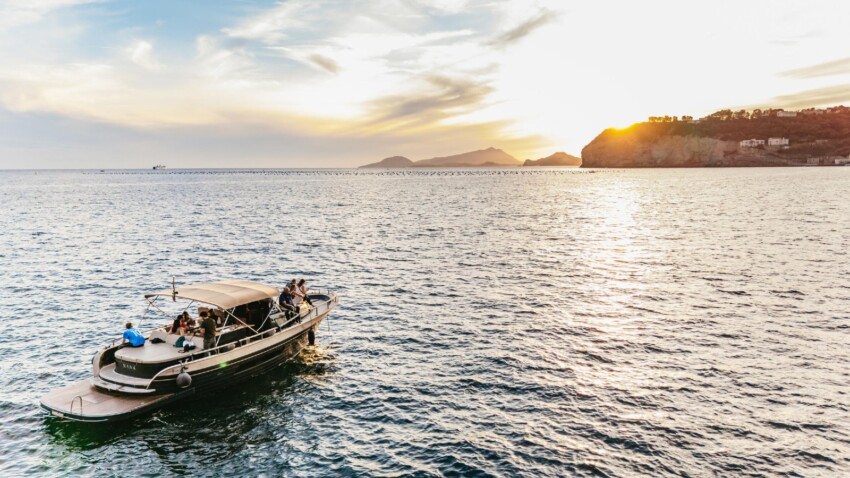
The optimal season for boat tours in the Gulf of Naples runs from May to October. During this period, the sea is generally calm, water temperature permits swimming (from July to September exceeding 24–26°C), and tour operators’ services are fully operational with daily departures.
June and September are the preferred months for those seeking the right balance between good weather, warm sea and manageable tourist flows. July and August are peak season: the sea is warm and days are brilliantly bright, but tour places sell out weeks in advance, Capri’s Blue Grotto is mobbed and the islands are very crowded. Booking at least two weeks ahead is essential these months.
May and October instead offer lower prices and fewer crowds, with most services still active; the sea may be slightly more choppy, but fine weather days are frequent.
From November to April, many operators drastically reduce departures or suspend them entirely. Some Naples coast tours remain available year-round on fine days, but island and Amalfi Coast tours depend on weather conditions and should be verified day by day. The northerly wind and rough seas can cause cancellations even in high season: all reputable operators provide free cancellation in case of adverse weather.
Before boarding, make sure you bring: high-SPF sunscreen (sun reflection off the water increases exposure), a hat and sunglasses, a lightweight jacket even in summer (wind at sea creates a significant temperature difference compared to the mainland), water shoes or waterproof sandals for swimming stops, swimwear and a towel if bathing stops are planned. Those prone to seasickness should take preventative medication at least an hour before departure; avoid heavy meals in the hours before boarding and opt for a spot on the stern deck, where the swell is less noticeable.
Always choose operators with proper licensing and mandatory insurance: check reviews on Google and TripAdvisor, verify that the vessel is certified and the crew holds a boating licence. Unlicensed vessels without proper documentation offer no insurance cover in case of accident.
The main departure points are Molo Beverello (just steps from Piazza Municipio, in the heart of Naples harbour), Mergellina Port (on the western side of the seafront, more convenient for tours of the Posillipo coast and the Campi Flegrei) and Pozzuoli Port (for excursions in the Campi Flegrei area and to the Flegrei Islands).
Tours to the Amalfi Coast can also depart from Sorrento, reducing sailing time. The exact meeting point is always communicated by the operator when you book.
In most cases yes, with some precautions. Larger, more stable boats (gozzo, open speedboats, medium-sized motor boats) handle children well. Fast rubber dinghies may be better suited to older children who can tolerate dynamic manoeuvres.
It’s advisable to avoid full days on a boat with children under 3 years old, preferring shorter tours such as the Naples coast tour (1.5–2 hours). Always bring sunscreen, a sun hat, snacks and preventative seasickness medication if the child is prone to it.
Yes. Private charter is available for any number of people, from 2 upwards. The cost is for the entire vessel and is split among participants: for a group of 6–10 people, private charter can be competitive compared to group tours, with the added benefit of complete freedom over route and timings.
For special occasions—proposal, birthday, anniversary—many operators offer personalised arrangements with aperitifs, decorations and on-board music.
All reputable operators offer free cancellation in case of adverse weather conditions (rough seas, strong winds, storms) that make sailing unsafe or unpleasant. In these cases you’re entitled to a full refund or rescheduling on an alternative date.
Cancellation is usually communicated the evening before or early in the morning: it’s good practice to provide a reachable phone number. For online bookings, always check the cancellation terms before finalising your purchase.
For swimming stops you don’t need to be able to swim: vessels are equipped with ladders for entering the water and guides stay on board. For snorkelling, it’s advisable to be comfortable in the water, though the areas are always calm and shallow.
Equipment (mask, fins, snorkel) is usually provided by the operator; check whether it’s included in the price or available for separate hire. Life jackets are always available on board for anyone who requests one.
Molo Beverello is right next to Piazza Municipio, less than 10 minutes’ walk from Piazza del Plebiscito. By Metro Line 1, the nearest stop is Municipio. On Line 2, the stop is Montesanto (about 15 minutes’ walk). Numerous city bus routes have stops nearby. Ferries and hydrofoils to the islands also depart from the port: see our guide to ferries from Naples for all information on public transport connections to Capri, Ischia and Procida.
 Hotel
Hotel  Budget accommodations
  Apartments
  Family Hotel
  Luxury Hotel
  Resorts