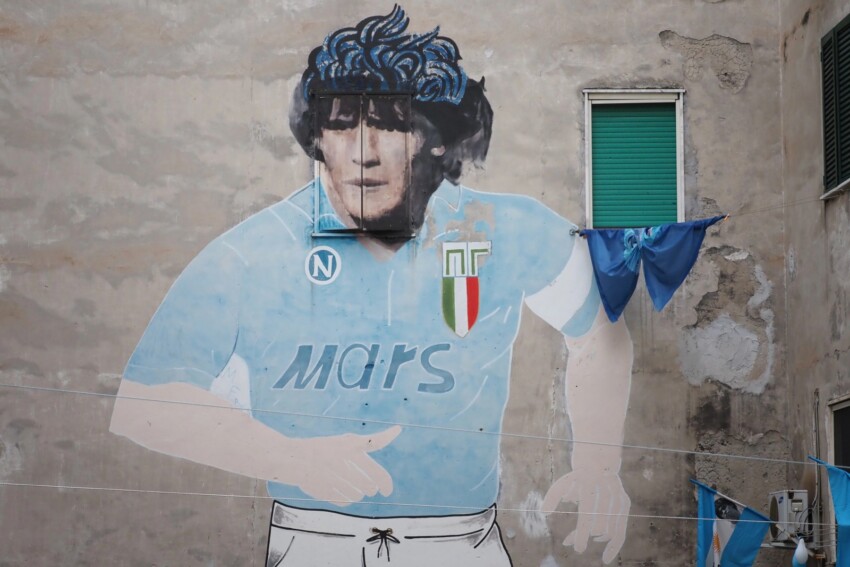
On a six-storey building in an alleyway of the Spanish Quarters, in a narrow street called Via Emanuele De Deo 60 and now universally known as Largo Maradona, there is a work of art that requires no admission ticket, has no closing hours and no curator – yet it attracts more visitors than many museums.
The mural of Diego Armando Maradona has become over the years the symbol of a popular cult that extends far beyond football, an anthropological phenomenon, a place of collective memory, a point of convergence for supporters, tourists, artists and anyone seeking to understand the visceral relationship between Naples and its hero.
When the work was painted in 1990, no one imagined it would last thirty years. It was a gift from a twenty-three-year-old boy from the Spanish Quarters to his city, a spontaneous tribute marking the second championship just won. Then Maradona left Naples, the work faded, and a window was even built over it. But it did not die. It was restored, documented, photographed, visited by footballers and managers, politicians and rock stars, in broad daylight and in the dead of night.
When Diego died on 25 November 2020 in Buenos Aires, the world did not look towards his villa in Argentina: it looked towards Largo Maradona in Naples, where thousands of people brought candles, flowers, shirts and letters. It was there that his symbolic tomb lay.
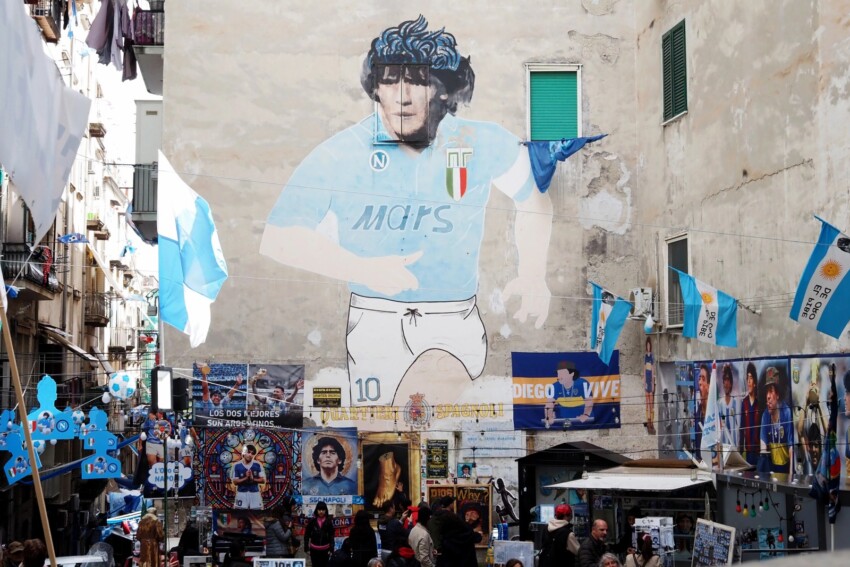
It is 1990. Naples has just won its second championship in the 1989-90 season, the last title in the club’s history until the third won in 2023, and Diego Armando Maradona, who arrived from Barcelona in 1984 with 13.5 billion lire in his pocket and pressure on his shoulders that would have crushed anyone else, scored 16 goals in 28 matches – his personal record outside Argentina. The Spanish Quarters celebrated as only Naples knows how: fireworks, street processions, songs echoing through the alleyways.
It is in this atmosphere that a 23-year-old named Mario Filardi, a self-taught artist born and raised in the Spanish Quarters, decides to give something permanent to his neighbourhood. He takes a small photograph of Maradona, the champion captured in motion wearing Naples’ number 10 shirt, the iconic version from the 1980s with the Mars sponsor and captain’s armband, and transforms it into the focal point of his entire undertaking. Two nights and three days of non-stop work on a precarious scaffolding over ten metres high, with neighbourhood residents keeping car headlights on to illuminate the wall through the night. Materials were passed up the scaffolding hand by hand: a spontaneous chain of human solidarity.
The coordinator of this collective effort was Antonio Esposito, known as “Bostik”, a Naples ultra at the time who would become the informal guardian of the mural and the entire piazza over the years. When the work is completed, the Naples sky lights up with fireworks: not for a sporting victory this time, but for a work of art born in an alleyway. The mural covers more than two storeys of the six-storey building, and Maradona’s stylised figure, almost like a comic-book superhero, is recognisable from every corner of the street.
Mario Filardi unfortunately never witnessed the rebirth of his work: he died prematurely in 2010 in Zurich, at forty years old, never having pursued an institutional artistic career. He had not sought one: he had done what he felt he needed to do, in the place where he had grown up, for the people he loved. In 2016 the City of Naples dedicated a commemorative plaque to him on Via De Deo, posthumously recognising the value of that act of urban love.
Throughout the 1990s and 2000s, Filardi’s mural began to fade inexorably. Neglect, the damp of the alleyways and time took their toll, and the work risked being forgotten. Then something rather bizarre happened: the residents of the flat at the height of Maradona’s face opened an unauthorised window on the wall, roughly at the centre of the mural, precisely at the level of the champion’s face. Suddenly, Maradona had a window instead of a face.
It was Salvatore Iodice, a craftsman and artist from the Spanish Quarters, who stepped forward in 2016 to save the work. Iodice, whose carpentry workshop was located right in the neighbourhood, raised three thousand euros from private donors and obtained a cherry picker from the City. He carefully studied Filardi’s original and repainted it while maintaining its compositional structure, but reinterpreting the figure in a modern key whilst respecting the comic-book spirit of the original. The window problem was solved with an ingenious invention: the resident family (the Vitiello family) were persuaded to allow the wooden shutters of the window to be painted in trompe-l’œil, so that when the window is closed, Diego’s face appears complete and unbroken. A year later, in 2017, Argentine artist Francisco Bosoletti completed a further restoration of the entire mural, refining the contours and restoring the work’s colours in an intervention that marked the definitive version visible today.
It was at this point that “Largo Maradona” as we know it was created: what had been a car park and rubbish dump at the end of Via Emanuele De Deo a few years earlier transformed into an equipped piazza, with a decorated wall, information panels and, most importantly, a permanent votive altar at the foot of the building.
When you arrive at Largo Maradona, you quickly discover that there is an element of unpredictability to your visit: Maradona’s face might not be visible. The reason lies in that detail which made headlines worldwide – the bathroom window of the Vitiello family, the family living in the flat precisely at the height of Diego’s face. When the wooden shutters painted by Bosoletti are closed, the mural appears intact. When the family wants to open the bathroom window, which is entirely legitimate, the champion’s face disappears, replaced by two open wooden shutters.
The Vitiello family, interviewed multiple times by the national press, has spoken with ironic resignation about their situation: “It’s nice to live inside a work of art, but we’d like to be free to open the window at least in the evening”. No one pays them to keep it closed, and they have no obligation to do so. However, the social and moral pressure of the Maradonist cult upon them is evident: every time the window opens, a small storm erupts on Naples’ social media.
For visitors, the practical advice is to arm yourself with patience and wait a few minutes: in most cases the window is closed, especially during the central hours of the day. In the evening and early morning, when the family uses the bathroom, the chances of finding the “missing” face increase. But even the open window, at the end of the day, is part of the mural’s story: it is one of the most authentic symbols of the relationship between street art and everyday life in a city like Naples.
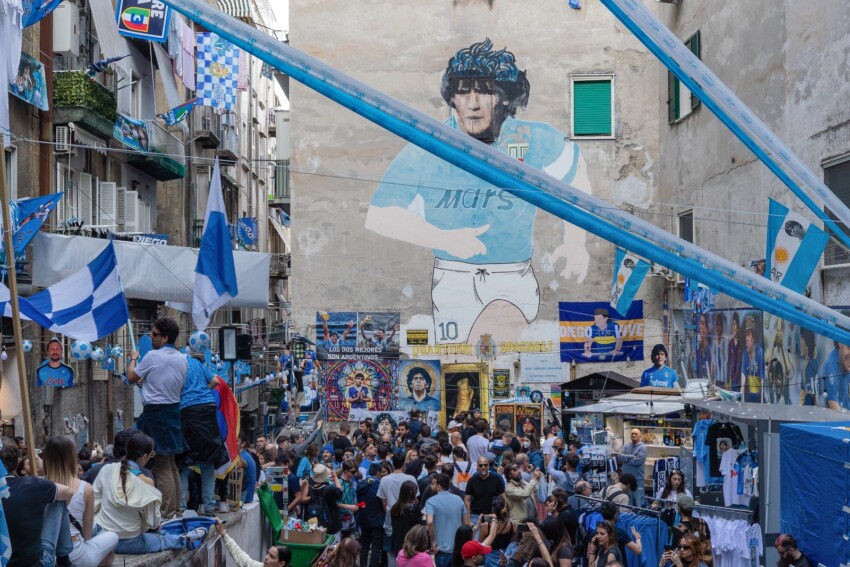
At the foot of the building, in what was once a corner of urban decay, there has developed over time a spontaneous votive altar without equal in Europe outside of proper religious shrines. Perpetually burning candles, photographs from every era of Diego’s career, number 10 shirts from Naples and Argentina, scarves, letters, drawings, commemorative plaques, miniature trophies, dolls, messages in dozens of different languages. Following Maradona’s death on 25 November 2020, the altar multiplied exponentially: for weeks, the piazza was inaccessible due to crowds and was covered with tributes.
What strikes visitors to Largo Maradona, even those who are not football enthusiasts, is the emotional quality of the space. It is not a tourist site in the conventional sense: it is a place where people come to gather, to remember, to feel something. Naples supporters come here before important matches. Rival supporters come the evening before facing Naples at the stadium. Foreigners arrive wearing Maradona shirts and photograph themselves in tears. José Mourinho went there. Antonio Conte went at night, incognito, with his family, shortly after signing his contract as Naples manager. Kvicha Kvaratskhelia went there in the dead of night as a final farewell to the city, before moving to PSG.
The piazza is animated at all hours of day and night. Sellers of Maradonist merchandise occupy the surrounding alleyways: shirts, posters, statuettes, key rings, prints. It is a vibrant informal economy that has developed organically around the cult of Diego, and is as much part of the experience of the place as the mural itself.
Diego Armando Maradona arrived in Naples on 5 July 1984, transferred from Barcelona in what was at the time the most expensive move in football history. He was 23 years old, had already won everything there was to win in Argentina, and found himself having to manage an expectation that would have crushed any other human being. The San Paolo, now the Diego Armando Maradona Stadium, welcomed him with 75,000 people in delirious celebration for a simple presentation training session – an unprecedented event in world football history.
In his seven years in Naples, from 1984 to 1991, Maradona transformed Naples from a mid-ranking club into an international football powerhouse: two championships (1987 and 1990), a UEFA Cup (1989), a Coppa Italia (1987). But Maradona’s value to Naples went far beyond trophies. In a city that for centuries had suffered geographical and cultural marginalisation from northern Italy, Diego embodied the vindication of the weak, had come from Buenos Aires, from the poverty of Villa Fiorito, had humiliated the arrogant with the ball at his feet. For Neapolitans, his success was their success. His victories were the answer to every insult received.
He was also, inevitably, a contradictory man: generous and self-destructive, brilliant and fragile, capable of extraordinary acts of humanity and choices that would mark him. Naples loved him entirely, without reservation and without judgment. And he repaid that rare and total unconditional love: Maradona said more than once that Naples was the city where he felt most understood, most loved, most “at home”. The mural of the Spanish Quarters is the crystallisation of this feeling.
After his death, Naples multiplied the tributes: beyond the murals, the bars and pizzerias dedicated to him, the shirts and merchandise, the stadium itself bearing his name following a vote by the Naples City Council in December 2020, just weeks after his death. The third championship in 2023, won thirty-three years after the second, was celebrated as Diego’s return, as if the champion had guided the team from another dimension. That evening, Largo Maradona was unreachable for the crowds.
The mural is located at Via Emanuele De Deo 60, in the heart of the Spanish Quarters, just a few minutes’ walk from Naples’ historic centre. Access is free and available at any time of day or night.
If you are already in the Spaccanapoli or Via Toledo area, you can reach the mural on foot in 10-15 minutes, walking north on Via Toledo and turning into the Spanish Quarters. The journey through the neighbourhood’s alleyways, with washing strung between buildings, scooters whizzing past, voices overlapping, is in itself an immersive experience of Naples’ popular soul, and forms an integral part of the visit. Those arriving from Capodichino airport can take Metro Line 2 to Montesanto or Line 1 to Toledo.
Using public transport, the most convenient way to arrive is the Metro Line 1, getting off at the Toledo stop: from there, the mural is reachable on foot in 7-10 minutes (approximately 450 metres), heading uphill into the Spanish Quarters’ alleyways towards Via Emanuele De Deo. The route is easily intuitive: simply follow signs for the Spanish Quarters and head uphill. The Dante stop (Line 1) is also convenient, with a walk of around 12-15 minutes through Piazza Dante and Via Toledo.
The mural is visible at any time of day or night, as it’s located on the façade of a private building on a public street. The only variable is the position of the Vitiello family’s window: when the shutters are open, Diego’s face disappears. To increase your chances of finding the window closed (and the mural intact), it’s recommended to visit during midday hours, when the family is typically away from home.
No, not at all. Visiting the mural is completely free and accessible to everyone without restrictions. It’s a work on the wall of a private building on a public street: there’s no ticket office, no booking required, no entrance times. Your only “expense” might be for a coffee or pizza at one of the neighbourhood’s local spots.
The mural is beautiful at any time, but early morning (between 8 and 10am) and late afternoon (between 4 and 6pm) offer softer light and fewer tourists. The most atmospheric time, if you love the nocturnal vibe, is evening and night: the votive altar is lit by candles, the neighbourhood is quieter, and you’ll understand why so many famous figures choose to visit Largo Maradona in the dead of night. Before a Napoli match at the Maradona stadium, the area is particularly charged with energy.
The Quartieri Spagnoli is nowadays one of Naples’ most visited areas by international tourists, and the presence of the mural has contributed over the years to a progressive revitalisation of the neighbourhood. During the day the area is lively and bustling, with bars, shops and a steady flow of visitors. As with any working-class neighbourhood in a major European city, it’s sensible to keep an eye on your belongings, especially during evening hours. Football tourism and cultural interest have brought many positive changes to the area in recent years.

 Hotel
Hotel  Budget accommodations
  Apartments
  Family Hotel
  Luxury Hotel
  Resorts