Bestseller
Naples: Royal Chapels & Treasure of St. Gennaro Ticket
From 15,00 €
Buy the ticket
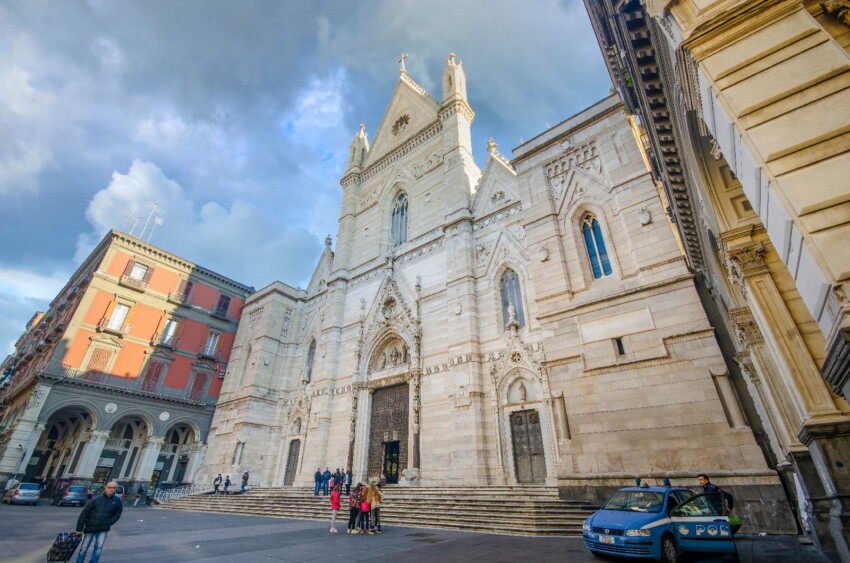
The Naples Cathedral, also known as the Basilica of Santa Maria Assunta, is one of the most important religious buildings in the city and the place where three times a year you can witness the miracle of the liquefaction of the blood of Saint Januarius, the patron saint of Naples. The Cathedral complex also includes the Basilica of Santa Restituta, where you’ll find the baptistry of San Giovanni in Fonte, considered the oldest in the Western world, and the chapel of the Treasure of Saint Januarius which houses the saint’s relics.
Anyone visiting Naples cannot miss this magnificent example of Gothic architecture that represents an important symbol not only for the history of Naples but also for all Neapolitans. The religious building has been destroyed and rebuilt many times over the years, so the structure we see today is the result of several restoration projects.
On 19 September each year, the date commemorating the martyrdom of Saint Januarius, the Cathedral of Naples holds a solemn celebration attended by the cardinal archbishop and countless faithful. During the ceremony you can witness the liquefaction of the saint’s blood, which remains liquid for the following eight days. This is one of the occasions that draws many devotees of the saint not only from Naples and its province but from across Campania.
The Cathedral features a Latin cross layout and consists of a nave divided into three sections with ten side chapels (five on each side), altars and funeral monuments. The central nave, approximately 100 metres long, was originally covered with a wooden trussed ceiling that in 1621 was transformed into an ornate, gilded coffered ceiling featuring biblical scenes. On the counter-façade are the tombs of Charles I of Anjou, King of Naples, Charles Martel of Anjou, King of Hungary, and his wife Clemenza of Habsburg.
The transept, following restoration work in the 19th century, displays Neo-Gothic Baroque style and is covered with a gilded wooden coffered ceiling featuring paintings by Forlì. The cathedral’s apse, as it appears today, results from work carried out in both the 16th and 18th centuries; the latter work, undertaken by Paolo Posi, completely transformed the original Gothic polygonal structure and added wooden choir stalls.
From the transept you can also access the Succorpo Chapel, commissioned by Cardinal Oliviero Carafa in 1497 when he brought the relics of Saint Januarius back to the city, previously kept at the Sanctuary of Montevergine in Avellino.
The Succorpo Chapel is also known as the Chapel of Saint Januarius or Carafa Chapel in honour of Cardinal Oliviero Carafa who commissioned its construction. Before being housed here, the relics of Saint Januarius were first kept in the catacombs of San Gennaro and then at the Sanctuary of the Madonna of Montevergine in Avellino province. Cardinal Carafa decided to bring the remains back to Naples where the saint’s head and blood were already preserved.
The Chapel remains the property of the Carafa family, which at the end of the 19th century commissioned restoration and restructuring work. Beneath the bronze altar lies an urn containing the relics of Saint Januarius’s body and in front of the altar stands a marble statue of Cardinal Carafa in prayer. The crypt, considered a true work of art, is divided into three sections by ten columns and is completely lined with marble whilst the ceiling features eighteen ornate coffered panels decorated with figures of saints and cherubs.
From the left nave of the cathedral you can reach the Basilica of Santa Restituta, dating back to the Early Christian period. Built by Constantine I, the Basilica was later incorporated into the Cathedral complex and currently has a three-section layout separated by Corinthian columns.
Here you can admire both the Baptistry of San Giovanni in Fonte, considered the oldest in the Western world, and an archaeological area containing remains from the Greco-Roman and Early Christian periods.
During the 16th century, the city of Naples faced difficult periods marked by military conflicts, plague crises and volcanic eruptions. In this situation, Neapolitans decided to pray to Saint Januarius, the city’s patron saint, to help them overcome the period and made a vow to build him a new chapel inside the Cathedral. For this reason, even today the Chapel does not belong to the Diocese but to all Neapolitans.
The construction of the Chapel of the Treasure of Saint Januarius, started on 8 June 1608, was initially assigned to architect Francesco Grimaldi and after his death to Giovan Giacomo di Conforto. To build the Chapel, several buildings were demolished including the church of Sant’Andrea, an oratory, three cathedral chapels and some houses.
The building has a Greek cross layout and was erected in the Neapolitan Baroque style. The high altar is at the centre of the presbytery whilst two altars are positioned laterally and four smaller altars are placed at the bases of the pillars supporting the dome. Surrounding the chapel are nineteen bronze sculptures depicting the city’s patron saints tasked with protecting Naples from war, plague and Vesuvius eruptions. Among these stands out the sculpture of Saint Januarius seated, dating from 1645, located near the high altar.
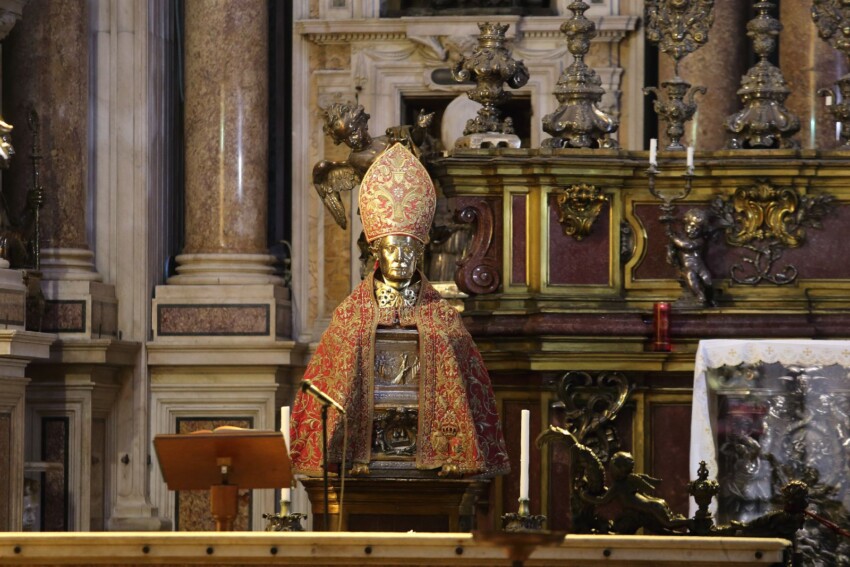
The High Altar houses the ampoules containing Saint Januarius’s blood whilst above the altar is the Bust of the Saint containing the cranial bones. The chapel is also connected to the Museum of the Treasure of Saint Januarius which houses and preserves paintings, statues, busts, jewels and precious fabrics that kings and queens, nobles and common people brought as offerings to the saint over the years.
The admission ticket for the Treasure of Saint Januarius costs €12.00, whilst a reduced ticket (for law enforcement, teachers, etc) costs €8.50. Children under 12, accredited tourist guides and disabled people with a disability rating of 75% or more enter free of charge. The museum has accessible ramps for disabled visitors.
At the ticket office you can download the QR code free of charge to access the app that provides a multimedia guide to the Museum.
If you’d like to explore further with an official guide, choose one of the tickets below.
Entrance to Naples Cathedral is free and is available during the following hours:
Admission to the Treasure of Saint Januarius museum is available daily during the following hours:
The Cathedral is located in the heart of Naples’ historic centre, in a limited traffic zone (ZTL), so we recommend reaching the church by public transport or on foot.
By metro, the nearest stations are: Piazza Cavour, Museo or Dante. For visitors with limited mobility, De Santo Parking – Gardes is available on Via Giuseppe dei Ruffi, a side street off Via Duomo, just over 100 metres from the museum.
According to tradition, three times a year—the first Saturday in May, 19 September and 16 December—the miracle of liquefaction of Saint Januarius’s blood occurs, drawing thousands of faithful each year.
Around 300 AD, during the reign of Diocletian, one of the emperors who most brutally persecuted Christians, Saint Januarius was bishop of Benevento and decided to organise a visit to the faithful at Pozzuoli. Unfortunately, Sosso, a deacon of Miseno and friend of Saint Januarius, was arrested en route to Pozzuoli on the orders of Dragonzio, governor of Campania. Januarius fought for his release and even visited him in prison. For these reasons the saint was arrested by Dragonzio and condemned to be torn apart by lions.
Legend has it that the beasts destined to tear apart Januarius actually knelt before him and refused to harm him. According to other sources, Januarius was a bishop greatly loved by the people and fearing popular uprisings, Dragonzio changed his mind and decided to execute Saint Januarius by beheading him. On 19 September 305 the saint died by beheading.
Saint Januarius’s body was reportedly buried in the Agro Marciano and only in the 5th century, thanks to Giovanni I, bishop of Naples, it was moved to the Catacombs of Naples, which subsequently took his name. From the Parthenopean city the relics were moved again first to Benevento, then to the Abbey of Montevergine in Avellino and finally, thanks to Cardinal Oliviero Carafa, found their place in Naples Cathedral.
According to tradition, Saint Januarius’s blood liquefied during the transfer of the body from Agro Marciano to Naples following an encounter with his nurse Eusebia who had with her ampoules containing the saint’s blood collected before his death. The reunion of the ampoules with the saint’s remains caused the first liquefaction episode. For this reason, the first Saturday in May each year, commemorating the first translation, the miracle of Saint Januarius occurs. The second liquefaction happens on 19 September, the date of the beheading, whilst a third liquefaction occurs on 16 December, the “Feast of the Patronage of Saint Januarius”, in memory of the tragic eruption of Vesuvius in 1631 which spared Naples only after the people had invoked the saint’s aid.
Originally this site housed a temple dedicated to the god Apollo, on whose ruins the Basilica of Santa Restituta was built in the 4th century AD, along with the baptistry of San Giovanni in Fonte and the Basilica of Santa Stefania. The Basilica of Santa Restituta and the Baptistry of San Giovanni were incorporated into the cathedral project whilst the Basilica of Santa Stefania unfortunately was destroyed.
The church commissioned by Charles of Anjou in 1294, who convened French architects for its design, was completed under the reign of Robert of Anjou in 1313 and in 1314 was officially dedicated to the Assumption. Work inside the building was, however, also entrusted to Italian craftsmen, including Masuccio I, Giovanni Pisano and Nicola Pisano. Between the mid-14th and 16th centuries two major earthquakes struck the city of Naples, damaging many parts of the cathedral. Following these events, restoration work was organised, during which the Succorpo Chapel and the Royal Chapel of the Treasure of Saint Januarius were built to thank the saint for helping the city during the plague epidemic.
In 1788 the central nave was also restructured in the Gothic style, whilst the façade was redesigned in Neo-Gothic style by architect Enrico Alvino. After being damaged during the Second World War, the cathedral underwent restoration work between 1969 and 1972, which not only revealed ancient Roman and Greek remains but also the 16th-century coffered ceiling.
The Naples Cathedral is located in the heart of the city, 650 metres from the San Severo Chapel, approximately 1.5 km from Naples Central Station and 2.5 km from Piazza del Plebiscito.

 Hotel
Hotel  Budget accommodations
  Apartments
  Family Hotel
  Luxury Hotel
  Resorts