Bestseller
Naples: Città della Scienza Interactive Museum Entry Ticket
From 8,00 €
Buy the ticket
There is a place in Naples where you can literally walk inside the human body, witness the birth of a star in a seventeen-metre dome, touch a live tarantula spider and discover how your own brain works. Located in Bagnoli, in a former industrial area overlooking the Gulf of Pozzuoli transformed into one of Italy’s most important science dissemination hubs, it is called Città della Scienza.
Founded in 1996 by Neapolitan physicist Vittorio Silvestrini on the principle that science should be accessible to everyone – not just to academies and universities, but to children, families and the curious of all ages – it has become over the decades a model exported around the world, from Africa to the Middle East and China.
Città della Scienza is not a traditional museum in the classical sense: it has no glass cases, no labels to read in silence, and it does not ask visitors to simply observe. Instead, it is a place designed for direct experience, where you touch, activate, explore, make mistakes and understand.
Its flagship museum, Corporea, is Europe’s first fully interactive museum dedicated to health and biomedical sciences. Its Planetarium is Italy’s largest in 3D projection. Its laboratories welcome tens of thousands of students each year. And its story – one of vision, devastation and rebirth – is among the most dramatic and significant in contemporary Neapolitan culture.
The Città della Scienza complex spans over 35,000 square metres, encompassing permanent buildings, exhibition pavilions, outdoor areas and the Bagnoli seafront. Your visit can focus on the main museum area – Corporea, the Planetarium and temporary exhibitions – or expand to include outdoor spaces, laboratories and scheduled events. Below are the main sections not to miss.
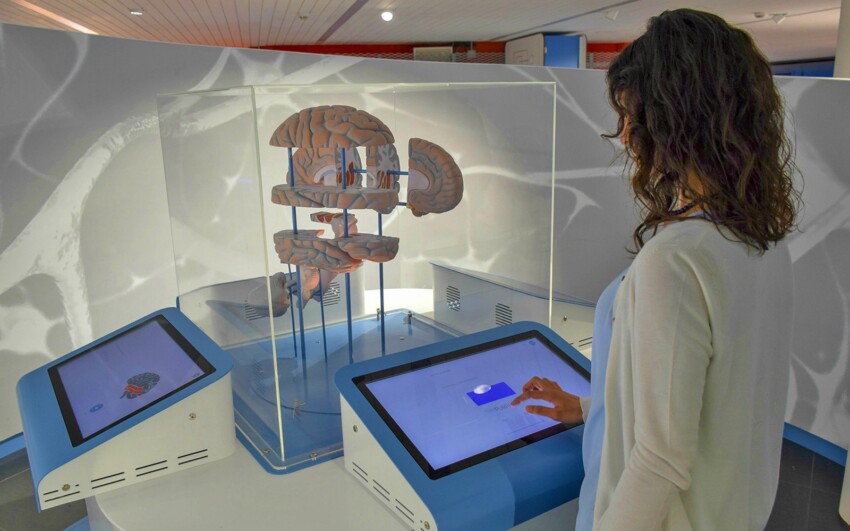
Corporea is the heart and jewel of Città della Scienza: an interactive museum covering over 5,000 square metres spread across two levels, offering an immersive journey through the human body, biomedical sciences and preventative health culture. Opened on 4 March 2017 – deliberately the same date as the arson attack of 2013, chosen as a symbolic act of rebirth – it is Europe’s first fully interactive museum devoted entirely to health and biomedical technologies.
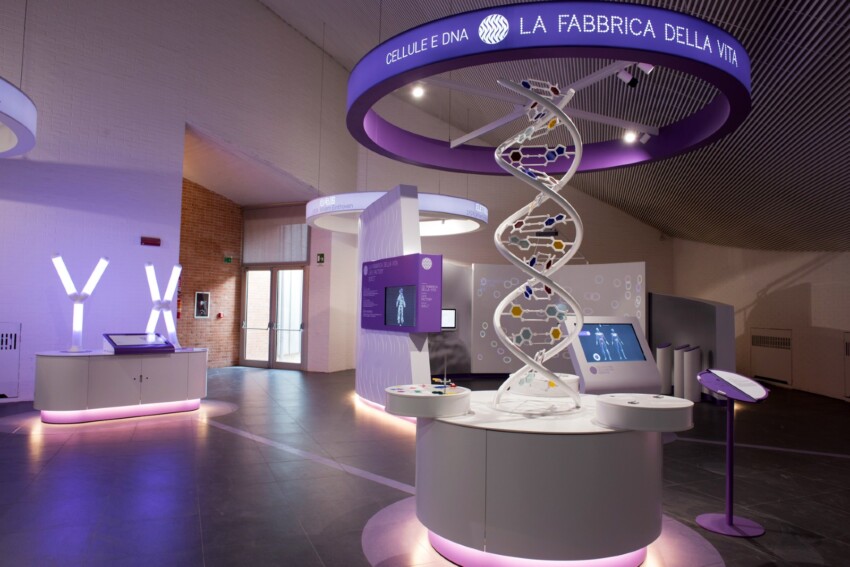
The visit unfolds through themed areas exploring different body systems: from neurology to cardiology, from immunology to genetics, from reproduction to musculoskeletal anatomy. In each area, interactive exhibits allow visitors to experience phenomena first-hand: you can measure your neural reaction speed, observe muscle activity in real time, understand how the immune system works through physical simulations, and explore full-scale anatomical models. Particularly effective with children are the multimedia installations that translate complex biological processes into intuitive and entertaining sensory experiences.
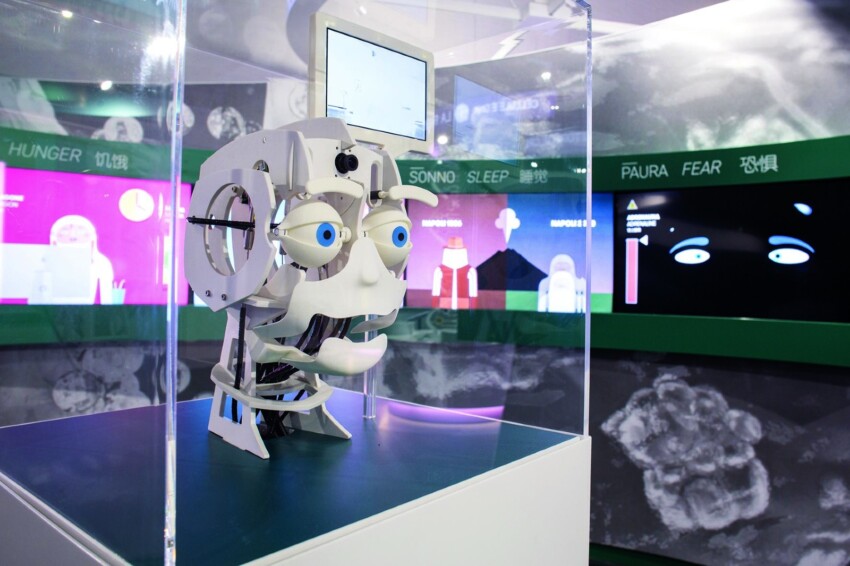
Corporea recently welcomed Aphel, a state-of-the-art humanoid robot that interacts with visitors and runs demonstration sessions. The presence of this AI system integrated with robotics adds contemporary relevance to the experience: not just the human body as it is, but how technology can support, replace or extend it in the future. Guided tours of Corporea for families and school groups must be booked in advance, especially during peak season; a Science Centre ticket automatically includes access to Corporea.

The Planetarium at Città della Scienza is one of Italy’s most advanced facilities and ranks among Europe’s most sophisticated: a hemispherical dome 17 metres in diameter equipped with a high-resolution 3D digital projection system that simulates the starry sky, planetary movements and interstellar journeys with extraordinary visual and audio quality. Opened in 2017 alongside Corporea, it is the result of years of planning following the 2013 fire, financed partly through insurance funds and donations raised nationally and internationally.
The Planetarium offers a varied programme in different formats: pre-recorded shows (such as Robot Explorer, designed for younger children, and From Earth to Universe, recommended from age 8) and LIVE shows conducted by an astronomer in real time, who illustrates the current month’s sky, answers audience questions and shares the latest astronomy news. LIVE shows, in particular, have the advantage of always being different and adapting to the month’s astronomical phenomena – an upcoming eclipse, a close planetary approach, an ongoing space mission – with a level of engagement that recorded formats cannot replicate.
The Planetarium can be visited with a separate ticket from the Science Centre, or with a combined ticket (Science Centre + Planetarium) offering savings compared to individual purchases. On weekdays, Planetarium tickets are only available on-site. At weekends, the programme is more extensive and it is advisable to arrive at opening time to secure a place at your preferred show.
The temporary exhibitions programme is one of Città della Scienza’s major strengths: each year, international-scale exhibitions on current scientific topics are mounted, often produced in collaboration with leading European science museums and research institutions. The ability to continually refresh the exhibition offer is one of the reasons many Naples residents return multiple times a year.
The Insetti & Co section, also known as Bugs and Company, is one of the most popular permanent sections for younger visitors: an exhibition dedicated to the world of insects, arthropods and small invertebrates combining live specimens, natural history collections, giant-scale models and interactive stations for exploring one of the most diverse and ecologically fundamental animal groups. Insects represent over 70% of known animal species and play crucial ecosystem roles, from pollination to decomposition, often overlooked or undervalued.
The area’s layout is designed to dismantle the instinctive disgust many children (and adults) feel towards insects, replacing it with scientific curiosity and respect for biodiversity. Certain stations allow observation of live insects – ants in transparent ant farms, stick insects, cockroaches, scorpions – in controlled and safe conditions. Staff in this area are specialised in engaging younger audiences and know how to transform fear into an effective learning moment. Entry to Insetti & Co is included in the Science Centre ticket.
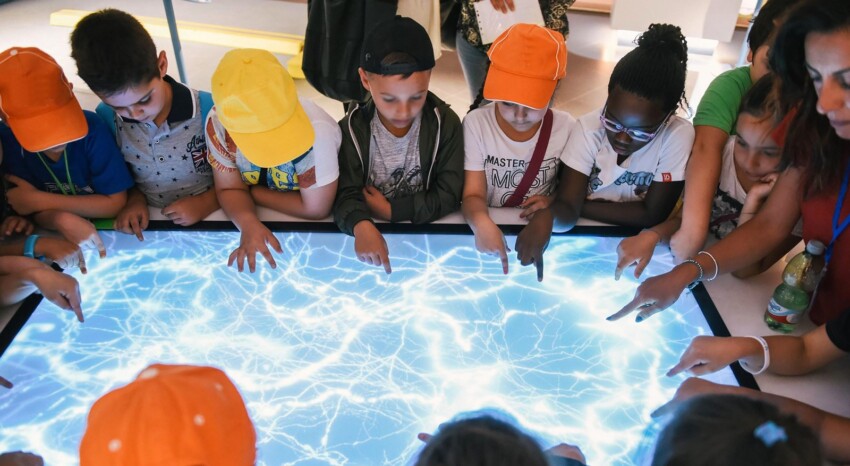
The educational laboratories have always been at the heart of Città della Scienza’s pedagogical identity: equipped spaces where children, teenagers and adults can conduct real scientific experiments under the guidance of qualified staff. The laboratory programme covers subjects ranging from chemistry to physics, biology to robotics, astronomy to neuroscience, with pathways tailored to different age groups. Many laboratories are specifically designed for school groups and must be booked in advance; on weekends and during holidays, some activities are open to the general public and included in the day’s schedule.
Science Shows – live science demonstrations with high-impact experiments – are offered periodically in the museum’s public areas and represent some of the most engaging moments for children. Controlled explosions, spectacular chemical reactions, liquid nitrogen demonstrations and physics experiments are the stars of these short shows (15–20 minutes) that can transform abstract concepts into memorable images. Participation in laboratories and shows is included in admission and entry is on a first-come, first-served basis: it is worth checking the programme posted at the entrance and planning accordingly from the first few minutes of your visit.
Città della Scienza is not just indoors: the complex boasts outdoor areas overlooking the sea, offering a perspective rarely associated with a science museum. The Bagnoli seafront, a former industrial site of the great Italsider steelworks undergoing progressive urban regeneration thanks to a national project funded by PNRR resources, stretches before the facility with views of the Gulf of Pozzuoli, the Phlegraean Fields, Nisida and, on clear days, as far as Ischia and Procida. Families with children appreciate the opportunity to alternate museum visits with time outdoors, picnics on the grass and seafront walks.
The Padiglione Galilei 104, on the waterfront, houses the Teatro Galilei managed by the theatre cooperative Le Nuvole and programmes children’s theatre, performances and cultural initiatives alongside the scientific offer. In the outdoor area there is a refreshment point with Neapolitan cuisine, ideal for a lunch break without leaving the complex. Paid parking is approximately 200 metres from the main entrance.
Futuro Remoto is Italy’s longest-running science dissemination festival, organised annually by Città della Scienza since 1987. Each edition focuses on a theme – over the years covering energy, the brain, time, life, matter and the future – and offers several days of conferences, performances, exhibitions, workshops, debates with scientists, artists and thinkers of international standing.
The event is completely free and open to all, and represents one of the most extraordinary opportunities to engage with science in an accessible and participatory way. For the current edition’s calendar, consult the official website.
The Science Centre ticket includes access to Corporea, Insetti & Co and temporary exhibitions included in that day’s programme. Entry is free for children under 3, disabled visitors and their companions, and Bagnoli residents (with some exceptions on major event days). Teachers accompanying school groups enter free at a ratio of 1 per 10 students.
The Planetarium ticket is not included in the Science Centre and is purchased separately. On weekdays, Planetarium tickets are available on-site only and not online. For regular museum visitors, a Family Card (annual pass for 4 people with unlimited access and 15% discount at the Science Store) and an Open Card (10 visits) are available.
Tickets are available online or at the entrance ticket office. Laboratories, shows and special events not included in the basic ticket are accessed on a first-come, first-served basis; advance booking is required for school groups. Please note that prices may vary on major holidays and special occasions.
Città della Scienza is open Tuesday to Sunday, 9:00 to 17:00. It is closed on Mondays. Notable closure dates include: 25 December and 1 January; on Christmas Eve and New Year’s Eve (24 and 31 December) opening is reduced to 9:00–14:00. On certain holidays such as 8 December, 29 December, and 5 and 6 January, the museum is open with normal hours: check the updated calendar on the official website.
For a complete visit including Corporea, Planetarium, temporary exhibitions, the insects area and laboratories, allow at least 4–5 hours. Those focusing only on Corporea and one Planetarium show can organise a satisfying visit in 2–3 hours. The best time to arrive is at opening (9:00): laboratories and shows sell out quickly at weekends and during holidays, and Planetarium seats should be booked immediately upon entry. During peak periods (Sundays, long weekends, school holidays) the complex can be very crowded, especially in the Corporea section: in these cases online ticket purchase is recommended to avoid queues at the ticket office.
The best period for a visit in terms of lighter crowds is Tuesday, Wednesday and Thursday outside school holiday periods. Spring and early autumn also offer the chance to enjoy the outdoor areas overlooking the gulf in the most pleasant weather conditions.
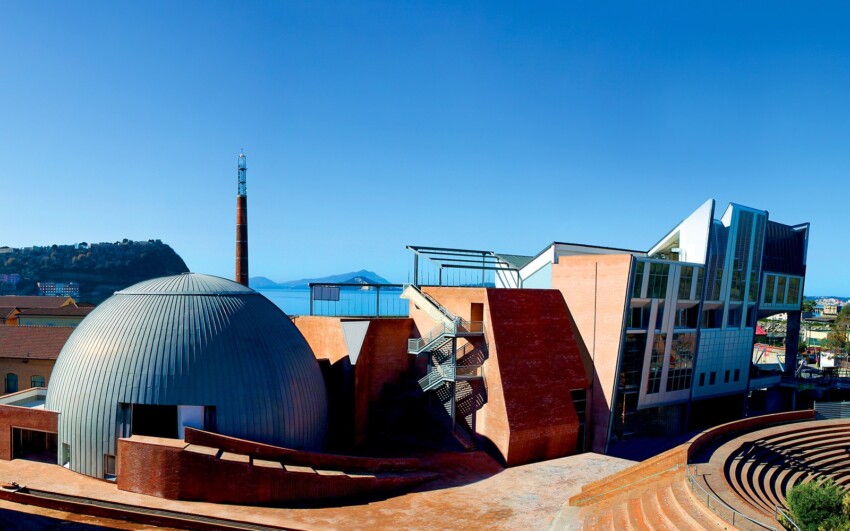
The City of Science is located at Via Coroglio 57/104, 80124 Naples, in the Bagnoli district, approximately 8 km from Naples city centre and 10 km from Capodichino Airport.
The most convenient option using public transport is the Cumana Railway (operated by EAV): from Montesanto station in Naples, get off at the Bagnoli stop and continue on foot or by bus C1 for about 10 minutes until you reach Via Coroglio.
Alternatively, the Metro Line 2, departing from Central Station (Piazza Garibaldi) or Mergellina, goes directly to Campi Flegrei station (Piazzale Tecchio), from where bus C1 takes you straight to the entrance at Discesa Coroglio 36 (the same entrance as Pausilypon Park).
If you’re arriving by car, take the Fuorigrotta or Agnano exit from Naples ring road, then follow signs for Bagnoli and Via Coroglio. The Vomero exit allows you to reach it via Via Cilea and Via Manzoni. Paid parking is available approximately 200 metres from the entrance. Alternatively, if arriving from the A1 motorway, take the ring road (A56) until the Fuorigrotta exit.
Absolutely. City of Science is designed to be accessible and engaging from the age of 3 onwards. Corporea has sections specifically designed for the 3-6 age group, with child-sized exhibits and staff experienced in working with younger visitors. Children under 3 enter free of charge. Weekend workshops are organised with activities tailored to different age groups, some reserved for children from age 5. The outdoor areas allow for active breaks during your visit.
For individual visitors and families, booking is not mandatory: you can buy tickets on-site or online. Online booking is, however, highly recommended at weekends, during holiday periods and during major temporary exhibitions to avoid queues and guarantee access to the Planetarium.
No. The Science Centre ticket gives you access to Corporea, Insects & Co and temporary exhibitions included in the programme, but does not include the Planetarium, which requires a separate ticket. For those wishing to visit both, the combined ticket (Science Centre + Planetarium) offers savings compared to purchasing two individual tickets. Workshops, shows and special events are not included with any ticket and are available on a first-come, first-served basis.
A complete visit, including Corporea, Planetarium, temporary exhibitions, the insects area and participation in workshops or shows, typically takes 4-5 hours. Those focusing on Corporea and a single Planetarium screening can plan for 2-3 hours. With very young children, who have different needs and rhythms, it’s advisable not to plan more than 3-4 hours and to allow for frequent breaks in the common areas or outside.
Yes. The complex has a refreshment area serving Neapolitan cuisine, open during visiting hours. In warmer months, an outdoor seating area with sea views is also available. Outside food and drink are not permitted in the exhibition areas, but you can consume them in the common areas and outdoors.
In the immediate vicinity, along Via Coroglio and throughout the Bagnoli district, you’ll find several trattorias and casual eateries.
Yes. City of Science has accessible routes and entrances for visitors with mobility disabilities, lifts between Corporea levels and equipped toilet facilities. Disabled visitors with a disability certificate of over 74% and their carer enter free of charge. For specific requirements, it’s advisable to contact the Contact Centre before your visit to arrange access appropriately.
The location of City of Science in Bagnoli makes it an ideal starting point for exploring the western side of Naples. Pausilypon Park and Grotta di Seiano Cave are just a few minutes’ walk away along Discesa Coroglio, the same street as the museum. The Campi Flegrei area with Amphitheatrum Flavianum and Lake Avernus are less than twenty minutes away by car. If you’d rather head back towards the city centre, you can reach the National Archaeological Museum and Capodimonte Museum in thirty minutes.
For a comprehensive overview of Naples attractions, consult our guide, and for accommodation see our section on where to stay in Naples.

 Hotel
Hotel  Budget accommodations
  Apartments
  Family Hotel
  Luxury Hotel
  Resorts