Piazza del Plebiscito is located in Naples' historic centre, between the seafront and Via Toledo, one of the city's main thoroughfares and a renowned shopping destination.
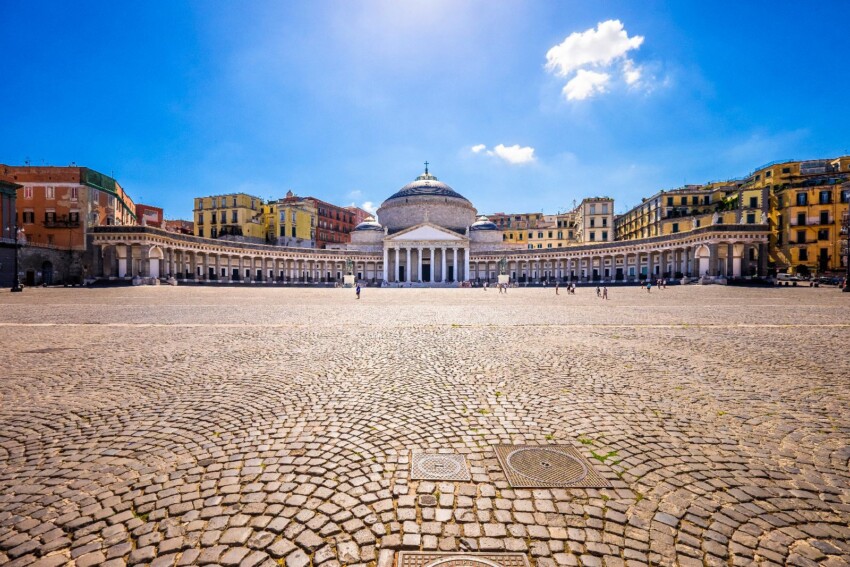
One of Naples’ most iconic landmarks is undoubtedly Piazza del Plebiscito, located in the city centre between the seafront and Via Toledo. It is considered the largest square in the city. The square’s history is inextricably linked to that of the Royal Palace, which served as the official residence of Spanish viceroys and the Bourbon family for over 150 years.
Piazza del Plebiscito is surrounded by several historic buildings, including Palazzo della Prefettura1 (facing inward) and Palazzo Salerno2 (facing the sea), the Basilica San Francesco da Paola3, and opposite to these stands the Palazzo Reale4. Spanning over 25,000 square metres, the square regularly hosts events, exhibitions and concerts.
At the centre of the piazza stand two equestrian statues – one sculpted by Antonio Canova and the other by his student Antonio Calì. They depict Charles III of Bourbon (founder of the Bourbon dynasty) and his son Ferdinand I.
During the 19th century, Joachim Murat and later King Ferdinand IV of Bourbon commissioned major urban development works, which included demolishing buildings and convents and constructing the imposing and elegant colonnade that flanks the basilica. The square’s name, Piazza del Plebiscito, was chosen following the plebiscite of 21 October 1860, which decreed the annexation of the Kingdom of the Two Sicilies to the Kingdom of Italy.
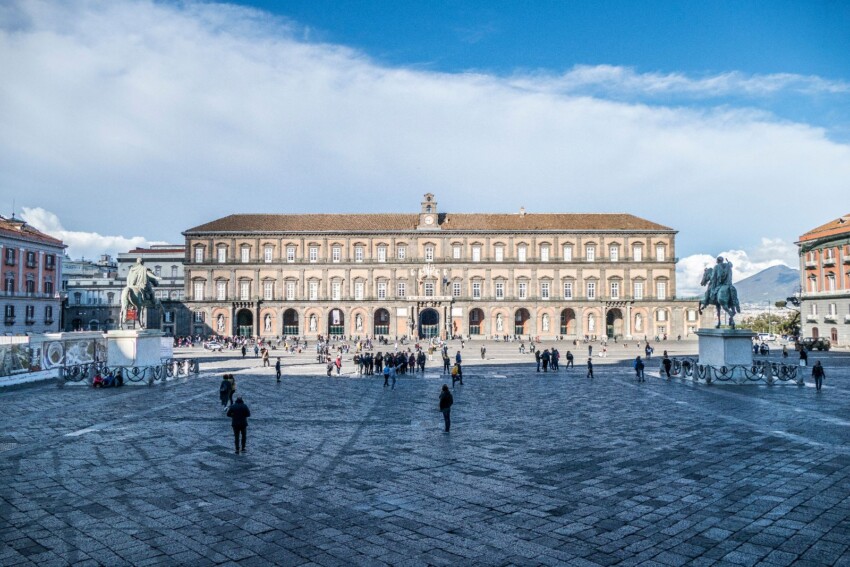
In the 17th century, Viceroy Fernando Ruiz de Castro felt the need to build a Royal Palace worthy of hosting the Spanish King Philip III of Habsburg and his family. The construction was entrusted to the architect Domenico Fontana, who designed the building in the late Renaissance style, featuring classical columns and decorative elements.
Today’s palace is the result of extensive enlargement and reconstruction work carried out during the 19th century following a fire that damaged the residence. Currently, part of the Royal Palace functions as a museum complex and houses the Royal Apartments, whilst another section is home to the National Library of Naples.
Read moreBuilt in the 19th century, the Basilica of San Francesco di Paola was commissioned by Ferdinand IV of the Two Sicilies following Joachim Murat’s expulsion from the city. Ferdinand IV had the basilica constructed as an act of gratitude to the saint to whom he had made a vow, asking for help to reclaim his throne.
Constructed in the neoclassical style, the basilica’s design echoes the Roman Pantheon and is positioned at the centre of a long colonnade that recalls the one at St Peter’s Basilica in Vatican City. Behind the religious building lies the Pizzofalcone hill, where legend has it the first settlement of ancient Parthenope was established.
The church was designed by architect Pietro Bianchi, who drew inspiration from the Roman Pantheon. However, unlike its ancient predecessor, he built two smaller domes and a main dome rising approximately 53 metres high. The façade is preceded by a short flight of Carrara marble steps and a portico with six columns in Ionic order, also in Carrara marble, where statues of the four cardinal virtues and three theological virtues are displayed.
Inside, the church has a circular floor plan and is decorated in the neoclassical style. It features a chapel on the left dedicated to the souls in Purgatory and a chapel on the right dedicated to the Blessed Sacrament. The church houses numerous works of considerable artistic merit, including paintings by Neapolitan neoclassical artists and polychrome marbles from the 18th century.
Around the entire perimeter of the religious building are thirty-four columns in Mondragone marble that support a drum structure containing galleries used by the royal family to attend religious services. Beneath the basilica lies an extensive underground chamber featuring a circular hall and various tunnels and corridors. The scale of this subterranean space suggests it may have been intended to house the tombs of the Bourbon family.
In the following map you can see the location of the main places of interest mentioned in this article.
The history of Piazza del Plebiscito is deeply intertwined with that of the Royal Palace; indeed, until 1817 it was known as Largo di Palazzo (Palace Square). It was only in the early 19th century, under Joachim Murat, that the square underwent major restructuring works designed to give it a new appearance. During the Napoleonic period, there were plans to transform this irregular open space into a well-defined, elegant piazza worthy of hosting the Royal Palace. Initially, the French appointed architect Leopoldo Laperuta to oversee this project.
Work on the square, which was to have been named Gran Foro Gioacchino, began in 1809. However, the French never completed it as Murat was driven from Naples and the Bourbons returned to power. Nevertheless, following Murat’s proposal, the elegant colonnade that graces the square to this day was executed. Ferdinand of Bourbon then revived the French project, but in keeping with his vow to San Francesco da Paola, he decided to build the Basilica of San Francesco in his honour. In this way, Piazza del Plebiscito became one of Italy’s finest examples of neoclassical architecture.
Unfortunately, in the 1960s, as the number of vehicles in the city increased, Naples City Council decided to transform the square into a public car park, with an area also allocated for public transport buses. Fortunately, things changed in 1994 during the G7 summit, when Piazza del Plebiscito was pedestrianised.
Piazza del Plebiscito is located in Naples’ historic centre and can be easily reached either on foot or by public transport. By bus, you can take ANM lines R1 (stop Via San Carlo), R3 (stop Via San Carlo) or C4 (stop Piazza Trieste e Trento).
By metro, line 1, get off at Toledo station, walk the length of Via Toledo, then cross Piazza Trieste e Trento; alternatively, you can get off at Municipio station and head towards the square. If you’re coming from the Vomero district, you can use the Funicolare Centrale (central funicular) to Augusteo station.
Finally, the square is connected to Via Ferdinando Acton via the Acton lift, located on the Royal Palace side. Use of the lift is free, and it is managed by ANM (Naples Mobility Company).
Piazza del Plebiscito is located in Naples' historic centre, between the seafront and Via Toledo, one of the city's main thoroughfares and a renowned shopping destination.

 Hotel
Hotel  Budget accommodations
  Apartments
  Family Hotel
  Luxury Hotel
  Resorts