There is a place in Naples where the city’s noise fades away, the horizon stretches out towards Capri and Ischia, and narrow streets slip down towards the sea between grand villas and coves of rare beauty. It is called Posillipo, and it takes its name from the ancient Greek Pausilypon, meaning “respite from pain” or “relief from suffering”—a name chosen two thousand years ago by a wealthy Roman nobleman for the villa he had built here, and one that still perfectly describes what this neighbourhood offers its visitors today.
Stretching across a promontory that separates the Gulf of Naples from the Gulf of Pozzuoli, Posillipo is one of Naples’ most exclusive and enchanting neighbourhoods: a village within the city, where Renaissance and eighteenth-century patrician villas coexist with fishing villages, archaeological parks with bathing establishments, breathtaking viewpoints with seafood trattorias.
Posillipo’s history is literally millennia old. The Greeks colonised it first, followed by the Romans who made it their favourite retreat—the poet Virgil himself and the Romantic poet Giacomo Leopardi spent their final years here, and their tombs can be found today at the foot of the hill, in Mergellina.
During the centuries of Spanish rule, noble families built their palaces here. In the eighteenth century the Bourbons chose it as a summer residence. Today it remains one of Naples’ most sought-after districts for those wanting to live with a view of the gulf, but above all it is one of the most beautiful destinations to visit: for its beaches, panoramas, archaeological sites and for that rare sensation, in a metropolis, of having found a refuge outside time itself.
Best-selling tickets and tours in Naples
Beaches at Posillipo
Posillipo’s coastline does not offer the long sandy beaches of the Amalfi Coast or Cilento, but rather a series of rocky coves, hidden inlets, cliffs and equipped beaches with a sea that can surprise you with its clarity. The water here is often an intense blue-green, and the absence of long traditional beaches is compensated by the uniqueness and authenticity of each of these spots, many accessible only by sea. Below are the main bathing areas of the promontory.
Gaiola Beach and Submerged Park
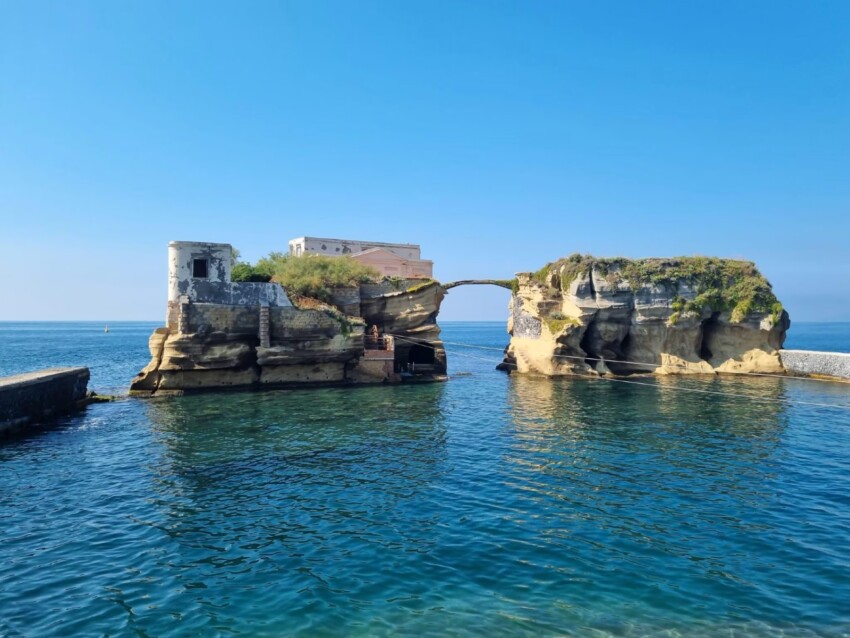
The Gaiola Beach1 is probably the most iconic and most photographed location along Posillipo’s entire coastline. It is a small beach of pebbles and coarse sand that opens between two small tuff islets separated from the mainland by a narrow strip of sea, in a landscape of almost unreal beauty.
The area is protected by the Gaiola Submerged Park Marine Protected Area, established in 2002, which safeguards a seabed of extraordinary biological and archaeological interest: remains of Roman structures, mosaics, amphorae and pipes from the imperial villa of Pausilypon lie between 1 and 15 metres deep in crystal-clear waters.
Swimming in the public zone (Zone B) is permitted in summer, while guided snorkelling and boat trips with transparent bottoms allow you to explore the submerged heritage.
The small abandoned villa on the larger islet is surrounded by one of Naples’ most famous cursed legends: a succession of illustrious owners, from German industrialist Hans Braun to Paul Getty, from Baron Langheim to lawyer Schwartz, met tragic fates after living in the house. Gianni Agnelli eventually purchased it for his nephew Carlo Amedeo, who later drowned in these very waters.
The beach and park are reached from Discesa Gaiola via a scenic road that descends from Posillipo’s hill. For information on activities and bookings, consult the official website gaiola.org.
Riva Fiorita and Lido delle Monache
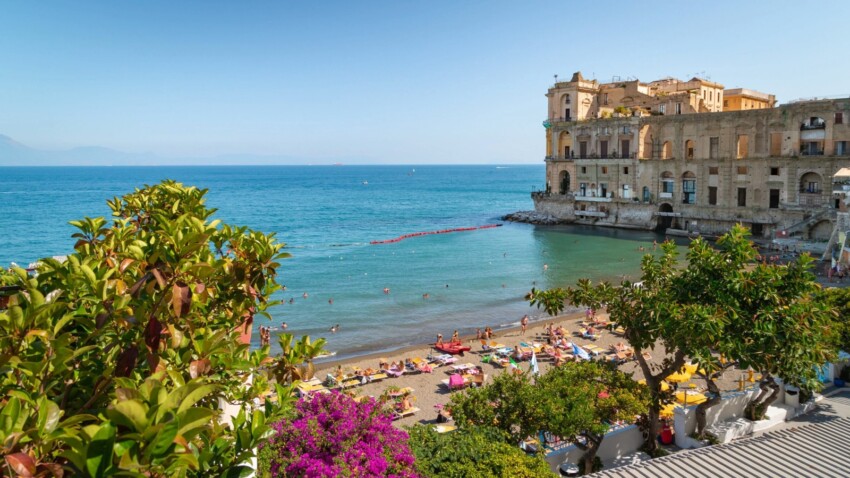
Riva Fiorita2 is one of Posillipo’s most secluded and private coves: a small inlet surrounded by private houses and villas, with rocks jutting into the water and a sea of unusual clarity for such a large city. It is reached by walking down Discesa Ferdinando Russo, a narrow street that descends from Posillipo’s main road to the sea: the walk takes just a few minutes, and the cove’s relative isolation is its reward.
The Lido delle Monache3, meanwhile, is the main free beach along Posillipo’s coast, situated below the hill and accessible from the main road: one of the few free bathing areas on the promontory, frequented mainly by residents. For those preferring equipped facilities, Bagno Elena and the adjoining Bagno Sirena are historic landmarks of Posillipo’s seafront, offering sea access, umbrellas and services, in a privileged location with a view of Palazzo Donn’Anna.
Marechiaro Cliff
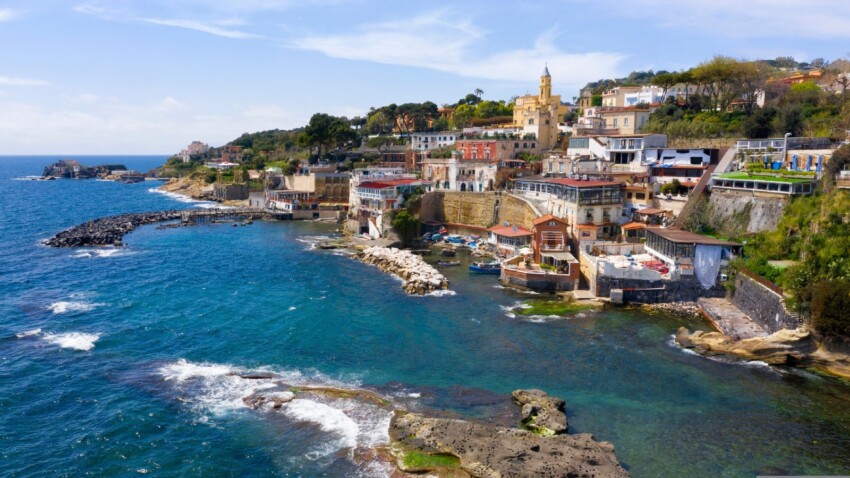
Marechiaro4 is Posillipo’s most celebrated fishing village. The small square of Marechiaro, with its little Baroque church of Santa Maria del Faro (built on the site of an ancient Roman lighthouse), moored boats and seafood restaurants overlooking the sea, is one of Naples’ most authentic and romantic spots.
From the village, you can reach, on foot or by the small boats of the historic Marechiaro boatmen, the Marechiaro Cliff: a large rocky cliff hanging straight over the sea where you can dive in and sunbathe with a direct view of Mount Vesuvius. It is not a beach in the traditional sense, but one of those places that Neapolitans jealously guard and which has no equivalent in the city. It is advisable to arrive early in the morning to secure the best positions near the water, and to bring all necessary supplies since on-site facilities are minimal.
Bay of Green Rocks
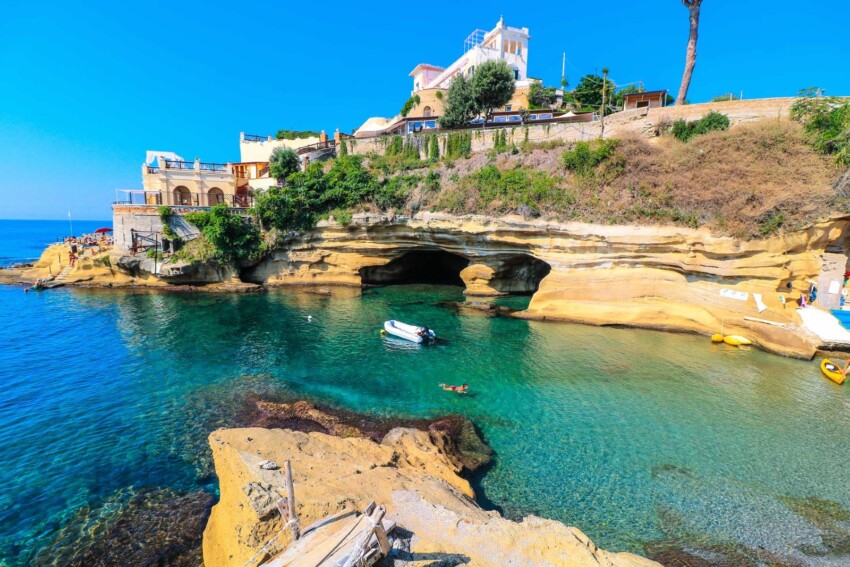
Set into the green tuff cliff of Posillipo, the Bay of Green Rocks5 is one of the most exclusive and panoramic spots along Naples’ coastline. The bay is part of the Villa Fattorusso complex, a historic venue for events overlooking the Gulf of Naples, and includes an equipped beach with paid access, two pools filled with seawater (one for adults and one for children), a garden area and a dining terrace.
The panorama that opens from the bay, with Capri and the Sorrento Peninsula in the background, Vesuvius to the right and the profile of Posillipo behind you, is one of the most beautiful in the entire gulf. Thanks to its sheltered position between the rocks, the sea is particularly calm even on windy days, making it suitable for families with children. Access is via a short descent from Posillipo’s main road.
Things to do and do at Posillipo
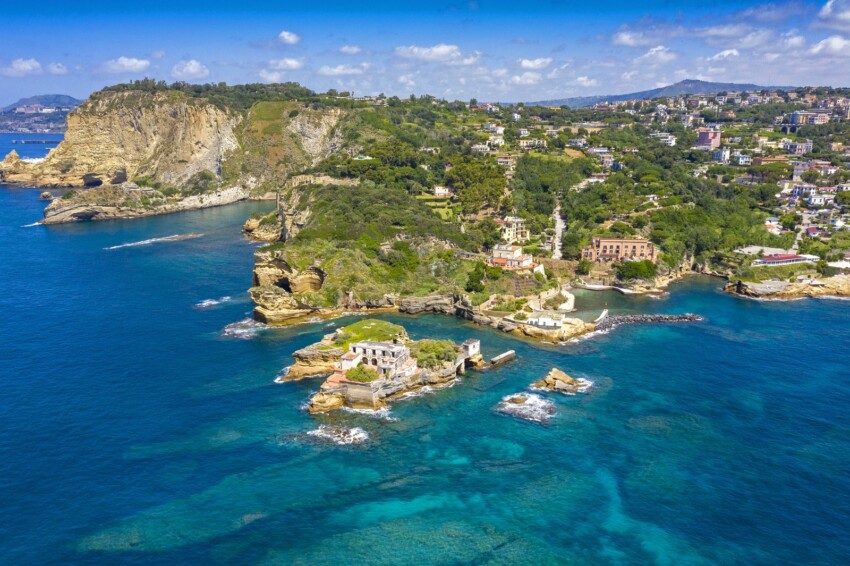
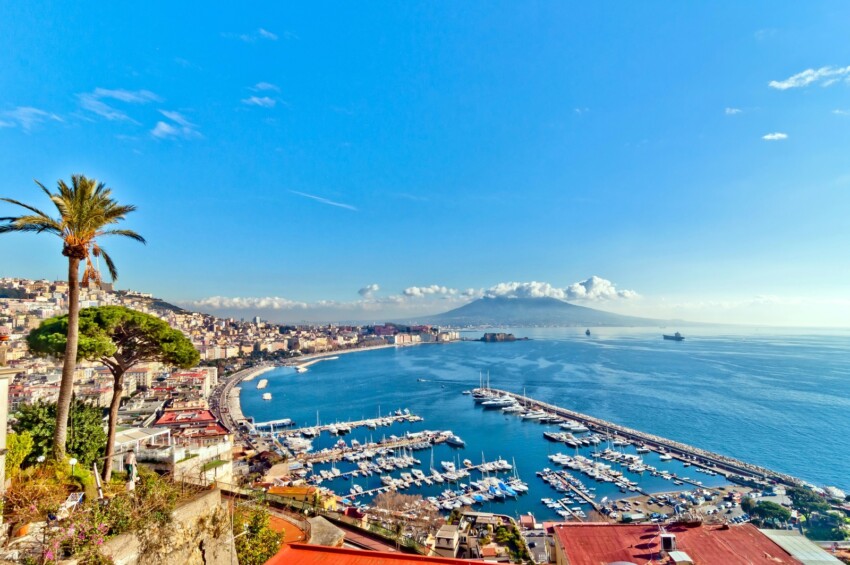
Posillipo is not just about the sea. The hill overlooking the gulf is scattered with historic palaces, scenic parks, archaeological sites and observation points that make a stroll along Via Posillipo, the road that runs the promontory from Mergellina to Cape Posillipo, one of the most scenic routes in Italy.
The best way to discover Posillipo is on foot or by boat, to see from the sea what cannot be glimpsed from land among the villas and vegetation.
Via Posillipo is the thread connecting your visit: a scenic road that winds for over five kilometres from Mergellina’s seafront to Cape Posillipo, with continuous views over the gulf and a sequence of extraordinary architecture.
The most spectacular monument along this road is Palazzo Donn'Anna6, one of Naples’ most striking buildings: an unfinished seventeenth-century palace, designed by Cosimo Fanzago between 1642 and 1644 for the vicereine Donna Anna Carafa, from whom it takes its name, and left partially unfinished due to the death of the patron and then her husband. With its arches suspended over the sea and Gothic windows reflected in the gulf’s waters, the building has an air of romantic ruin that has inspired painters, photographers and filmmakers for three centuries.
A little further on, Villa Rosebery7 is the official residence of the President of the Italian Republic in Naples: it is not open to the public, but its neoclassical façade and surrounding park contribute to the road’s charm. Villa Volpicelli8, built in the shape of a medieval castle directly overlooking the sea, is now famous throughout Italy as the exterior set of the popular television drama Un Posto al Sole.
The Virgiliano Park9, also known as Parco della Rimembranza, is Posillipo’s green lung: a terraced park of about 30 hectares that occupies the promontory’s summit and offers panoramic views in every direction that embrace the entire arc of the gulf. From there you can simultaneously see Capri, Ischia, Procida, Vesuvius, the Gulf of Pozzuoli and the Phlegrean Fields.
It was one of the favourite sites of eighteenth-century Grand Tour travellers; Goethe stopped here to contemplate the landscape, and today it features picnic areas, an open-air amphitheatre and installations with quotations from great travellers of the past who saw this same panorama. The sunset at Virgiliano Park, with the sun setting behind Ischia and the gulf turning orange and violet, is one of Naples’ most beautiful natural spectacles, free and accessible to all.
The Pausilypon Archaeological Park10 complex is Posillipo’s major cultural surprise: an artificial gallery of 770 metres carved into the tuff in the first century AD by Roman architect Lucius Cocceius, which runs through Posillipo’s hill and leads directly to the remains of the Roman imperial villa of Pausilypon, erected by the wealthy nobleman Publius Vedius Pollio and later inherited by Emperor Augustus. Within the park you will find a semicircular Roman theatre with 2,000 seats, an odeon (small covered theatre), reception halls and belvederes overlooking the sea with views of the Gaiola islets.
The Grotto of Seiano11, with its 120 arches in tuff stone built by the Bourbons in the nineteenth century to strengthen it, is an unforgettable experience: walking through it in the dark with light filtering through the side tunnels and then catching sight of the sea at the end of the tunnel is one of the most dramatic moments Naples has to offer. The park is accessible with free accompanied entry (Tuesday-Sunday 9:15am) or with a guided tour (adults €7, children 7-14 €4, free under 6) from Tuesday to Friday at 11:00am and Saturday, Sunday and public holidays at 10:30am and 12:15pm. The entrance is at Discesa Coroglio 36.
At the foot of the hill, in the Mergellina neighbourhood that marks the boundary between Posillipo and Naples’ city centre, you will find the Park of the Tombs of Virgil and Leopardi12: two funerary monuments that summarise two thousand years of literary history. The Latin poet died in Brindisi in 19 BC but wished to be buried in Naples, in the villa he loved on the Posillipo promontory. The tomb, a circular chamber structure from Roman times, is located on Salita della Grotta, surrounded by a small garden. Leopardi died in Naples in 1837 and was buried in the nearby church of San Vitale: his tomb was later moved, during construction of the Grotta di Posillipo gallery, to the park next to Virgil’s. Two poets separated by eighteen centuries, reunited on the same hill overlooking the gulf.
For those wishing to discover Posillipo’s coast from the sea, boat trips from Mergellina and Naples harbour are the best way to admire Palazzo Donn’Anna, the coastal grottos, Trentaremi Bay and the Gaiola islets from an impossible land-based perspective. Numerous operators offer guided tours with boats of various sizes; alternatively, the Marechiaro boatmen organise artisanal excursions along the coast.
Where to stay in Posillipo
Posillipo is one of Naples’ most sought-after neighbourhoods for accommodation, though the hospitality offering is naturally more limited compared to the historic centre or waterfront. Properties tend to be boutique hotels, charming bed and breakfasts, and elegant apartments set within historic villas or palaces with views over the gulf. Those staying in Posillipo typically prioritise peace and quiet plus panoramic views over proximity to museums and cultural sites, aware that the city centre is easily reached by bus or taxi in just a few minutes.
The upper part of Posillipo, along Via Posillipo, Via Petrarca and Via Orazio, concentrates most of the area’s most exclusive properties, with sweeping gulf vistas and access to Parco Virgiliano. It’s the ideal choice for those seeking tranquillity, fresh air and unforgettable views, provided you’re comfortable relying on a private vehicle or bus to reach the rest of the city.
The lower part, around Mergellina and the foot of the hill, offers properties closer to public transport, the metro and hydrofoil services, with the waterfront within walking distance.
For those after a truly immersive experience – waking to the gulf outside your window and Mount Vesuvius on the horizon – properties with sea-facing terraces in the Marechiaro or Gaiola areas are among the most memorable that Naples has to offer.
Those preferring a broader range of hotels, apartments and price points might look towards the nearby neighbourhood of Chiaia or Naples’ historic centre, both within about twenty minutes of Posillipo.
 Hotel
Hotel  Budget accommodations
  Apartments
  Family Hotel
  Luxury Hotel
  Resorts