Bestseller
Naples: Downtown Tour with Veiled Christ & St Clare Tickets
From 41,66 €
Buy the ticket
Regarded as one of the must-see attractions during a stay in Naples, the Cappella Sansevero is one of the greatest treasures of Italian artistic heritage. Located in the heart of the city’s historic centre, the Cappella Sansevero Museum is a place where charm and mystery intertwine to create a truly unique environment.
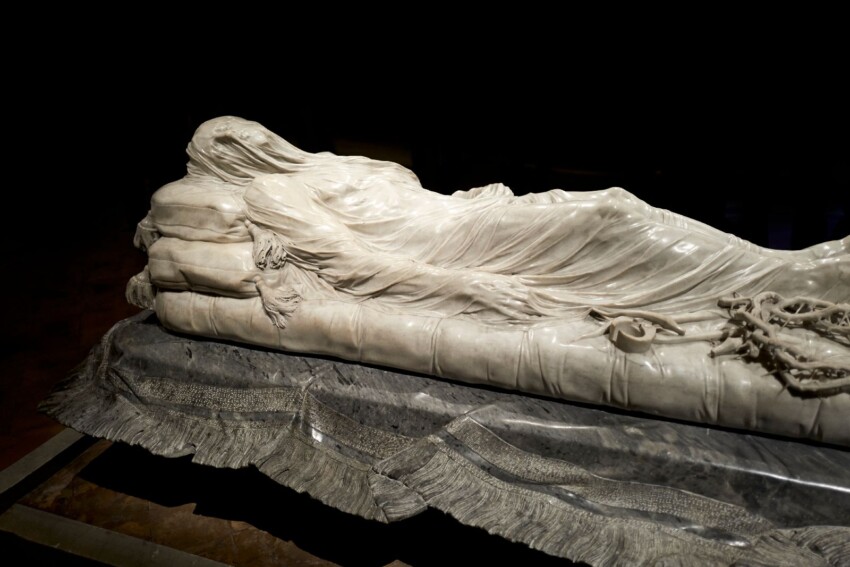
The Chapel attracts visitors from around the world with its precious artworks, baroque-style interiors and fascinating history, all of whom are captivated by the wonders the Cappella Sansevero Museum has safeguarded for hundreds of years. Inside, you’ll find the famous Veiled Christ created by Giuseppe Sanmartino, as well as 10 statues representing the virtues, several paintings, funerary monuments of the di Sangro family and two splendid anatomical machines.
The Chapel’s current flooring is made of Neapolitan terracotta, though it was constructed after a collapse in the 19th century. The original floor, in fact, was designed in the mid-18th century by Raimondo di Sangro, who commissioned Francesco Celebrano to create a “labyrinthine floor“. Executed with polychromatic marble inlays, the floor was meant to feature a continuous white line composed of swastikas all connected to one another and alternated with squares. The idea behind this special flooring was actually a metaphor for the difficulties mankind must overcome to achieve knowledge.
Built in the 17th century as Santa Maria della Pietà, the Cappella Sansevero was initially constructed as a place of worship to give thanks to the Virgin Mary for miracles granted to the faithful. However, in the 18th century, Raimondo di Sangro, seventh Prince of Sansevero, modified the complex by commissioning many of the works now on display and restructuring the Chapel according to entirely personal canons.
The Veiled Christ is certainly the most famous and evocative work housed in the Chapel’s central nave. Initially, the statue had been commissioned from Antonio Corradini, who had already created some of the Virtue statues in the Chapel, but unfortunately Corradini died in 1752. Raimondo di Sangro then decided to entrust the task to Giuseppe Sanmartino, who created one of the most beautiful marble works in Italian heritage. The sculptor created a life-size marble statue of Christ’s body after death, covered by a veil.
All who admire the work are astounded by the sculptor’s skill in giving the body of Christ truly unique characteristics, so much so that it appears lifelike. The work is executed with meticulous attention to detail and strikes one through details such as the swollen, still-pulsating vein on the forehead, the nail marks on the hands and feet. Near Christ’s feet are the objects of the Passion: a crown of thorns, pincers and nails. The shroud draped over his body, finally, highlights the wounds, the hollowed side and the suffering endured: the way it lies over the body and clings to it makes this cloth seem almost real.
The fact that Raimondo di Sangro was an alchemist closely connected to the world of freemasonry gave rise to a legend that the veil was actually real fabric transformed into marble through a special alchemical process known as “marmorisation”. However, this remains merely a tale, as analysis has confirmed that the work was created entirely in marble.
In the underground chamber of Cappella Sansevero are two display cases containing Anatomical Machines – the skeletons of a man and a woman with their circulatory systems perfectly reproduced. These Machines were created by the Palermitan physician Giuseppe Salerno around the mid-18th century and were later purchased by Raimondo di Sangro following an exhibition by the Sicilian doctor in Naples.
According to legend, Raimondo di Sangro had two of his servants killed, then had their bodies embalmed and preserved for scientific study. In fact, research has confirmed that the cardiovascular system of these two skeletons is a reconstruction made from numerous materials, including beeswax and dyes. What is remarkable and fascinating is the precision with which the circulatory systems have been reconstructed, making these two bodies genuinely pioneering models.
Along the entire main nave of the Chapel are 10 statues representing the virtues to be respected: Decorum, Generosity, Zeal for Religion, Sweetness of married life, Modesty, Disillusionment, Sincerity, Self-mastery, Education and Divine Love. These works were executed by various artists, among whom Antonio Corradini and Francesco Queirolo stand out.
Among the most striking statues is Disillusionment, a work by Queirolo depicting a man being freed from a net. According to the story, that man is Antonio di Sangro, father of Prince Raimondo, who after his wife’s death led a dissolute life until, growing old, he decided to return to Naples and embrace the priesthood. Equally striking for its incredible beauty are two statues by Corradini, Decorum, located to the left of the entrance door, and Modesty, dedicated to Cecilia Gaetani dell’Aquila d’Aragona, mother of Raimondo di Sangro.
Inside the Chapel are also several funerary monuments dedicated to members of the di Sangro family. Most notable is the tomb dedicated to Prince Raimondo di Sangro of Sansevero, which appears austere and understated at first glance. The upper part features an arch on which various emblems have been carved, commemorating Raimondo di Sangro’s literary, military and scientific achievements.
Below the arch is a marble frame containing the prince’s portrait, and further down a marble slab bearing the funeral eulogy of Raimondo in relief. The letters are white and initially contrasted with the pink background of the slab; the inscription was created using chemical solvents devised by the prince himself.
The Cappella Sansevero is open Friday to Sunday, from 9.00 am to 7.00 pm. Last admission is 30 minutes before closing.
The admission ticket for Cappella Sansevero costs:
You can also hire an audio guide for €3.50 or opt for a “tandem” offer of two audio guides for €5.00. Tickets can also be purchased online.
Certainly the best way to visit the Veiled Christ and Cappella Sansevero is with an official guide: for just a few euros extra, you’ll skip the ticket queue, guarantee your visit and be able to take part in a small city tour.
The Chapel also houses a bookshop located in the Sacristy area. For disabled visitors in wheelchairs or with reduced mobility, the entire Chapel nave and sacristy are accessible, whilst the underground chamber where the Anatomical Machines are housed is not visitable as it is accessed via a narrow 19th-century staircase.
Photography, video recording, mobile phone use and bringing animals are strictly prohibited inside.
The Cappella Sansevero is located in Naples’ historic centre, behind Piazza San Domenico Maggiore, not far from other attractions such as Naples Underground and the Archaeological Museum.
The easiest way to reach the Chapel is to take Metro Line 1 and get off at Dante station, then walk 500 metres; alternatively, you can get off at Università station and walk 800 metres. Other options include taking Metro Line 2 and getting off at Cavour station, or taking bus number 151, 154 or 601.
If you wish to reach the Chapel by car, you can drive to Piazza Garibaldi, then find parking in Via Mancini and take the metro to reach your destination.
According to Cesare d’Engenio Caracciolo’s account in the text “Napoli Sacra”, towards the end of the 16th century an innocent man being led to prison passed near the di Sangro residence in Piazza San Domenico Maggiore and there saw an image of the Madonna appear. The prisoner made a vow to the Virgin and promised to give her a silver lamp if he were proven innocent. Once his innocence was established, the man was released and kept his vow. From that moment on, the place is said to have become a place of pilgrimage for many of the faithful who prayed to the Virgin.
The Duke of Torremaggiore, Giovan Francesco di Sangro, also asked this Madonna to heal him from the serious illness that had struck him. It appears the Virgin granted the Duke’s requests, and once healed, he had a small chapel built in this place, nicknamed Santa Maria della Pietà or Pietatella. In the early 1600s, however, his son Giovan Francesco Alessandro di Sangro decided to restructure the chapel, expanding it and making it a suitable place to house the remains of all members of the di Sangro family.
In the 18th century, however, Raimondo di Sangro ordered various renovation works, maintaining only the original perimeter dimensions and the four side mausoleums. The Chapel’s interiors were therefore revisited, and Raimondo decorated it according to his inclinations and tastes, transforming it into the masterpiece we can all admire today.
The Cappella Sansevero Museum is located at Via Francesco De Sanctis, 19/21 in the heart of Naples. The Chapel sits 650 metres from the Naples Cathedral, 1.8 km from Piazza del Plebiscito and less than 2 km from Naples Central Station.

 Hotel
Hotel  Budget accommodations
  Apartments
  Family Hotel
  Luxury Hotel
  Resorts