Things to do at the Santa Chiara complex
The Santa Chiara Monumental Complex is not a single monument but rather a veritable historic citadel, where each space tells a different story. A complete visit, including the basilica, cloister, museum and archaeological area, requires at least 90 minutes, though those passionate about art history and archaeology can easily spend half a day here. Below is a detailed guide to each element of the complex.
The Clarisse Majolica Cloister
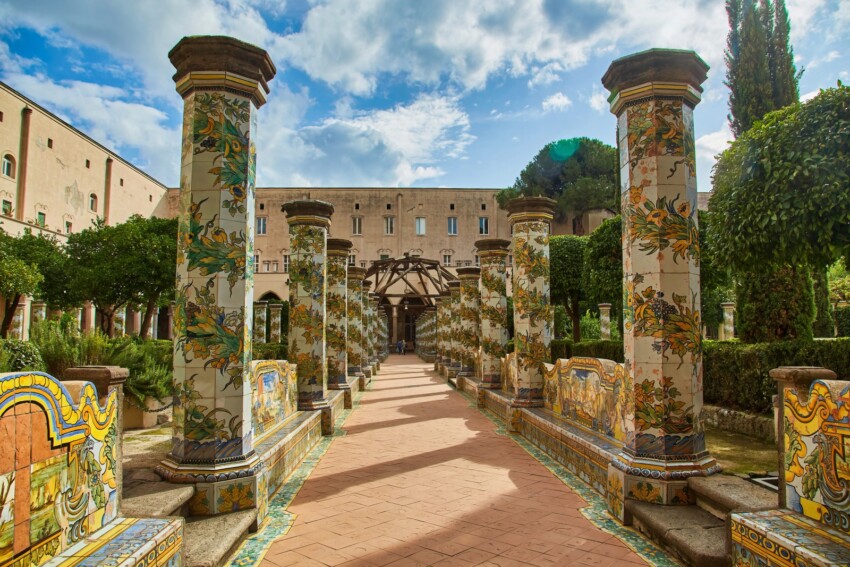
It is the iconic image of Santa Chiara, the place that appears in millions of photographs and which no description can fully capture: the Clarisse Majolica Cloister is one of the absolute masterpieces of Neapolitan Baroque and one of Italy’s most beautiful spaces. Built between 1739 and 1742 to a design by Domenico Antonio Vaccaro on commission from the abbess Sister Ippolita di Carmignano, and with financial support from Queen Maria Amalia of Saxony, wife of Charles III of Bourbon, the cloister radically transformed the original 14th-century space into a riot of Baroque colours and forms.
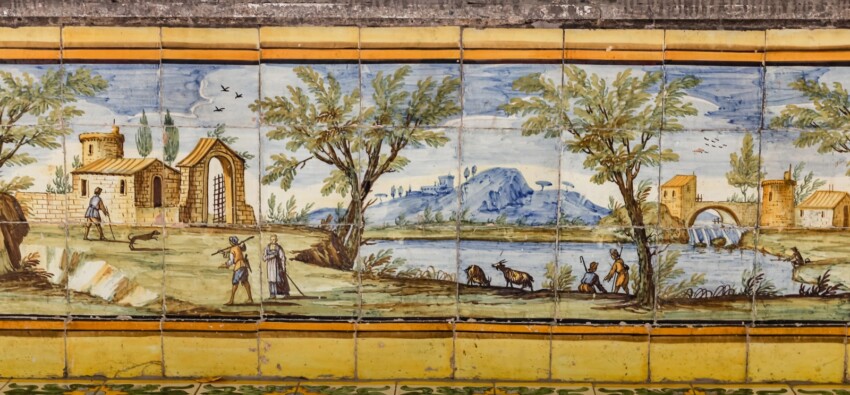
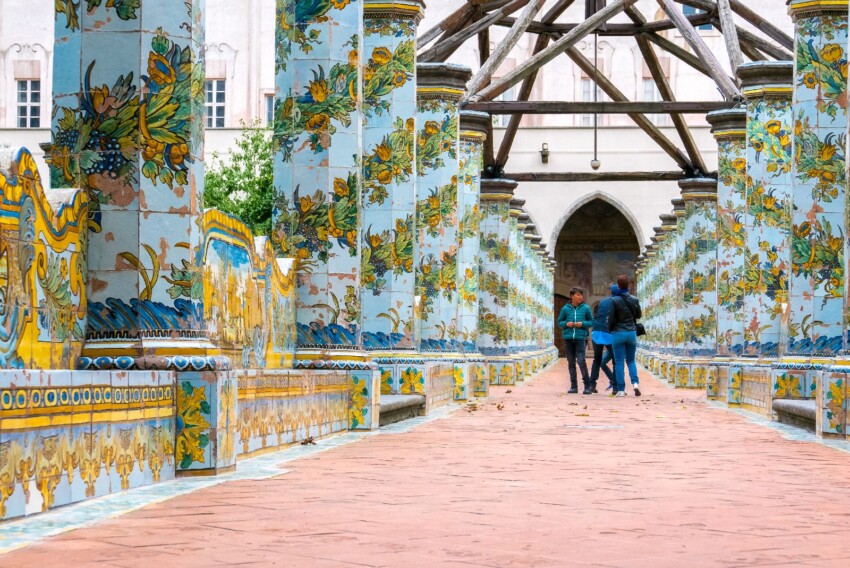
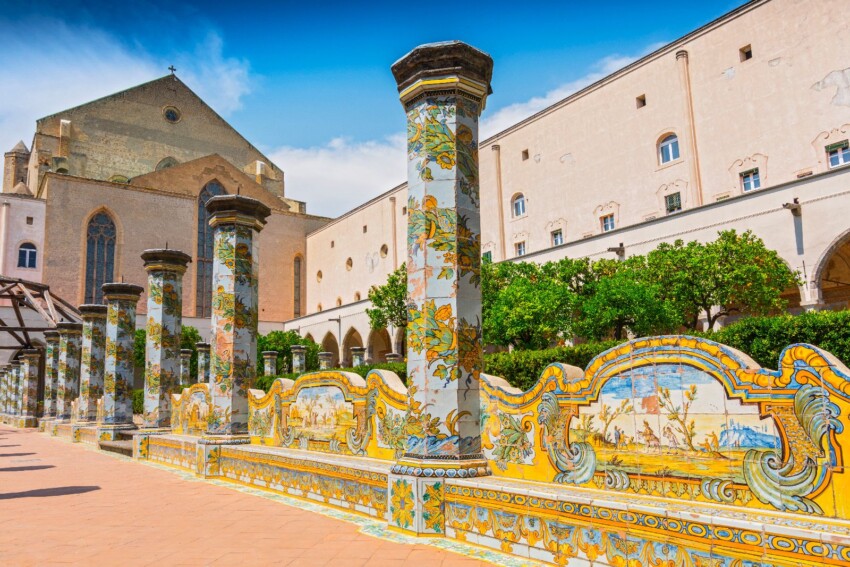
The most striking feature of the cloister are the 64 octagonal pilasters that punctuate the four pathways crossing the centre of the space: each is entirely covered with hand-painted majolica tiles depicting vine tendrils, scenes of daily life, mythological episodes and rural landscapes. The benches running along the pathways are also covered in majolica, displaying surprisingly vivid and narrative scenes: Poor Clare nuns feeding cats, skirmishes between common folk, 18th-century views of the Gulf of Naples that constitute a priceless iconographic record. The majolica tiles, created in the ceramic workshops of Donato Massa, recall in their colour palette – yellow, cobalt blue, copper green, manganese – the traditions of Vietrese and Campanian ceramics.
Around the cloister runs the 14th-century portico with pointed arches resting on piperno pillars, remaining virtually intact through the centuries. The portico walls are frescoed in the first half of the 17th century with allegories, figures of saints and Old Testament scenes: a pictorial cycle of considerable scope, often overlooked by visitors captivated by the majolica. At the centre of the cloister stand two octagonal fountains, also covered in majolica, which animate the space with the sound of water in summer.
Leaving the frenzy of Spaccanapoli and entering this cloister produces a sense of dislocation that few places in Naples can replicate: the city’s noise disappears, the light becomes softer, and you find yourself walking slowly, observing the details one by one. It is one of those places where time truly seems to slow down.
The Gothic Basilica of Santa Chiara
The Basilica of Santa Chiara is the largest Gothic-Angevin basilica in Naples, and its history is one of the city’s most dramatic. Built between 1310 and 1328 to a design by architect Gagliardo Primario, with the supervision of Leonardo di Vito, following the canons of Provençal Gothic brought to Naples by the Angevins, the building displayed a structure of extraordinary rigour and simplicity: a single nave of 130 metres, ten chapels per side surmounted by tribunes, tall twin and triple windows that filtered light, and a wooden truss roof. The yellow tufa façade, with its large pierced rose window at the centre and pointed arch, conveyed the Franciscan austerity the founders had intended.
In the 18th century, the basilica was radically transformed in Baroque style by Domenico Antonio Vaccaro and Ferdinando Sanfelice, who concealed its medieval structure beneath stucco, frescoes and ornamentations. On 4 August 1943, an Allied air raid struck the complex directly: a violent fire devastated the basilica for two days, almost completely destroying the Baroque superstructure and collapsing the roof. It was an immense loss, but it had the paradoxical effect of revealing the original Gothic structure, which remained intact beneath the 17th and 18th-century alterations. The restoration directed by Mario Zampino and completed in 1953 decided to restore the original medieval forms, forgoing the reconstruction of the lost Baroque.
The present interior is thus the product of this double story, Baroque stratification and its destruction, and presents an almost monastic sobriety that contrasts with the splendour of the cloister. The polychrome marble floor, originally created by Ferdinando Fuga in 1762 and miraculously surviving the bombs, adds an element of distinction to the perimeter of the hall. The bare walls bear the memory of lost frescoes.
Entrance to the basilica is free and follows independent opening hours: it is possible to access it independently of the monumental complex ticket.
The Royal Tombs
Santa Chiara was conceived from the outset as a pantheon of the Angevin dynasty, and the presbytery area of the apse houses some of the most important medieval funeral monuments in Italy. The most majestic is the tomb of Robert of Anjou, “the Wise”, who died in 1343: positioned on the back wall of the apse, it is the work of Florentine sculptors Giovanni and Pacio Bertini and is considered the greatest Italian medieval funeral monument. The structure develops across multiple superimposed registers, with statues of Angevin kings, bas-reliefs with the Virtues and figures of apostles, and a statue of the king on his throne in the upper chamber.
At the sides of the royal tomb are the funeral monuments created by the great Sienese sculptor Tino da Camaino and his workshop: on the right the tomb of Charles of Calabria, Robert’s son who died prematurely in 1328, among the most refined works of Neapolitan Gothic sculpture; on the left the tomb of Mary of Durazzo. Opposite was that of Mary of Valois, also attributed to Tino da Camaino. It should be noted that it was Tino da Camaino who initiated the basilica’s funeral cycle, creating the first Angevin tomb: that of Robert’s very young son, who died as a child, whom legend claims described the basilica as “a stable with twenty mangers”, receiving a divine punishment in return.
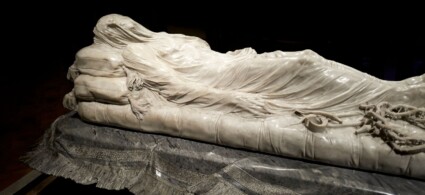
In the left transept there is also a sumptuous funeral monument from 1777 by Giuseppe Sanmartino, the same sculptor of the Veiled Christ at the Sansevero Chapel, created for Prince Philip of Bourbon, son of Charles III, who died at just thirty.
The Clarisse Choir and Giotto’s Remains
Accessible from the Opera Museum route, the Clarisse Choir is where the enclosed nuns attended religious services without being seen by the faithful. Here survives one of the basilica’s most precious and poignant testimonies: a fragmentary Crucifixion attributed to Giotto and his Neapolitan workshop, dating from 1326-1327, when the great Florentine master was present in Naples at the court of Robert of Anjou.
According to Giorgio Vasari, Giotto had frescoed the entire Santa Chiara basilica with episodes from the Old and New Testament: a cycle of immense proportions, now almost entirely lost through Baroque transformations and the 1943 bombing. What remains in the Clarisse Choir is barely sufficient to sense the quality of what was destroyed, and to transform the visit into something that transcends pure aesthetic appreciation. Confronted with these fragments, one becomes acutely aware of how history is also loss.
The Choir also preserves the original wooden benches of the nuns, carved with considerable skill, and contact with the daily life of the Poor Clares who lived in this enclosed space for centuries adds to the place a human and silent dimension that often strikes visitors more than any pictorial masterpiece.
The Bourbon Chapel
The first chapel on the right in the basilica houses one of Naples’ most singular and little-known places: the Royal Bourbon Chapel, which preserves the remains of 21 members of the Bourbon dynasty of Naples. Among these are four sovereigns, including Francis II of Bourbon, the last king of the Two Sicilies, who died in exile in 1894. The chapel is considered the last physical border of the Kingdom of the Two Sicilies and has a peculiar legal status that makes it, in certain respects, an enclave of the royal house within the Italian Republic.
The presence of the Bourbons in Santa Chiara is a chapter of Naples’ history that often surprises visitors: the 14th-century Angevin church became in the course of the 18th century the preferred pantheon of the new dynasty that had inherited the Neapolitan throne. Ferdinand I, the “King Lazarone”, Ferdinand II, called “Bomb” for his bombardment of Messina, and other sovereigns rest there in a setting of contemplation that the Gothic solemnity renders particularly intense.
The Franciscan Opera Museum
The Opera Museum houses artworks that survived the 1943 bombing and materials recovered during post-war restoration work. The visit proceeds through different thematic rooms, Archaeology, History, Relics, Marble, which restore the multi-secular stratification of the complex. Among the most significant pieces are several Angevin-era marble sculptures, decorative architectural elements, liturgical objects and reliquaries of extraordinary craftsmanship.
The piece that captures every visitor’s attention is the large 18th and 19th-century Neapolitan nativity scene, with its terracotta shepherds painted in the highest quality: an exceptional document of the Partenopean nativity tradition, which reaches unrivalled artistic heights in Naples during the 18th century. Just a few steps from San Gregorio Armeno, the street of nativity scenes, the Santa Chiara museum offers a sample of that tradition in its highest and historically documented expressions.
The museum also houses Giotto’s Painted Cross, a precious fragment of the 14th-century pictorial cycle, and a series of canvases and sculptures from the Baroque period recovered from the 1943 rubble. The convent library, partially visible through a glass wall, with its historic shelves and ancient volumes, completes the route with a note of intellectual contemplation.
The Roman Archaeological Area
One of the least known aspects of the Santa Chiara Complex is the presence of a significant archaeological area occupying a portion of the monastery’s underground. Excavations conducted during post-war restoration work brought to light the remains of a Roman thermal complex dating to the first century AD, with mosaic pavements, terracotta pipework for circulating hot water (tubuli), apsed chambers and wall structures in opus reticulatum and opus mixtum.
The discovery confirms that the area where Santa Chiara stands was already densely frequented in Roman times: it lay on the margins of the ancient Greek Neapolis, in a suburban zone that the Romans had designated for thermal structures, typically located outside city walls. The route through the archaeological area offers one of those classic “vertical stratification” effects that Naples produces better than any other Italian city: looking down through the grate and finding Roman mosaic, then raising your eyes and seeing 18th-century majolica, all in the same space, is an experience that better summarises the profound nature of this city than any explanation.
History of Santa Chiara Complex
The history of Santa Chiara Complex is a tale of royal ambitions, Franciscan faith, baroque transformations, wartime violence and steadfast reconstruction: in many ways, it mirrors the history of Naples itself.
Its foundation dates back to 1310, when Robert of Anjou, known as “the Wise” for his erudition and patronage, and his wife Sancia of Majorca decided to build a great Franciscan religious citadel at the gates of the medieval city. Sancia, profoundly devout and inspired by the life of Saint Clare of Assisi, harboured a calling to monastic enclosure that her royal status made impossible to fulfil; Robert, meanwhile, sought to equip the dynasty with a mausoleum worthy of Angevin power. Work, entrusted to architect Gagliardo Primario, lasted until 1328; the basilica was consecrated in 1341.
The complex was conceived as a double monastic citadel: a convent for Poor Clare nuns and one for Franciscan friars, separate yet adjoining, united by the shared basilica. From the outset, the greatest artists of the age worked here: Tino da Camaino, the finest Gothic sculptor in Italy after Arnolfo di Cambio, created the Angevin tombs; Giotto, summoned to Naples by King Robert in 1326–1327, frescoed the interiors with cycles of extraordinary quality, today almost entirely lost.
For over four centuries, the complex remained essentially unchanged in its Gothic austerity. It was in 1742 that the abbess Sister Ippolita di Carmignano, supported by Queen Maria Amalia of Saxony, commissioned Domenico Antonio Vaccaro to renovate the cloister in baroque style. Vaccaro transformed the austere medieval monastic garden into the chromatic explosion of majolica tiles we see today, creating one of the absolute peaks of Neapolitan baroque. Simultaneously, Ferdinando Sanfelice worked on the basilica, covering it with baroque stuccoes and frescoes. The polychrome marble floor was added by Ferdinando Fuga in 1762.
4 August 1943 marks the darkest day in Santa Chiara’s history. During an Anglo-American bombing raid on Naples, an incendiary bomb struck the basilica directly. The fire burned for two days, destroying the roof, baroque decorations, most of the frescoes and many moveable artworks. The cloister, by a fortunate combination of circumstances, was spared: the fire did not reach that part of the complex, and Vaccaro’s majolica tiles remained intact. After the war, restoration was entrusted to architect Mario Zampino, who made the controversial yet, in retrospect, far-sighted decision to expose the original Gothic structure rather than reconstruct the lost baroque. The basilica reopened in 1953, restored to its 14th-century form.
The Santa Chiara Monumental Complex is part of the UNESCO site “Historic Centre of Naples“, recognised as a World Heritage Site in 1995, and continues to be a place of active religious life: Poor Clare nuns still live in part of the monastery, unseen by visitors but present in their silent enclosure.
Admission Tickets
Access to the Santa Chiara Basilica is completely free and requires no ticket: entry is unrestricted through the main portal on Via Santa Chiara during church opening hours. To visit the Majolica Cloister, the Opera Museum and Archaeological Area, you will need to purchase a ticket for the Monumental Complex at the ticket office located to the left of the basilica entrance.
Current prices are: full ticket €7; reduced ticket €5 for students under 30, teachers and over 65s (with valid ID); special ticket €4 for children aged 7–17; free entry for children under 7 and disabled visitors with companion. It is important to note that tickets are available for purchase on-site only at the complex’s ticket office: online booking or ticket purchase is not available for individual visitors (booking is only possible for organised groups). The complex is not currently included in the Campania Artecard scheme.
Guided tours can be arranged upon request for groups.
Opening Hours and Visit Duration
The Santa Chiara Basilica is open daily: mornings from 7:45 to 12:45 and afternoons from 4:30 to 8:00 pm. Admission is free during both time slots. The Monumental Complex (cloister, museum, archaeological area) follows different hours: Monday–Saturday 9:30 am to 5:30 pm, Sunday and public holidays 10:00 am to 2:30 pm. Last entry is permitted 30 minutes before closing in both cases. Please note that the complex may close for private events (weddings, conferences, religious celebrations): it is advisable to check the official website for any changes before visiting.
As for visit duration, a standard visit to the complex (cloister, basilica, museum) takes approximately 60–90 minutes. Those wishing to explore every detail of the cloister, majolica tiles and museum rooms can comfortably spend 120 minutes. Early morning (at opening, 9:30 am) is the best time to visit the cloister: morning light brings out the majolica colours in an incomparable way and tourist groups haven’t yet descended. Late afternoon, around 4:30–5:00 pm, is equally recommended for the quality of light.
The best time to visit Santa Chiara is spring and early autumn, when temperatures are pleasant, the cloister plants are in flower or in full leaf, and tourist flows are more manageable than in summer months. July and August are the busiest: during this period, a visit at the first morning opening is advised.
How to Get to Santa Chiara Complex
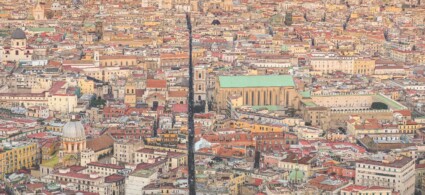
The Santa Chiara Monumental Complex is located at Via Santa Chiara 49/c, in the heart of Naples’ historic centre, at the intersection of Via Benedetto Croce (the Spaccanapoli section) and Via San Sebastiano, just steps from Piazza del Gesù Nuovo. Its central location makes it easily walkable from much of the historic centre and the city’s main arrival points.
The most convenient option for those arriving from Central Station (Piazza Garibaldi) or Naples Capodichino Airport is the metro. Line 1 serves two useful stops: Università (the nearest, about 5 minutes’ walk) and Dante (10 minutes’ walk through the historic centre). Line 2 has the Montesanto stop, from which Santa Chiara is reached in 10 minutes on foot.
Several bus routes also stop nearby. Bus R2 and 202 have stops on Corso Umberto I; bus 151 stops at Nuova Marina. In all cases, you’ll need to add a 5–10 minute walk through the historic centre, which offers the perfect opportunity to discover the alleyways and decumani of Greek Neapolis.
Frequently Asked Questions about Santa Chiara Complex
How much time does it take to visit the complex?
A standard visit, covering the majolica cloister, basilica, Opera Museum and archaeological area, takes approximately 60–90 minutes. Those with a passion for medieval art, Angevin history or Roman archaeology can easily spend 2 hours or more. A visit to the basilica alone, which is free, takes about 20–30 minutes.
Is the basilica visit really free?
Yes. Access to the Santa Chiara Basilica is completely free for all visitors, with no ticket required. The only paid ticket covers the Majolica Cloister, Opera Museum and Archaeological Area (the “Monumental Complex”). The basilica is open daily, morning and afternoon.
Who is buried in the Santa Chiara Basilica?
The basilica houses numerous members of the Angevin dynasty, including founder Robert of Anjou (whose tomb, a work by the Bertini brothers, is Italy’s largest medieval funeral monument) and his relatives, with sculptures by Tino da Camaino. In a side chapel rest 21 members of the Bourbon dynasty, including four sovereigns, among them Francis II of Bourbon, the last king of the Two Sicilies.
Is the complex accessible for disabled visitors?
The basilica and cloister are accessible to visitors with mobility difficulties, thanks to barrier-free routes. Some sections of the Opera Museum and archaeological area may have steps or height differences; it is advisable to check in advance with the complex’s staff. Disabled visitors enter the monumental complex free of charge, along with one companion.
Is it possible to attend Mass in the basilica?
Yes. The Santa Chiara Basilica is an active church where religious services are regularly celebrated. You may attend Mass at the usual times of liturgical celebration. Please note that during services, access to areas reserved for the faithful may be restricted for tourists: it is appropriate to respect silence and observe dress code befitting a place of worship.
Are there dress code requirements for entry to the basilica?
Yes. As with any active Catholic place of worship, the basilica requires respectful attire: shoulders and knees must be covered. In case of inappropriate dress, you may borrow or purchase a sarong or shawl at the entrance. The Monumental Complex (cloister and museum) has no dress restrictions, but as it still houses a monastic community, modest dress is nonetheless recommended.

 Hotel
Hotel  Budget accommodations
  Apartments
  Family Hotel
  Luxury Hotel
  Resorts