Bed & Breakfast Medea
Naples - Via San Giovanni Maggiore Pignatelli 48
Book now
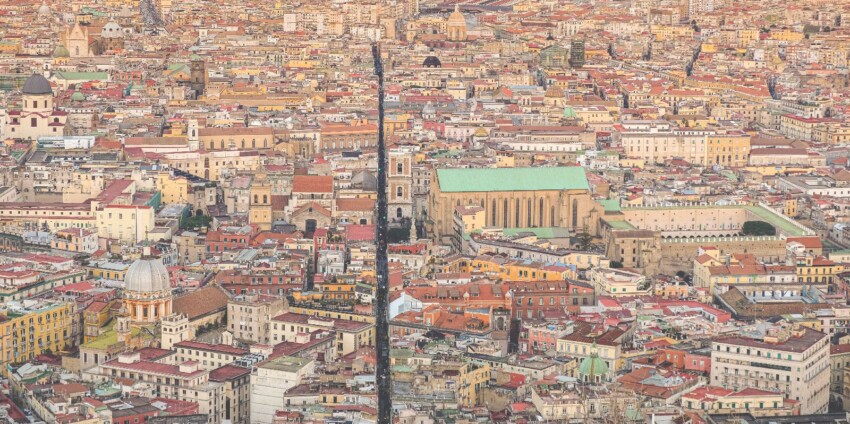
If you want to discover the true essence of Naples, you simply must take a stroll along Spaccanapoli, the street that runs from the Spanish Quarter to the Forcella district, dividing the city in two. This street has remarkably ancient origins – it was already one of the most important thoroughfares in Naples for the Greeks, although at that time it started in Piazza San Domenico Maggiore and continued through to Via Duomo.
The street subsequently underwent extensions, first by the Romans who lengthened it to what is now Piazza del Gesù, and then in the sixteenth century by the viceroy Don Pedro di Toledo, who extended it further to reach the Spanish Quarter. Today Spaccanapoli is considered the Lower Decumano and is connected to the Upper one by the famous Via San Gregorio Armeno.
To better understand the origin of the name Spaccanapoli, head to the Vomero area and visit the terrace at San Martino, from where you can admire the entire city from above and see this thoroughfare cut Naples perfectly in two. Walking along this street is a journey into the heart of “real Naples”: among magnificent churches, apartments where locals live, ancient palaces and a few small bars, you can experience the most authentic essence of the city.
That said, it’s worth noting that Via Spaccanapoli has never actually existed as such and doesn’t appear on maps (except tourist ones), as this street is actually made up of seven different streets.
Located in the heart of the city, Spaccanapoli is home to numerous churches, buildings and places of interest well worth a visit. Here’s a list of things to see if you walk along this street starting from the Spanish Quarter area.
Piazza del Gesù Nuovo is one of Naples’ most important squares and is home to the beautiful Church of Gesù Nuovo. As you walk along Spaccanapoli, you’ll notice the square open up suddenly before you, and within it you can admire not only the church, but also the Immaculate obelisk and the Church of Santa Chiara. The Church of Gesù Nuovo was built in the seventeenth century following the style of Neapolitan Baroque with sumptuous marble decorations and paintings. The interior features a Greek cross layout with five chapels on each side, two of which are positioned beside the apse.
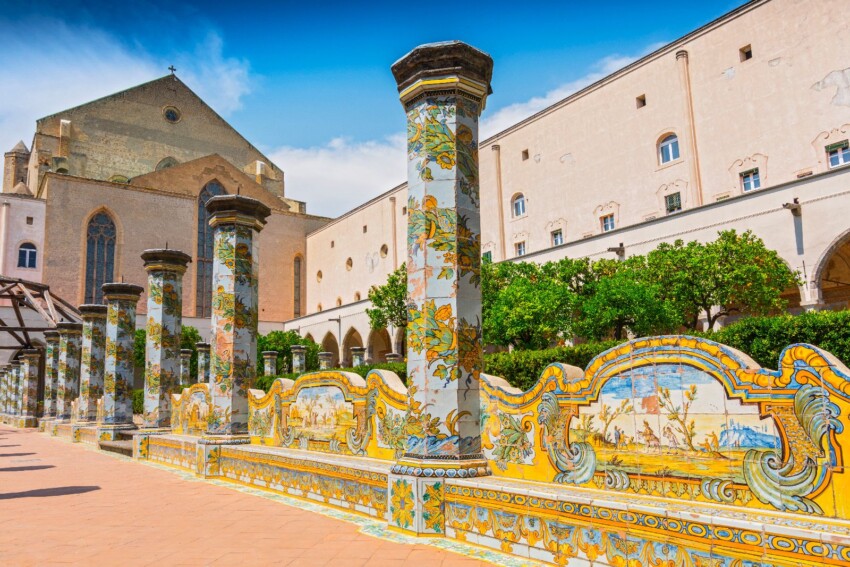
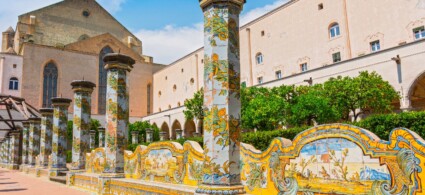
A true jewel of Neapolitan architecture, the Santa Chiara Monumental Complex was built at the behest of Robert of Anjou and his wife Sancia of Majorca during the fourteenth century. The rulers wanted Naples to have a royal chapel worthy of hosting the royal family. In addition to the church, the complex included two convents – one for Poor Clare nuns and one for Franciscan friars.
The church was built by Gagliardo Primario, who designed it following the values of simplicity inherent in the Franciscan rule, constructing a single nave 82 metres long with ten chapels on either side. Members of the Angevin and Bourbon royal families were buried here for many years, and the tomb of Robert of Anjou, created by the Bertini brothers, still stands at the centre of the building.
The church remained unchanged in appearance until the eighteenth century, when Ferdinando Sanfelice and Domenico Vaccaro, in an attempt to embellish the building, destroyed much of its interior and created Baroque ornaments.
However, the religious building was destroyed during Second World War bombing and was subsequently rebuilt according to its original design as a simple and austere church. The undisputed highlight of the complex is the majolica cloister, which, in addition to being a true work of art, is also an oasis of tranquillity in the heart of the city. Dating from the fourteenth century, the cloister features pointed arches and has remained unchanged over the years, whilst the interior garden has been completely redesigned.
Considered one of Naples’ principal squares, Piazza San Domenico is the junction of two important city streets: Spaccanapoli and Via Mezzocannone, which runs north-south across the city. The square is a popular spot both day and evening, and is home to various bars and cafés where you can enjoy a drink or snack with friends.
In the centre of the square stands an obelisk erected by the Dominicans in 1556 to give thanks for the end of the plague, and behind it is the Basilica of San Domenico, a church designed in perfect Baroque style. The interior of the building features a Latin cross layout divided into three naves and is rich in sculptural and pictorial works of great value. The ceiling, which originally had exposed timber beams, was replaced in the seventeenth century with a coffered ceiling adorned with gilt in Baroque style.
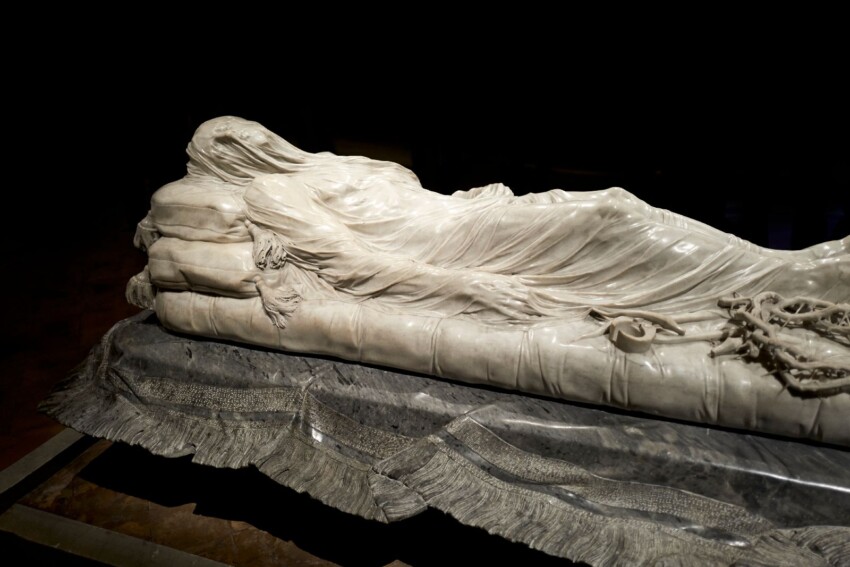
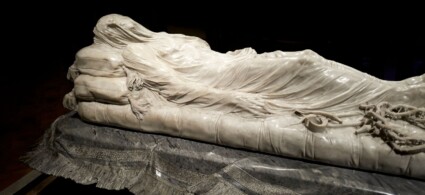
From Piazza San Domenico, you can take a short detour to reach the Sansevero Chapel, one of Naples’ most fascinating places. Built in the sixteenth century but later restructured by Prince Raimondo di Sangro in the eighteenth century, the chapel houses the Veiled Christ by Giuseppe Sanmartino, a work considered to be of extraordinary beauty.
The Chapel is a hidden gem tucked away in Naples’ narrow lanes and, in addition to the Veiled Christ, houses numerous other creations well worth discovering, including two anatomical machines, statues representing virtues and several funeral monuments dedicated to members of the Sangro family.
As you walk along Spaccanapoli, you must stop at Piazzetta Nilo, named after the large statue of the god Nile that stands in the square. In ancient times, this was an area where numerous Alexandrian merchants lived and worked, and they were devoted followers of the cult of the god Nile.
The square is home to Palazzo Pignatelli di Toritto, Palazzo De Sangro di Vietri and the Church of Sant’Angelo a Nilo, which was built between the late fourteenth and early fifteenth centuries at the behest of Rinaldo Brancaccio. The church preserves within it the tombs of numerous members of the Brancaccio family, including the funeral monument of Cardinal Rainaldo Brancaccio, which was created by Donatello and Michelozzo.
The Sacred Mount of Mercy is an ancient sixteenth-century palace built at the behest of several Neapolitan nobles who wanted to create a charitable institution offering interest-free loans. Inside, the Chapel is considered a building of great value, featuring at its entrance two niches with statues by Pietro Bernini representing Charity and Security, whilst in the pediment above is the Pietà by Michelangelo Naccherino. The interior has been finely decorated with gilded stucco and features paintings of considerable quality.
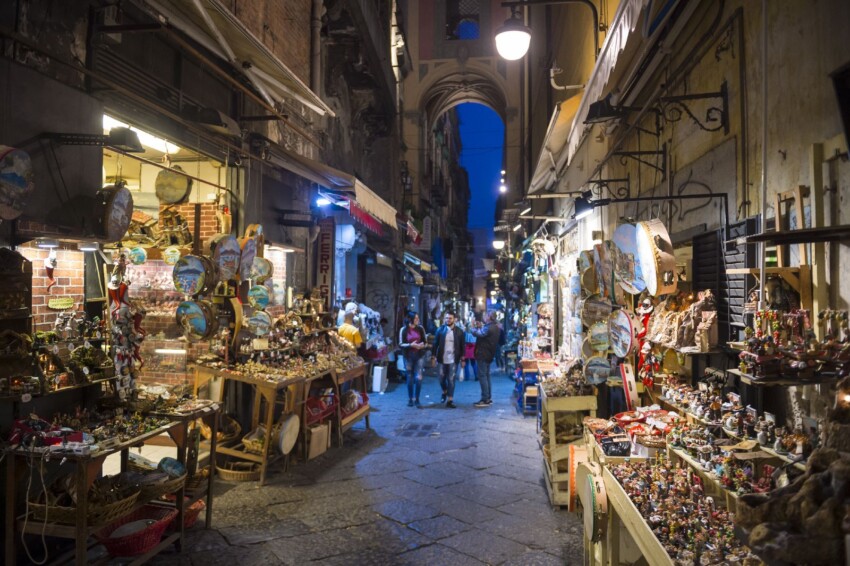
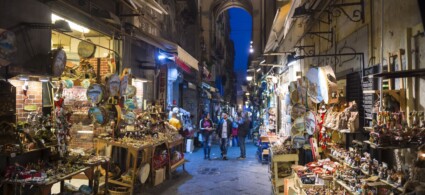
Via San Gregorio Armeno intersects with Spaccanapoli at the junction with Via San Biagio dei Librai and is a street famous worldwide as the “street of nativity scenes”. Along this street, numerous artisans’ workshops, often run by the same families for generations, hand-craft figures for the Neapolitan nativity scene.
Over the years, the tradition has also evolved, and some figurines now depict famous personalities from politics and entertainment. Via San Gregorio Armeno is particularly magical and atmospheric during the Christmas season when the shops display their finest creations.
In the following map you can see the location of the main places of interest mentioned in this article.
Spaccanapoli is a street approximately two kilometres long that runs through the beautiful historic centre of Naples, declared a UNESCO World Heritage Site. Naples’ city centre is one of the best areas to stay, as it provides easy access to the city’s main attractions.
In recent years, charming hotels, small bed & breakfasts and guesthouses have opened up along Spaccanapoli, allowing visitors not only to fully experience this area of the city but also to stay close to many points of interest.
Spaccanapoli runs through the entire city centre and the seven streets that make it up are: Via Pasquale Scura, Via Maddaloni, Via Benedetto Croce, Via San Biagio dei Librai, Via Vicaria Vecchia, Via Forcella, Via Giudecca Vecchia.
If you want to walk the entire street starting from the Spanish Quarter, you can take Metro line 2 and get off at Montesanto; alternatively, you can also take the Cumane line or the funicular and get off at Montesanto.
Spaccanapoli is the decumanus that cuts through the city of Naples in an east-west direction. The street begins at Via Pasquale Scura, in the area of the Spanish Quarter and extends to Via Giudecca Vecchia and Via Tupputi in the Forcella neighbourhood.

 Hotel
Hotel  Budget accommodations
  Apartments
  Family Hotel
  Luxury Hotel
  Resorts