Hotel & Spa Bellavista Francischiello
Massa Lubrense - Via Partenope 26
Book now
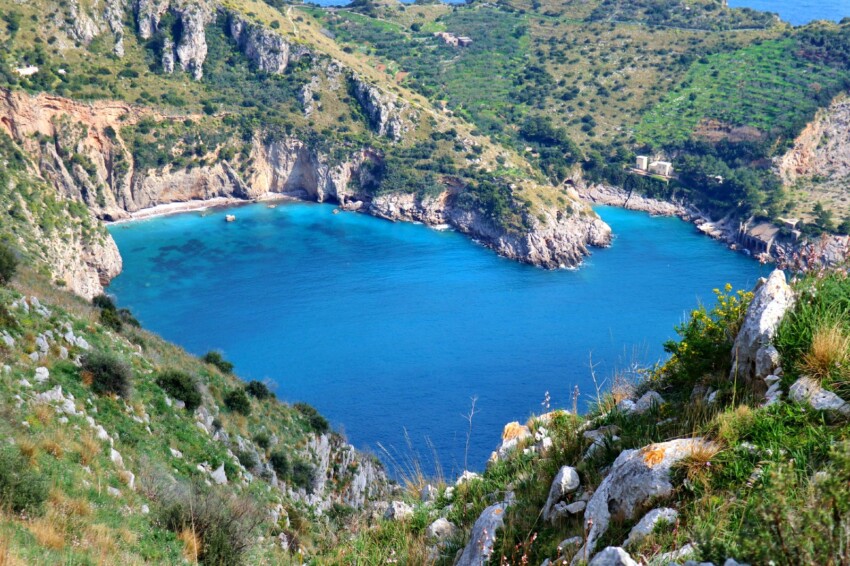
There are places you have to earn your way to, not simply reach. Ieranto Bay is one of them: no roads, no car parks, no bars or beach umbrellas for hire. Located at the far tip of the Sorrentine Peninsula, in the municipality of Massa Lubrense, access is on foot only, either via a path through Mediterranean scrubland or by sea with boats from the authorised cooperative.
The name comes from the ancient Greek Ieros, meaning sacred, because nearby at Punta Campanella stood the temple of the goddess Athena, which Greek sailors would visit before crossing the strait to Sicily. And it was here that Pliny the Elder placed the Sirens who enchanted Ulysses on his return to Ithaca: the bay, with its enclosed shape and complete silence broken only by water, is the very physical location that Greek mythology had in mind.
Today the bay is managed by the FAI – Fondo Ambiente Italiano, which received a donation of 47 hectares in 1986 from Ilva, the steel giant that had operated a limestone quarry here from 1918 to 1952, employing Sardinian miners in a fully-fledged industrial village perched above the Tyrrhenian Sea.
Traces of that industrial past remain visible: the partially collapsed stone oil mill, the massive iron pier used to load cargo ships, and remnants of lime kilns along the path. Today the area forms part of the Punta Campanella Marine Protected Area, which protects 40 kilometres of coastline between Naples and Salerno provinces and is home to over 260 animal and plant species, Posidonia meadows, seahorses and an upwelling of cold water that creates exceptional marine conditions for snorkelling and diving.
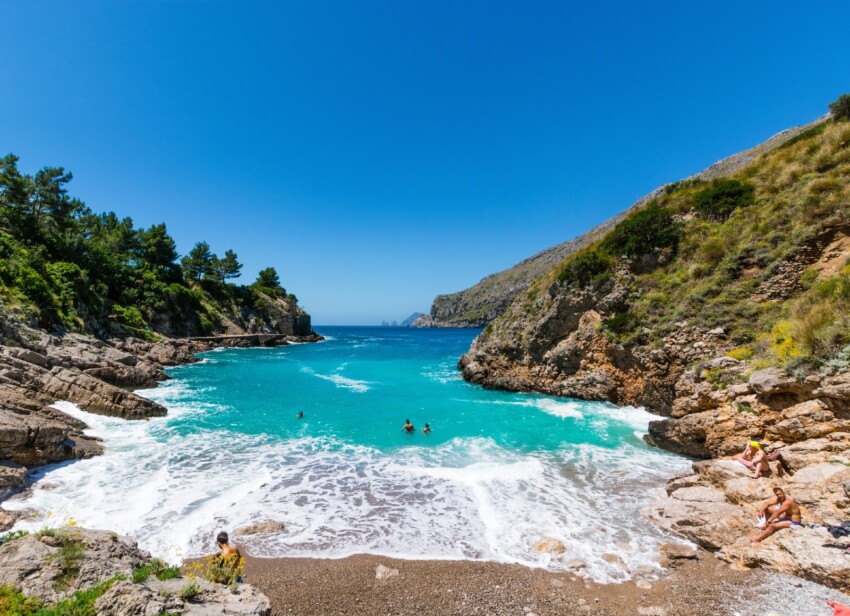
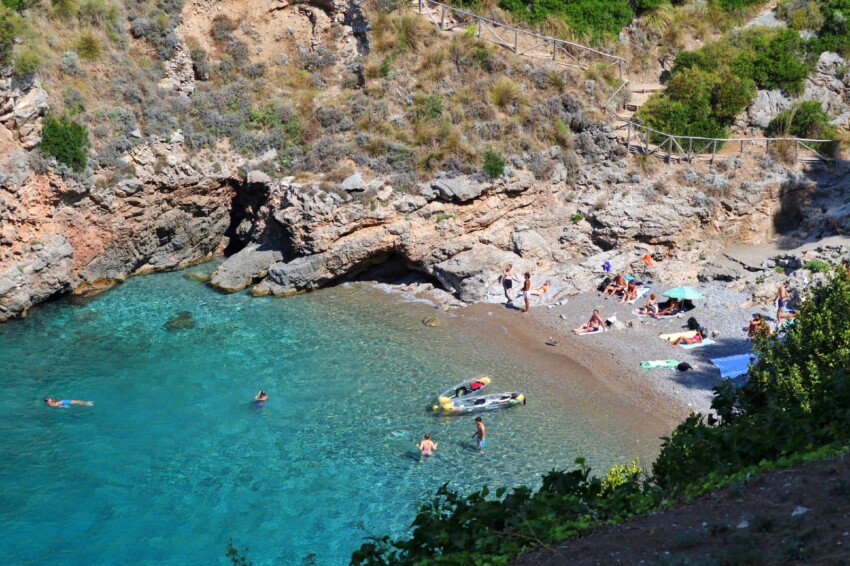
The bay divides into two coves separated by Punta Capitiello: the Baia Grande, more open and panoramic, and the Baia Piccola with its small pebble beach at Capitiello, the only stretch of shoreline reachable on foot, surrounded by sheer limestone walls dropping into the water.
The sea is a deep azure that shifts to emerald green near the rocks, with such clarity you can see the seabed several metres down. Private motorboats are forbidden in the protected area: the bay’s acoustic tranquillity is complete, broken only by wind and seagulls nesting on the cliffs of Punta Penna.
Access is free, from dawn until one hour before sunset, with no advance booking required.
The inevitable starting point for reaching the bay overland is the small square in Nerano, a hamlet of Massa Lubrense about 15 kilometres from Sorrento. From the right corner of the square, heading down the road towards Marina del Cantone for a few dozen metres, you’ll find the beginning of the marked path known as Via Ieranto: a gently sloping paved mule track.
The route is classified as CAI 339, with moderate difficulty, a length of roughly 6 kilometres round trip and an elevation change of about 250 metres. The descent takes 40-45 minutes; the ascent requires the same time but is physically more demanding. Allow at least 4 hours total for the trek plus time spent at the bay.
The first 500 metres wind through olive groves at altitude, passing Villa Rosa, the house where English writer Norman Douglas stayed in the early 1900s whilst gathering material for his books on Campania and Calabria.
Shortly after, the path reaches the Crinale di Sprito: a natural balcony and arguably one of the most breathtaking viewpoints on the peninsula. To the right you’ll see Punta Campanella and the Faraglioni rocks of Capri, crystal clear on bright days. To the left, the Gulf of Salerno stretching to Punta Licosa with the Amalfi Coast in the distance and the Galli islets. Below, in the centre, Ieranto Bay with its impossible colour. From this spot you understand why the Greeks held this stretch of coast sacred.
The path then descends between the dry-stone walls of ancient olive terrace networks, passes ruins of the quarry’s stone mill and reaches a fork: turn left to climb towards Monte Alto and Punta Penna (a nesting site for a rare raptor species – approaching is strongly discouraged); turn right to descend to Capitiello beach, reached via steps that require care due to uneven ground. On the promontory stands the Torre di Montalto, a 16th-century watchtower built during the viceregal period (1516-1707) to defend the coast from Ottoman corsair raids.
By car: take the A3 motorway Naples-Salerno, exit at Castellammare di Stabia, follow signs for the Sorrentine Peninsula towards Meta, then Sant’Agata sui Due Golfi and finally Nerano.
Paid car parks near Nerano’s small square are limited and fill quickly in summer: arrive by 8:00 am on July and August weekends. Alternatively, you can park in Termini (Piazza Santa Croce, blue-line spaces, free from 1 pm to 5 pm) and walk down to Nerano square in around 10 minutes – there’s a small climb on the way back but you avoid the hunt for parking in Nerano.
By bus from Sorrento station, SITA/EAV buses to Marina del Cantone, Nerano stop, around one hour’s journey. Always check current timetables at sitasudtrasporti.it.
For those wanting to skip the hiking, the only alternative is the boat run by Cooperativa Sant’Andrea, the sole operator authorised by the Marine Protected Area’s regulations to access the bay by boat. Boats depart from Marina del Cantone beach (2 kilometres from Nerano): in high season the service runs regularly, with multiple departures daily.
Private motorboats cannot enter the bay; however, kayak access is permitted, making this the most adventurous way to explore Baia Grande, Baia Piccola and the sea caves dotting the seabed around the surrounding headlands. Several cooperatives in Nerano and Marina del Cantone offer kayak hire with environmental guide accompaniment.
Whatever your arrival method, bring everything you need: there are no bars, restaurants, umbrellas or showers on the beach. The only facility available is a toilet in the FAI shelter above the final steps.
If you want to reach Ieranto Bay early in the morning – the best way to find the beach still empty – you’ll gain an enormous advantage by staying in the immediate area rather than in Sorrento.
Massa Lubrense and its hamlets offer a range of accommodation from farmhouses nestled among olive groves to holiday homes right on the Marina del Cantone waterfront, from historic village B&Bs to apartments with sweeping gulf-view terraces.
Prices are considerably lower than Sorrento or Positano whilst maintaining the same quality of sea and scenery. Staying in Nerano or Marina del Cantone means you’re five minutes’ walk from the FAI gate: the difference between arriving on the path at 7:30 am and having the bay to yourself, or arriving at 10:00 am into the throng of summer crowds, is precisely that.
For those wanting a more connected base with additional services, Sorrento is the most efficient logistical choice: the bus to Nerano takes about an hour from here and runs frequently during summer months. Sorrento’s advantage is its central position relative to all peninsula destinations – Pompeii and Naples via the Circumvesuviana train, Capri and the Amalfi Coast by ferry, Massa Lubrense and Punta Campanella by bus – making it ideal if you’re combining a bay visit with a wider itinerary.
Those arriving by car who’d rather avoid Sorrento’s traffic and parking costs will find Sant’Agata sui Due Golfi, a viewpoint at 391 metres where you can simultaneously see the Gulf of Naples and Gulf of Salerno, an interesting, tranquil and unusual base.
The village sits roughly 5 kilometres from Nerano via a pleasant mountain road, with a handful of B&Bs, farmhouses and restaurants serving excellent local cuisine. The village’s panoramic terrace early in the morning, with both bays lit by raking light, is reason alone to choose this as your base. Some properties include private parking, a significant advantage when exploring the peninsula by car.
The Bay of Ieranto lies in the hamlet of Nerano, in the municipality of Massa Lubrense (NA), at the southern tip of the Sorrentine Peninsula, roughly 15 km from Sorrento and directly opposite the island of Capri.
 Hotel
Hotel  Budget accommodations
  Apartments
  Family Hotel
  Luxury Hotel
  Resorts