Seven Hostel & Rooms
Sant'Agnello - Via Iommella Grande 99
Book now
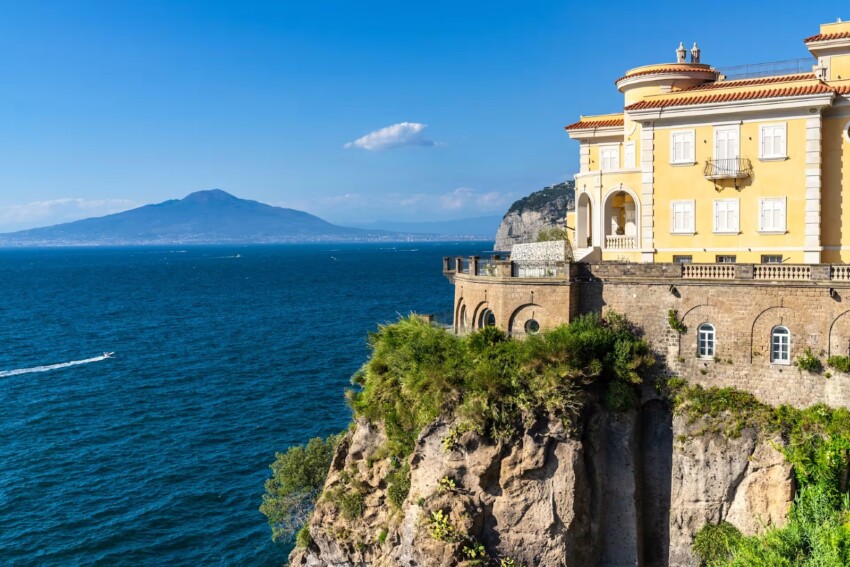
Sant’Agnello is the smallest municipality on the Sorrento Peninsula, covering just 4 square kilometres, yet it concentrates such a wealth of history and beauty that visitors who expect merely a residential suburb of Sorrento are pleasantly surprised.
The town borders Sorrento to the west and Piano di Sorrento to the east, with the urban fabric now continuous between the three, yet Sant’Agnello has maintained its independence and, more importantly, its own distinct character—more residential and peaceful than the bustling commercial atmosphere of its larger neighbour. The town is divided into five historic quarters: Angri, the oldest, a medieval nucleus centred around the church; Cappuccini, perched on the cliff edge; Colli di Fontanelle, with agricultural roots; Maiano; and Trasaella, nestled among olive groves.
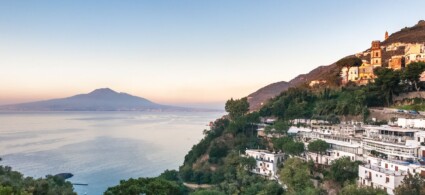
The geographical position mirrors that of the entire peninsula: the town is perched on a tufa terrace overlooking the Gulf of Naples, with houses facing Mount Vesuvius and the islands of Capri, Ischia and Procida.
Those choosing Sant’Agnello as a base find prices generally 15–25% lower than Sorrento with comparable views, the Circumvesuviana station just five minutes’ walk away, ferries to Capri and the Amalfi Coast equally close, and the authentic village atmosphere that Sorrento can no longer offer.
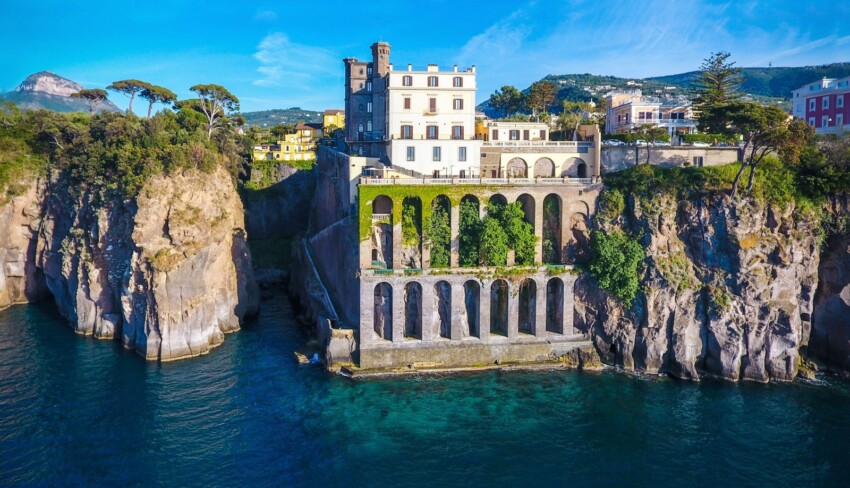
Sant’Agnello is best explored on foot, following the route that connects the historic quarters and descending towards the sea through the gardens and terraces that characterise this stretch of coast. A few hours suffice to see everything, but the calibre of some of the stories linked to its buildings justifies a longer stay than a morning.
Villa Crawford is Sant’Agnello’s most celebrated and distinctive attraction: a villa perched above the sea, built on massive bastions emerging from the water above the small Pecoriello Gulf, which belonged to American writer Francis Marion Crawford, son of the renowned sculptor Thomas Crawford, whose works adorn the Capitol in Washington. In 1885, whilst on his honeymoon at the Hotel Cocumella in Sant’Agnello, he became so enchanted with the place that he decided to remain there for life. He purchased the villa, then a modest farmhouse belonging to the de Renzis family, and transformed it into his residence and literary studio, personally overseeing the expansion works.
Crawford was among the most widely read American writers of his time: author of gothic and historical novels translated worldwide, he was so famous that admirers called him the Prince of Sorrento. At Villa Crawford he composed many of the works that made him celebrated, received intellectuals and artists of his era, and sailed the Gulf of Naples aboard his yacht, holding a master mariner’s licence.
He had the buttresses built to stabilise the tufa slope, and on the stones of the bastions had carved the words “In Tempestate Securitas”, safety in the storm, still visible from the sea today. The garden was embellished with sculptures by his father Thomas and ancient artefacts from his collection, and completed with a tennis court and a private stairway to the small harbour for his yacht. The interior wooden panelled walls are the work of Sorrento craftsman Giovanni Massa.
Crawford died in the villa on Good Friday, 9 April 1909, aged just 55. By his express wish he rests in the Sant’Agnello cemetery, in a tomb to the right of the entrance avenue. In 1954 his nephew Onorio Rocca di Roccapadula, who had become a Salesian priest, donated the villa to the Institute of Mary Help of Christians (Daughters of Mary Help of Christians, the order founded by Don Bosco and Saint Mary Domenica Mazzarello), which continues to manage it today as a religious retreat and youth oratory.
Visits are possible on request, for events or cultural occasions.
The Hotel Cocumella, in the Cappuccini Quarter, is one of the most fascinating historic hotels in Southern Italy: its history begins in 1597, when Jesuits from Naples founded here a convalescence residence for sick members of the order, taking advantage of the mild climate and sheltered position on the cliff edge. The complex comprised a church, a house, an orchard and a citrus grove. In 1705 the Jesuit Father Nicola Partenio Giannettasio, mathematician, Latin poet and professor at the Naples Collegium, stayed here for an extended period; in 1708 he had a small chapel erected next to the ancient Saracen watchtower, using it as a bell tower—the Saracen tower remains visible today. Giannettasio was also the first to hypothesise the etymology of the name “Cocumella”: possibly from the nymph Colomeide, or from cuccume, terracotta vessels locally used for heating water.
In 1767 the Jesuits were expelled from the Kingdom of Naples: the Cocumella became state property and was transformed into a Boarding School for the Orphans of Coast Sailors. The Marquis Berardo Galiani, an architecture scholar and brother of the renowned economist Ferdinando Galiani, was appointed its first Superintendent in 1770, supervised the adaptation works and died in office in 1774; a commemorative plaque commissioned by Ferdinand IV still stands in the complex’s church. In 1789 Pietro Antonio Gargiulo purchased the entire property for 10,800 ducats, and his heirs transformed it into the luxury hotel it is today, with an interlude during World War II, when the complex was requisitioned as the headquarters of the English Command. Over its history the Cocumella has hosted Goethe, Hans Christian Andersen, Joachim Murat, the Duke of Wellington, Alberto Moravia, Rita Levi-Montalcini and filmmaker Mario Monicelli. A legend also circulates: Claire Jane Clairmont, Percy Bysshe Shelley’s last lover, allegedly hid in a wall of the hotel a case containing the poet’s heart, which Byron had given her after removing it from his friend’s body drowned at Lerici in 1822.
The Cappuccini Quarter also hosts the Church and Convent of the Capuchin Friars, built in 1586 perched above the sea, and the Marinella Belvedere: Sant’Agnello’s most enchanting vantage point, overlooking the Gulf of Naples and the beach below, offering one of the most classic sunsets on the Sorrento Peninsula.
The Angri Quarter is Sant’Agnello’s oldest nucleus: the medieval village formed here, around the main church, and most buildings date from the eighteenth century, with some structures preserving earlier architectural characteristics. Walking through the lanes of the Angri Quarter is the most authentic experience the town offers: narrow streets, portals in local stone, staircases between citrus groves, sudden glimpses of the sea between houses.
The quarter’s oldest building is the Church of the Most Holy Annunciation, in neoclassical style, built before the fifteenth century. Inside is preserved a precious panel depicting the Annunciation, work of Neapolitan master Silvestro Buono, painter of the Neapolitan school of the sixteenth century also active at the Gesù Nuovo and other city churches. The quarter is also home to some of the wood inlay workshops that continue the Sorrento tradition: small tables, chessboards, boxes and frames with floral motifs and coastal views, crafted using the tarsia technique documented in the peninsula since the sixteenth century.
An address not to miss in the Angri Quarter is the Sessa Candle Workshop: the sole remaining traditional beeswax candle factory on the entire Sorrento Peninsula. Production still employs traditional techniques—wax casting, hand-moulding, finishing—and the workshop produces votive candles, candles for religious ceremonies and decorative pieces. It is a craft enterprise that survives thanks to a loyal clientele of churches, confraternities and private individuals across the peninsula: one of those places you almost stumble upon and remember for years.
Sant’Agnello preserves a small yet fine ecclesiastical heritage. The Church of Saints Priscus and Agnellus, dedicated to the town’s patron saint, stands almost at the border with Sorrento in a position reflecting the borough’s origins: it was around this church that the first medieval nucleus formed, and a small chapel already existed in the fifteenth century. The current structure, enlarged over the centuries, preserves on the high altar a painting by Gustavo Mancinelli, nineteenth-century Neapolitan painter, depicting the Madonna enthroned with Saints Priscus and Agnellus; the background of the painting shows the Sorrento citrus groves, Punta Gradelle and some sailing vessels at sea: a pictorial record of the Sorrento landscape of the nineteenth century.
Nearby stands the Church of Saint Joseph, built in the first half of the twentieth century at the behest of the Confraternity of the Sacred Heart of Mary and Saint Joseph: the facade in white marble is adorned with a bas-relief depicting Saint Joseph among angels and two statues of Saints Peter and Paul. The interior is enriched with frescoes by Veronese painter Agostino Pegrassi, including the vault cycle featuring “The Glory of Saint Joseph” and “The Betrothal of Mary and Joseph”. In the Trasaella Quarter stands finally the baroque church dedicated to the Madonna delle Grazie, in an atmosphere of greenery and tranquillity far from tourist flows. Holy Week is when Sant’Agnello’s churches animate the town with processions organised by local confraternities, among the most deeply felt on the peninsula.
Sant’Agnello’s main beach is called La Marinella and is accessible from the Marinella Square, in the Cappuccini Quarter, by descending a staircase carved into the tufa slope or using the lift connecting the belvedere to sea level. The beach, a mix of sand and smooth pebbles with some tufa platforms in the water, has an equipped bathing establishment with loungers, umbrellas, showers and a restaurant, plus a small free area. The views of the bay from above, with the Cappuccini Quarter houses emerging from the cliff and Mount Vesuvius’s silhouette in the distance, rank among the most photographed on the Sorrento Peninsula. Water quality is excellent thanks to the depth of the seabed and distance from river mouths.
Nearby lies the Il Pizzo Estate, on Viale dei Pini: 16 hectares of citrus grove, olive grove, Mediterranean scrub and historic garden extending from the plateau to the coast, with characteristic valloni, vertical tufa fissures where ancient streams once descended to the sea, and panoramic terraces overlooking the gulf. The complex stands on a pre-existing monastic settlement and the eighteenth-century villa at the entrance to the avenue is among the best-preserved examples of noble rural architecture on the peninsula.
It was chosen as a filming location for the Danish film Love Is All You Need (2012, directed by Susanne Bier, starring Pierce Brosnan), which introduced the estate to an international audience. Adjacent to the estate, the Urban Oasis Park, created by WWF Terre del Tirreno with the municipal administration, offers a small green urban space with a pond and wooden bridge, open to the public.
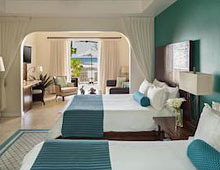
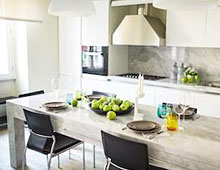
Sant’Agnello offers quality accommodation at prices generally 15–25% lower than Sorrento: historic hotels on the cliff edge with gulf views, charming villas and small hotels in historic gardens, bed & breakfasts and apartments in the town centre.
Some establishments are directly on the Circumvesuviana line, allowing you to reach Naples in 50 minutes, Pompeii in 30, and ferries to Capri within a few minutes’ walk.
Sant’Agnello is served by the Naples-Sorrento Circumvesuviana line: Sant’Agnello station is located along Corso Italia, a short walk from the town centre.
The journey from Naples takes approximately 55 minutes with stops at Ercolano and Pompeii. By car you take the SS 145 (Corso Italia) from Castellammare di Stabia or Sorrento: Sant’Agnello is less than 2 km from Sorrento and approximately 47 km from Naples. Ferries to Capri and the Amalfi Coast depart from Sorrento’s Marina Piccola port, reachable on foot in about 15 minutes or by bus.
What's the weather at Sant’Agnello? Below are the temperatures and the weather forecast at Sant’Agnello for the next few days.
Sant'Agnello lies on the Sorrentine Peninsula, in the Naples Metropolitan Area, less than 2 km east of Sorrento and approximately 47 km from Naples. It borders Piano di Sorrento to the east and Sorrento to the west. The Circumvesuviana railway station is located in the town centre.
 Hotel
Hotel 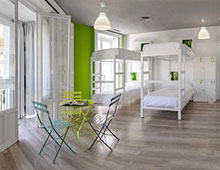 Budget accommodations
  Apartments
  Family Hotel
  Luxury Hotel
  Resorts